

According to the Steering Committee, the Resolution of the 13th National Congress of the Party, the Conclusion No. 49-KL/TW of the Politburo , and the strategies and plans for transport development have affirmed that railways are one of the priority areas for investment, especially high-speed North-South railways, railways connecting to seaports, industrial zones, major cities, and international intermodal railways.
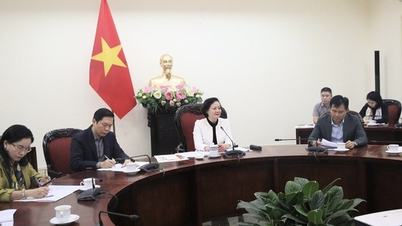
Prime Minister Pham Minh Chinh chaired the first meeting of the Steering Committee for National Key Projects in the Railway Sector. |
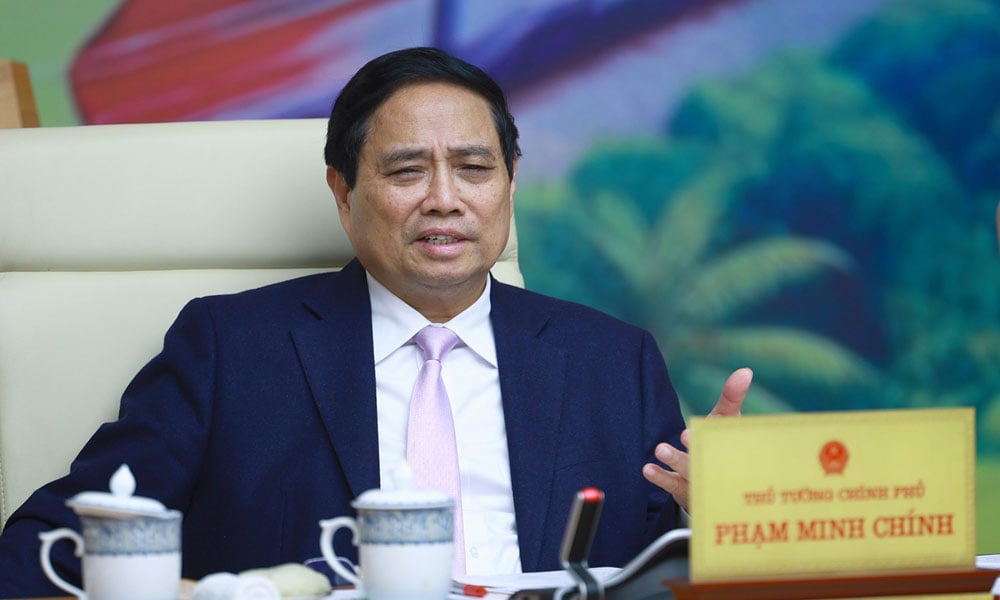
Recently, the National Assembly issued three resolutions to implement railway projects, including: a resolution on the investment policy for the high-speed railway project on the North-South axis; a resolution on the investment policy for the Lao Cai - Hanoi - Hai Phong railway line project; and a resolution on piloting some specific mechanisms and policies to develop the urban railway network system in Hanoi and Ho Chi Minh City. These new railway infrastructure construction projects are large-scale, have very high investment costs, and require high technical standards, especially since high-speed rail is being implemented for the first time in Vietnam.
The Prime Minister has issued Decision No. 609/QD-TTg establishing the Steering Committee for National Key Railway Projects and Decision No. 24/QD-BCDDDSQG promulgating the regulations on the organization and operation of the Steering Committee. The list of projects includes: the North-South high-speed railway project; the Lao Cai - Hanoi - Hai Phong, Hanoi - Lang Son, Mong Cai - Ha Long (Quang Ninh) railway lines; and urban railway projects in Hanoi and Ho Chi Minh City.
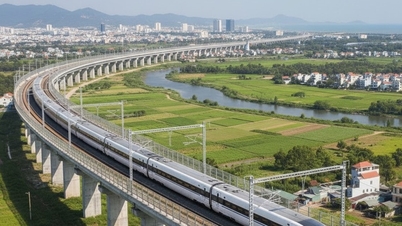
Specifically, the North-South High-Speed Railway Project, approved by the National Assembly in Resolution No. 172/2024/QH15, has a total length of 1,541 km from Hanoi to Ho Chi Minh City, with a design speed of 350 km/h. The preliminary total investment is 1,713,548 billion VND (approximately 67.34 billion USD). The implementation period is from 2025 to 2035.
The Lao Cai - Hanoi - Hai Phong railway line, with a gauge of 1,435 mm, will transport both passengers and freight. The main line will have a total length of approximately 390.9 km, with a branch line of 27.9 km. The total investment is 8.369 billion USD. Phase 1 involves single-track construction, with land acquisition carried out according to the double-track scale. The project is scheduled for completion between 2025 and 2030.
The Hanoi – Lang Son railway line connects the capital city of Hanoi with the provinces of Bac Ninh, Bac Giang, and Lang Son, and also provides international transport links with China; its total length is approximately 156km.
The Hai Phong - Ha Long - Mong Cai railway line connects Hai Phong city with Quang Ninh province; it also provides international transport links with China; the total length of the line is approximately 187km.
According to Resolution No. 188/2025/QH15 of the National Assembly, Hanoi is expected to build 15 urban railway lines; Ho Chi Minh City is expected to build 10 urban railway lines.
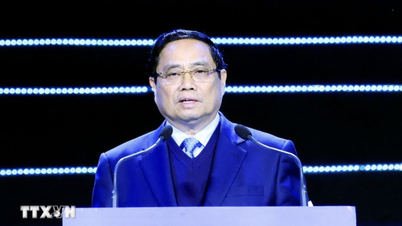
In his concluding remarks, emphasizing the importance of investing in railway projects and developing the railway industry, Prime Minister Pham Minh Chinh stated that to achieve the set goals, we must have a mindset that transcends our own limitations, break free from old habits, and promote a spirit of self-reliance, self-strength, and national pride.
Clearly stating his determination to build a strong railway industry, master the technology, produce railway carriages and locomotives, and develop a railway industrial ecosystem, the Prime Minister said that this is also an opportunity for our country and our people to gain more motivation and inspiration to rise and develop. Therefore, the Prime Minister assigned the Ministry of Construction and the Ministry of Education and Training to develop a plan for training human resources, both domestically and internationally, with specific training plans, programs, and targets for each level and specialization, establishing and developing railway departments at universities; especially training chief engineers. Along with that, he called for the formation and establishment of large corporations, including private corporations, related to the railway industry. If the task exceeds their authority, they should report to the competent authority for decision-making and amendment of related regulations.
To secure resources for railway projects, it is necessary to diversify funding sources, including state capital, loans, issuance of construction bonds, public-private partnerships, and TOD (Transit-Oriented Development) projects, while also managing resources strictly to avoid losses and waste.
The Prime Minister assigned the Ministry of Science and Technology and the Ministry of Construction to develop appropriate technical standards; apply modern technology and transfer advanced techniques. The Ministry of Construction, in collaboration with other agencies, will review mechanisms, policies, obstacles that need to be addressed, and necessary policies, and report to the National Assembly at the upcoming session.
Assigning several tasks, the Prime Minister requested a unified understanding of the importance of railway projects; focusing on removing difficulties and accelerating project progress, especially in land clearance by separating it into a distinct project, and once the route is established, assigning local authorities to handle land clearance and attract investment for railway stations, starting with the Lao Cai – Hanoi – Hai Phong project.
Calling for enhanced inter-sectoral coordination and increased accountability, the Prime Minister emphasized the need for high determination, immense effort, decisive action, and focused, targeted work, ensuring each task is completed thoroughly and effectively. Tasks and work must adhere to six principles of clarity: "clear person, clear task, clear progress, clear results, clear responsibility, and clear authority" as a basis for monitoring and review. Simultaneously, he stressed the need for decisive and strict handling of cases of delays and irresponsibility, while promptly commending outstanding collectives and individuals, and encouraging innovation.
Directing the project to be people- and business-centered, with projects aiming to serve the people, improve service quality, reduce congestion, protect the environment, and promote sustainable development, the Prime Minister assigned the Ministry of Construction and the Ministry of Justice to develop and issue legal documents to guide the specific mechanisms and policies already approved by the National Assembly. If any mechanisms or policies are still lacking, they should be submitted to the National Assembly for general application to all projects.
The Prime Minister instructed the Ministry of Construction to promptly incorporate the opinions of other ministries and agencies to finalize and submit to the Government for promulgation the Government Resolutions implementing Resolution No. 172/2024/QH15 and Resolution No. 187/2025/QH15 of the National Assembly; and to take the lead in coordinating with Hanoi and Ho Chi Minh City to develop and submit to the Government the draft Resolution to implement Resolution No. 188/2025/QH15.
The Ministry of Agriculture and Environment is drafting a Decree regulating the temporary use and return of forests for the construction of temporary works serving the project, to be completed by September 2025.
The Ministry of Construction is developing a Decree stipulating criteria for selecting state-owned organizations and enterprises to be assigned tasks or Vietnamese organizations and enterprises to be commissioned to provide railway industrial services and goods; and is developing a Decision of the Prime Minister stipulating the list of railway industrial services and goods assigned to state-owned organizations and enterprises or commissioned to Vietnamese organizations and enterprises.
The Ministry of Construction has drafted a guiding decree allowing investors to simultaneously carry out the preparation, appraisal, and approval of feasibility studies, construction designs after the basic design phase, tender documents, and request for proposals.
Noting the need to study and refer to international lessons learned for railway industry development projects, the Prime Minister requested localities to urgently develop detailed plans and proactively allocate local budget funds to carry out compensation, support, and resettlement work; and to implement the construction of resettlement areas for the Project based on the preliminary design documents in the pre-feasibility study report approved by the National Assembly.
Regarding specific projects, for the Lao Cai - Hanoi - Hai Phong railway line project, the Ministry of Finance is urgently submitting a proposal to the Prime Minister to establish a State Appraisal Council. The Prime Minister has agreed to commence the construction of the new Lao Cai station infrastructure and the resettlement areas for the project in 2025. The Ministry of Foreign Affairs and the Ministry of Finance, based on the pre-feasibility study report of the project, will work with the Chinese side to negotiate the Agreement. At the same time, they will promote the Hanoi - Lang Son and Hai Phong - Ha Long - Mong Cai railway line projects.
Regarding the North-South high-speed railway project, the Prime Minister requested efforts to commence construction in December 2026. The Ministry of Justice has provided input on applying simplified procedures in construction, and the issuance of a Decree on the overall design should be completed in early April 2025; at the same time, ministries and agencies should promptly provide feedback after the Ministry of Construction seeks opinions on the draft Decree.
Regarding the Hanoi and Ho Chi Minh City urban railway projects, the Prime Minister requested the People's Committees of Hanoi and Ho Chi Minh City to review the implementation status of urban railway projects in their respective localities. The Ministry of Finance was also asked to promptly provide its opinion on ceasing the use of ODA funds and preferential foreign loans for the project and to adjust the funding sources for the Ho Chi Minh City urban railway project, Line 2, Ben Thanh - Tham Luong section.
According to VNA
Source: https://baobacgiang.vn/vuot-qua-gioi-han-cua-chinh-minh-xay-dung-bang-duoc-nganh-cong-nghiep-duong-sat-postid415115.bbg








































































Comment (0)