

The Ho Chi Minh City Department of Education and Training has announced specific information regarding education and training projects that have attracted investment capital and land in residential development areas approved by the city for businesses to be the investors, but which have not yet been implemented.
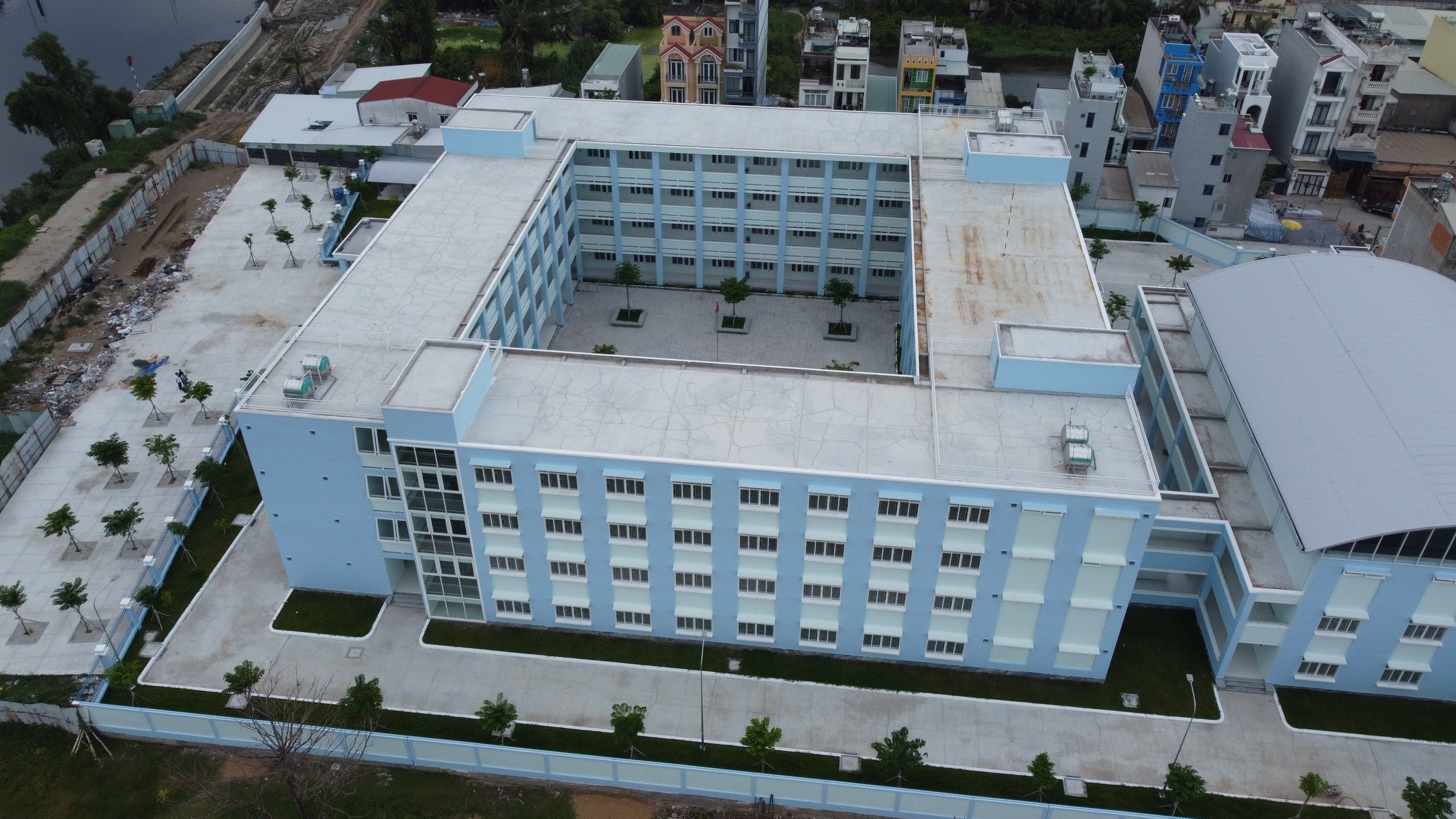
A school project was recently put into operation in 2024 in Binh Tan District, Ho Chi Minh City.
PHOTO: BINH TAN DISTRICT EDUCATION AND TRAINING DEPARTMENT
The project was assigned to a business as the investor but has not yet been implemented.
On December 9th, the Ho Chi Minh City Department of Education and Training announced a specific list of education and training projects attracting investment in the 2024-2025 period, as well as a list of land allocated for education within residential development projects that have been approved by the city and assigned to businesses as investors but have not yet been implemented.
Accordingly, the Department of Education and Training announced information on 23 education and training projects attracting investment to develop the school network in Thu Duc City and other districts. The Department of Education and Training provided specific information on each project, including details on land type, current land status, project development area, and contact information for investment.
The locations of the 23 projects are as follows: 3 projects in Thu Duc City; 10 projects in District 8; and 8 projects in District 12, District 7, and Go Vap District, with one project in each district. These projects develop a network of schools on the following scale: 3 schools meeting international standards; 1 multi-level school following an advanced, integrated school model; 3 kindergartens; 1 international standard kindergarten; 1 national standard kindergarten; 1 national standard primary school; 1 national standard secondary school; 4 primary schools; 3 secondary schools; and 5 high schools.
In addition, after conducting a review in various localities, the Department of Education and Training provided information on 69 land plots designated for educational purposes within residential development projects that had been approved by the city for allocation to businesses as investors but had not yet been implemented, in order to attract investment. For each residential area, the Department of Education and Training provided information on the project, the location of the land plot, the scale of school investment, and the area...
Regarding the provision of information on educational project categories and land allocation, Mr. Duong Tri Dung, Deputy Director of the Ho Chi Minh City Department of Education and Training, stated that mobilizing social resources for investment and development in the city ensures compliance with the state's guidelines, directions, and policies. Simultaneously, it contributes to promoting investment activities, helping investors easily access information about projects and priority areas of the city, thereby boosting investment attraction to develop economic and social infrastructure and reduce the burden on the budget.
Commitment to creating favorable conditions for investors to participate in educational projects.
Recently, on December 6th, the Department of Labor, War Invalids and Social Affairs, the Department of Education and Training of Ho Chi Minh City, and the Ho Chi Minh City State Financial Investment Company (HFIC) jointly organized a conference to implement the policy of interest rate support for investment projects in the fields of education and vocational training in Ho Chi Minh City.
Within the framework of this conference, Mr. Nguyen Quang Thanh, Deputy General Director of HFIC, provided information on interest rate support policies for investment projects developing the school network, including a maximum loan amount of up to 200 billion VND per project, no matching capital required, flexible loan terms, and the ability to borrow for multiple projects simultaneously. In particular, the city also committed to creating favorable conditions for investors to participate in education and training projects through public investment and public-private partnership (PPP) models, aiming to reduce the burden on the budget and promote the sustainable development of the education sector.
Source: https://thanhnien.vn/92-du-an-va-quy-dat-xay-dung-truong-lop-chua-thuc-hien-tai-tphcm-185241209132025312.htm
















![[Photo] Prime Minister Pham Minh Chinh holds a phone call with the CEO of Russia's Rosatom Corporation.](/_next/image?url=https%3A%2F%2Fvphoto.vietnam.vn%2Fthumb%2F1200x675%2Fvietnam%2Fresource%2FIMAGE%2F2025%2F12%2F11%2F1765464552365_dsc-5295-jpg.webp&w=3840&q=75)













































Comment (0)