

Within the framework of the 2025 National Press Conference at the National Convention Center, Hanoi , on the morning of June 20, many leaders of press agencies, experts and journalists participated in a discussion session with the topic "Artificial intelligence and digital transformation strategies of Vietnamese press offices".
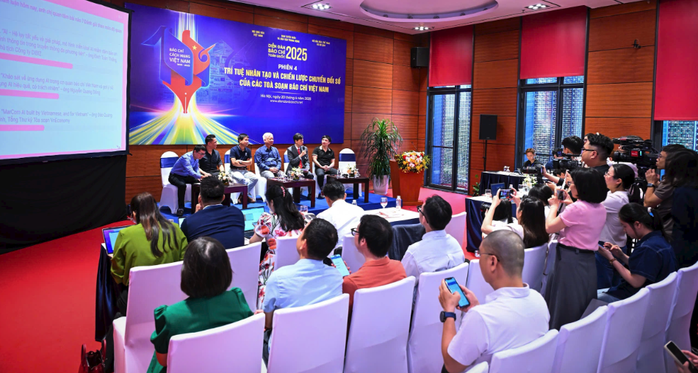
The discussion session attracted the attention of many leaders, experts and journalists.
Mr. Dao Trung Thanh, Deputy Director of the Blockchain and Artificial Intelligence Institute (ABAII), who opened the discussion, gave some interesting examples of AI-generated products as a practical demonstration of the current power of AI. Mr. Thanh presented a video podcast exchange between two AI hosts discussing the current press situation.
During the following discussion, the moderator also frequently used AI-generated videos based on verified documents, to show that the proper use of AI can absolutely help journalists save time while still being able to create vivid, quality, and accurate journalistic products.
In his speech, Mr. Nguyen Quang Dong, Director of the Institute for Policy Studies and Media Development (IPS), presented the results of a practical survey on the level of AI application in Vietnamese press agencies.
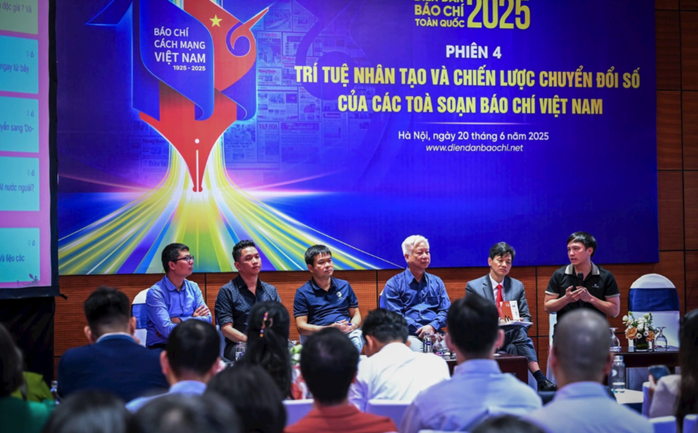
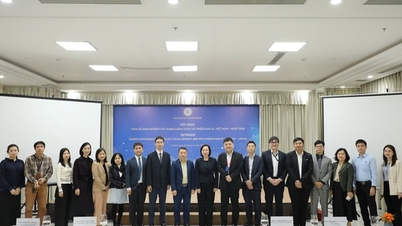
Speakers and delegates attending the discussion session
Accordingly, the application rate has increased sharply but is still fragmented: IPS's survey (in collaboration with the Vietnam Journalists Association and the Vietnam Digital Communications Association) shows that the rate of press agencies that have applied AI or have plans to apply it has doubled compared to 2023, reaching more than 60% in 2024.
However, most AI applications today still focus on content production stages such as: Suggesting, editing headlines and summaries, editing, checking spelling, creating images/videos or translating. The focus is mainly on the individual role of journalists, rather than on the strategic direction of the entire newsroom.
Meanwhile, the application of AI to further research activities or to serve business problems and analyze reader behavior is very low.
The most used AI tools are ChatGPT, Gemini, Copilot, and internal software. The investment cost for AI by newsrooms is still very low, mostly under 1 million VND/month or using the free version.
Mr. Dong pointed out three major issues that are affecting the effectiveness of AI application by Vietnamese press agencies.
That is a misplaced focus, it seems that Vietnamese press agencies are focusing on content production instead of focusing on business model problems, understanding readers and generating revenue. Meanwhile, major international press organizations have invested in AI to solve business problems, attract and retain readers.
Lacking an overall strategy, AI adoption remains spontaneous, at the individual or department level, rather than at the organizational level. Few newsrooms have formal internal policies on the use of AI, which poses a great risk of fake news and loss of credibility.
There is a lack of resources, including finance and AI-savvy personnel. Collecting, storing and analyzing reader behavior data to personalize content is also a major challenge.
To address these challenges, Mr. Dong suggests that news agencies need to approach AI holistically and strategically.
Accordingly, AI needs to be considered to attract and retain readers, creating new revenue sources in the context of traditional advertising decline and search engine traffic shifting to AI.
Newsrooms need to have an overall application strategy, technology investment strategy, and clear internal policies.
Risk management and ethics in the use of AI are also essential, with the Vietnam Journalists Association issuing a set of rules for responsible use of AI for the entire industry.
Mr. Dinh Toan Thang, Chairman of DIBIZ Company specializing in cybersecurity and anti-disinformation, analyzed the risk of disinformation created by AI and emphasized the need to establish a "media immune system" for newsrooms.
The concept of "Disinformation" should be understood as false information spread intentionally to deceive and cause harm, not just ordinary misinformation.
The proposed solution is that the press and relevant agencies need to use AI and information verification tools such as Google Fact-Check, and expand the verification process to photos, audio and video, to combat the problem of "Disinformation".
Source: https://nld.com.vn/bao-chi-dung-truoc-co-hoi-chua-tung-co-tu-ai-196250620135704012.htm
![[Photo] 60th Anniversary of the Founding of the Vietnam Association of Photographic Artists](/_next/image?url=https%3A%2F%2Fvphoto.vietnam.vn%2Fthumb%2F1200x675%2Fvietnam%2Fresource%2FIMAGE%2F2025%2F12%2F05%2F1764935864512_a1-bnd-0841-9740-jpg.webp&w=3840&q=75)

![[Photo] National Assembly Chairman Tran Thanh Man attends the VinFuture 2025 Award Ceremony](/_next/image?url=https%3A%2F%2Fvphoto.vietnam.vn%2Fthumb%2F1200x675%2Fvietnam%2Fresource%2FIMAGE%2F2025%2F12%2F05%2F1764951162416_2628509768338816493-6995-jpg.webp&w=3840&q=75)






















































































Comment (0)