

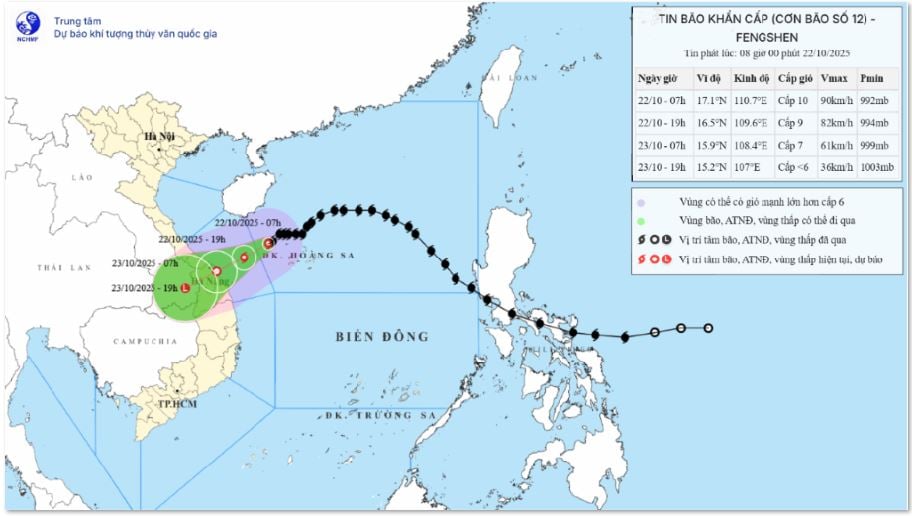
Specifically, due to the influence of the storm's circulation and cold air combined with an easterly wind disturbance and topographic effects, from noon on October 22nd to October 27th, the area from Ha Tinh to Quang Ngai will experience widespread heavy rain (heavy rain concentrated from the afternoon of October 22nd to the end of October 23rd). The area from southern Quang Tri to Da Nang city will generally receive 500-700mm of rain, with some localized areas exceeding 900mm. A warning is issued for heavy rain exceeding 200mm/3 hours. In addition, due to the influence of the circulation of Typhoon No. 12 combined with a strong cold front, from the afternoon of October 22nd, coastal areas of provinces from Quang Tri to Da Nang city will experience increasingly strong winds, reaching level 6, sometimes level 7, with gusts of level 8-9.
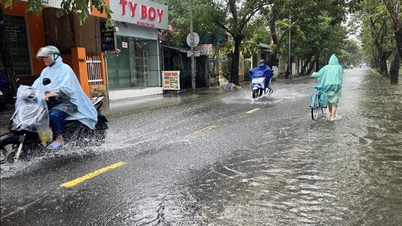
Heavy rains in the Central region are likely to continue until the end of October 2025. There is a high risk of flash floods and landslides in mountainous areas, and flooding in low-lying areas and urban centers.
"Local authorities need to pay attention to the safe operation of hydroelectric and irrigation reservoirs before, during, and after the storm, and be prepared with response plans for flood scenarios on rivers from Quang Tri to Quang Ngai that could reach and exceed alarm level 3. The forecast for natural disaster risk level due to floods and inundation is level 3. Be prepared for the risk of thunderstorms, tornadoes, and strong gusts of wind in the areas affected by the storm's circulation, both before and during the storm's landfall," noted Associate Professor, Doctor Mai Van Khiem, Director of the National Center for Meteorological and Hydrological Forecasting.
According to the National Center for Hydro-Meteorological Forecasting, at 7:00 AM on October 22nd, the typhoon's center was located at approximately 17.1 degrees North latitude and 110.7 degrees East longitude, in the sea northwest of the Hoang Sa (Paracel) Islands, about 280km east-northeast of Da Nang city. The strongest winds near the center of the typhoon reached level 10 (89-102 km/h), with gusts up to level 12. It was moving west-southwest at a speed of about 10 km/h.
Forecasts indicate that by 7:00 AM on October 23rd, the storm will be located along the coastal areas from Hue to Quang Ngai, with wind speeds of level 7, gusting to level 9, moving in a west-southwest direction at a speed of approximately 10-15 km/h and gradually weakening into a tropical depression. The affected area includes the western part of the North East Sea (including the Hoang Sa Special Economic Zone), and the sea area from Quang Tri to Quang Ngai (including the special economic zones of Con Co, Ly Son, and Cu Lao Cham islands). The level of natural disaster risk is level 3.
Subsequently, at 7 PM on October 23rd, the storm over southern Laos, with wind speeds below level 6, moved in a west-southwest direction at a speed of approximately 10-15 km/h and gradually weakened into a low-pressure area. The affected area includes the sea region from Quang Tri to Quang Ngai (including the special island zones of Con Co, Ly Son, and Cu Lao Cham); and the coastal mainland of provinces and cities from Quang Tri to Da Nang.
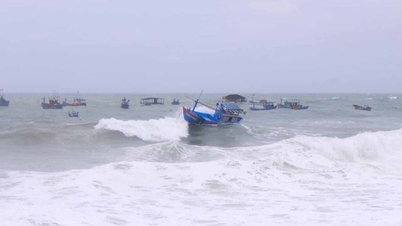
Due to the impact of the storm, the western sea area of the North East Sea (including the Hoang Sa special zone) will experience strong winds of force 7-8; areas near the storm's center will experience winds of force 9-10, gusting to force 12; sea waves will be 3-5m high, and 5-7m high near the storm's center, with very rough seas.
The sea area from Quang Tri to Quang Ngai (including Con Co Special Economic Zone, Cu Lao Cham Island and Ly Son Special Economic Zone) will experience strong winds of force 6-7, reaching force 8 near the storm's center, with gusts up to force 10, and waves 3-5 meters high, resulting in rough seas.
Coastal areas of provinces and cities from Quang Tri to Da Nang will experience storm surges of 0.4-0.8m.
Warning: Coastal areas and river mouths from Quang Tri to Da Nang city need to be wary of large waves combined with high tides and storm surges causing flooding in low-lying areas, waves overflowing coastal and river roads, and coastal erosion. All ships, boats, and aquaculture farms in the aforementioned dangerous areas are at risk of being affected by thunderstorms, tornadoes, strong winds, large waves, and high tides.
Source: https://baotintuc.vn/xa-hoi/bao-so-12-ap-sat-dat-lien-tu-ha-tinh-den-quang-ngai-co-mua-rat-to-20251022090828380.htm

![[Photo] Closing Ceremony of the 10th Session of the 15th National Assembly](/_next/image?url=https%3A%2F%2Fvphoto.vietnam.vn%2Fthumb%2F1200x675%2Fvietnam%2Fresource%2FIMAGE%2F2025%2F12%2F11%2F1765448959967_image-1437-jpg.webp&w=3840&q=75)
![[Photo] Prime Minister Pham Minh Chinh holds a phone call with the CEO of Russia's Rosatom Corporation.](/_next/image?url=https%3A%2F%2Fvphoto.vietnam.vn%2Fthumb%2F1200x675%2Fvietnam%2Fresource%2FIMAGE%2F2025%2F12%2F11%2F1765464552365_dsc-5295-jpg.webp&w=3840&q=75)












































![[OFFICIAL] MISA GROUP ANNOUNCES ITS PIONEERING BRAND POSITIONING IN BUILDING AGENTIC AI FOR BUSINESSES, HOUSEHOLDS, AND THE GOVERNMENT](https://vphoto.vietnam.vn/thumb/402x226/vietnam/resource/IMAGE/2025/12/11/1765444754256_agentic-ai_postfb-scaled.png)







































Comment (0)