

On June 2nd, the Department of Preventive Medicine ( Ministry of Health ) sent a document to the Dien Bien Provincial Department of Health directing measures to prevent the spread of anthrax after three anthrax outbreaks occurred in the province, affecting 13 people.
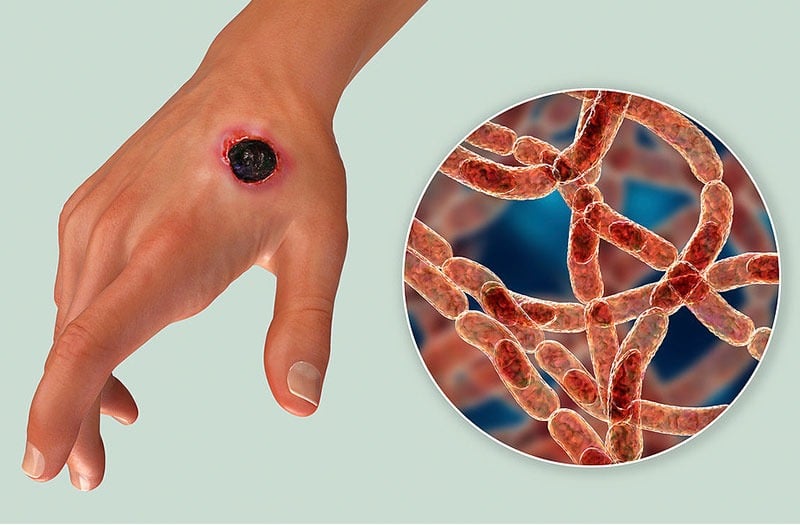
One of the symptoms of anthrax is the appearance of black lesions on the skin.
According to a report from the Dien Bien Provincial Center for Disease Control, from May 5th to 30th, three outbreaks of cutaneous anthrax were recorded in Tua Chua District, with 13 cases reported.
Of these, Muong Bang commune (1 outbreak) and Xa Nha commune (2 outbreaks) have not recorded any deaths so far. All cases have a history of epidemiological links to slaughtering and consuming buffalo and cattle meat.
Authorities also recorded an additional 132 people who had contact with or consumed the meat of the three buffaloes and cows mentioned above. Symptoms included blisters and skin ulcers. Some people experienced headaches, abdominal pain, diarrhea, shortness of breath, and general body aches.
To proactively prevent the transmission of anthrax from animals to humans, the Ministry of Health requests the Dien Bien Provincial Department of Health to closely monitor the health of those involved in slaughtering and consuming the same source of buffalo and beef as the aforementioned cases, as well as those in close contact with the infected individuals, in order to provide timely prevention and treatment; strengthen surveillance and early detection of suspected anthrax cases; and treat the environment in the outbreak area according to regulations.
In addition, the health department is strengthening coordination with veterinary agencies and relevant departments in monitoring and detecting anthrax in animals to take timely preventive measures in humans; and coordinating in investigating and handling anthrax outbreaks in animals.
Strengthen communication about measures to prevent the transmission of anthrax from animals to humans, paying particular attention to high-risk areas and those involved in raising, trading, and slaughtering cattle and buffalo. Advise people not to slaughter or consume food from sick or dead cattle, buffalo, or horses of unknown origin.
Direct healthcare facilities in the area to admit, isolate, and treat patients, and promptly notify the Center for Disease Control and Prevention to investigate and handle outbreaks.
In this document, the Department of Preventive Medicine requests the Director of the Central Institute of Hygiene and Epidemiology to direct, guide, and support localities in conducting investigations, surveillance, and monitoring of suspected cases and close contacts of confirmed cases; and to handle outbreaks according to regulations.
Provide guidance and support to local authorities in confirmatory testing of samples from suspected human cases; consider providing capacity-building training to local authorities in monitoring, detecting, investigating, and managing anthrax outbreaks in humans, as well as guidance on coordination with the veterinary sector.
Previously, outbreaks of anthrax had occurred in the communes of Xa Nha and Muong Bang in Tua Chua district. However, people remained complacent, failing to report unusual deaths of buffalo and cattle, and instead slaughtering and selling the meat. Specialized agencies and local authorities are implementing various activities to prevent and control the spread of the disease.
Anthrax, also known as thermal anthrax, is a group of infectious diseases caused by the gram-positive, rod-shaped bacterium Bacillus anthracis. This bacterium commonly exists in natural conditions, in soil, or as a parasite on domestic or wild animals.
When humans come into contact with animals carrying disease-causing bacteria, they can become infected and develop serious illnesses when the bacteria enter the body. Typically, the disease enters the human body through contact routes such as: skin infections; respiratory infections; and gastrointestinal infections.
Source link
































































































Comment (0)