


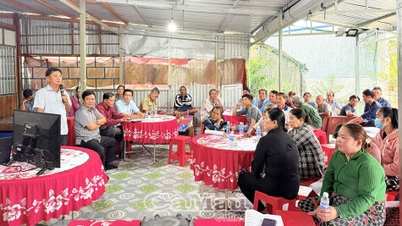
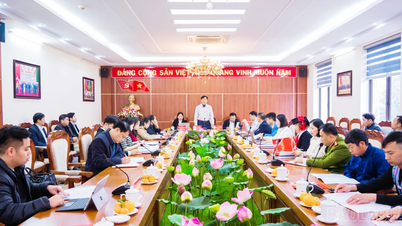
Delegates participating in the signing ceremony to implement the super-intensive shrimp farming model in Ca Mau - Photo: VGP/LS
The RAS-IMTA recirculating aquaculture system is a super-intensive, recirculating shrimp farming model with minimal water changes and high biosecurity. Phase 1 of the model has been piloted in Ca Mau province, covering 100 hectares for whiteleg shrimp farming.
The Ca Mau Department of Science and Technology assessed that phase 1 of the project was successful, achieving a survival rate of 85-90%, a yield of 40-50 tons/ha/crop, and a stocking density of up to 250-300 shrimp/m². The quality of the farmed shrimp met the important factors that facilitated export to demanding markets such as the EU and the US. The product also obtained prestigious international certifications, such as ASC and BAP.
This model not only brings high economic efficiency but also provides a solution to environmental problems, with treated wastewater meeting standards, aligning with the trend of developing aquaculture towards green growth and a circular economy.
Following initial success, Ca Mau province aims to develop and implement the project on a scale of 1,500 hectares in the near future. De Heus Company will collaborate with provincial authorities to further expand the model to 1,000 hectares, with implementation expected from 2025 to 2030.
Speaking at the signing ceremony, Vice Chairman of the Ca Mau Provincial People's Committee Le Van Su affirmed that a production model, even if environmentally friendly, is difficult to sustain in the long term if it is not economically efficient. Therefore, the province focuses on applying technical solutions to increase productivity, reduce costs, and improve product quality, while promoting linkages between farmers and businesses producing seeds, supplying materials, processing, and exporting. This approach helps farmers access quality seeds and feed at reasonable prices, and sell their products directly to businesses without going through middlemen, thereby increasing profits.
At the conference, delegates discussed various comprehensive solutions to achieve the target of 1,500 hectares, particularly the linkage between banks, businesses, cooperatives, and farmers to overcome capital difficulties and promote green credit.
Dr. Nguyen Nhut, from the Research Institute for Aquaculture 2, emphasized that the RAS-IMTA model demonstrates sustainable effectiveness, especially from the 35-day rearing period onwards, with low risk and increasing efficiency. However, he noted that farmers need to closely monitor and strictly adhere to technical procedures to achieve optimal results.
According to statistics, Ca Mau province leads the country in terms of area, scale, and shrimp farming output with over 427,000 hectares, the largest in the country.
Annual shrimp production reaches over 900,000 tons, with export revenue projected to reach US$2.5 billion in 2025 and potentially exceed US$3 billion in subsequent years.
In 2024, Vietnam's shrimp industry achieved export turnover of over 4 billion USD, an increase of 14% compared to 2023; of which, Ca Mau reached 1.65 billion USD and Bac Lieu 1.21 billion USD, ranking among the top in the country.
LS
Source: https://baochinhphu.vn/ca-mau-trien-khai-mo-hinh-1500-ha-tom-sieu-tham-canh-102250911152557746.htm

































































Comment (0)