

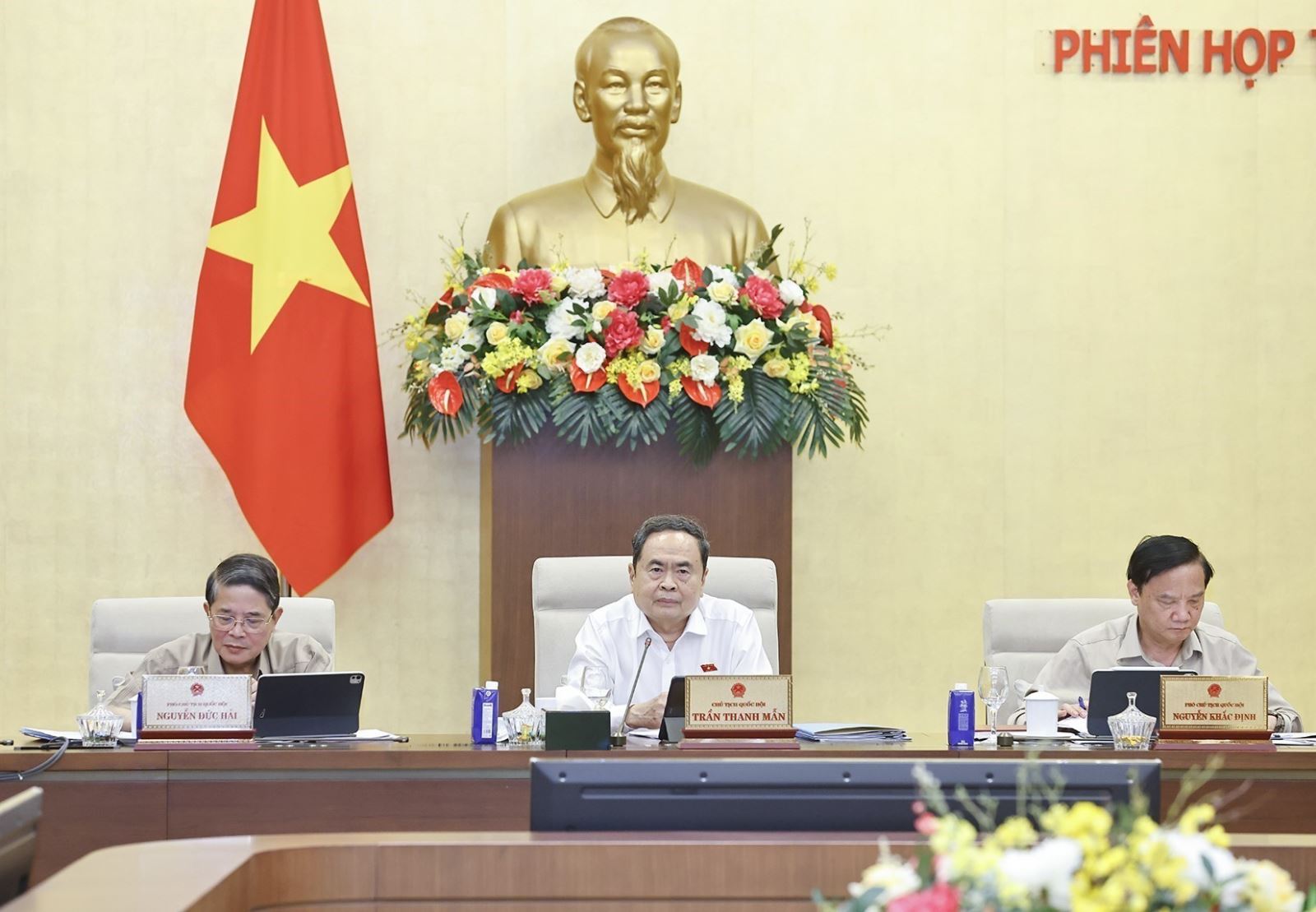
In reviewing the draft law, the Standing Committee of the National Assembly's Committee on Science , Technology and Environment (N&E) agreed with the necessity of comprehensively amending the Construction Law for the reasons stated in Government Report No. 863/TTr-CP. The Standing Committee of the N&E found that the draft law's dossier basically meets the requirements stipulated in the Law on the Promulgation of Legal Normative Documents for draft laws submitted under the simplified procedure. However, to provide a basis for National Assembly deputies to consider and approve it, further improvements are needed to ensure consistency with other laws currently being amended and to guarantee feasibility during implementation.
Regarding the institutionalization of the Party's guidelines and policies and the State's policies, the Standing Committee of the Science, Technology and Environment Committee believes that the draft Law has been developed in line with a new direction of innovative thinking in lawmaking, with the spirit of a "framework law," entrusting the Government with the task of specifying details on frequently changing issues. However, the Standing Committee of the Science, Technology and Environment Committee requests the drafting agency to further review and assess more thoroughly the level of institutionalization of some of the Party's guidelines, especially on the development of sustainable urban systems, improving labor productivity in the construction industry, and mechanisms for mobilizing social resources in investment in socio-technical infrastructure construction.
At the same time, closely adhering to the principles and directions outlined in the four pillar resolutions, the draft law and accompanying documents must be reviewed to ensure full compliance with Regulation 178-QĐ/TW dated June 27, 2024, of the Politburo on controlling power and preventing corruption and negative practices in lawmaking; the draft law must be reviewed to ensure that it only regulates matters within the National Assembly's authority, and does not "legalize" provisions of special mechanism resolutions or decrees and circulars in the construction sector. If such provisions are included, their impact and necessity must be thoroughly assessed, ensuring feasibility and adherence to the National Assembly's authority.
Regarding the constitutionality, legality, consistency of the draft Law with the legal system, and compatibility with international treaties, the Standing Committee of the Committee on Science, Technology and Environment noted that the contents of the draft Law are fundamentally consistent with the provisions of the 2013 Constitution and compatible with relevant international treaties to which the Socialist Republic of Vietnam is a signatory. However, further review and comparison of the provisions of the draft Law with related laws are needed to ensure the consistency and uniformity of the legal system, especially with laws currently under consideration, amendment, supplementation, or adoption at the 10th Session of the 15th National Assembly.
Regarding the feasibility of the draft Law, the Standing Committee of the Committee on Science, Technology and Environment believes that the draft Law is developed as a framework law, a law of principles, regulating fundamental issues for long-term stability, while entrusting the Government and ministries with providing detailed guidance to ensure flexibility and practical relevance. Overall, the provisions in the draft are feasible. However, entrusting many agencies with detailed regulations could lead to overlaps and conflicts between sub-laws (regarding land, investment, construction, telecommunications, technical infrastructure, appraisal authority, licensing, and quality management of construction projects, etc.), especially in the context of perfecting the current two-tiered government model. Therefore, it is recommended that the draft Law and its guiding documents be further reviewed and refined to ensure feasibility.
Speaking at the session, National Assembly Chairman Tran Thanh Man stated that the National Assembly should only enact "framework laws" based on legislation, while technical and specific issues would be addressed in Decrees and Circulars. He emphasized the need to ensure that the fundamental policies of the law are reflected within the law itself, and stressed the importance of flexibility and adaptability through decrees; technical standards, specific decentralization, and delegation of power to local governments.
“The revised Construction Law must improve the investment environment, reduce overlaps, and be consistent with existing laws such as the Public Investment Law, PPPs, and investment attraction laws. It must create strong legal opportunities for decentralization and delegation of power to localities; reduce sub-laws and avoid conflicts between ministries and agencies. There must be a strict monitoring mechanism to ensure that the Construction Law is applied effectively. It must also connect the construction sector with other sectors and reduce administrative procedures for citizens when applying for construction permits…”, the Chairman of the National Assembly stated.
The Chairman of the National Assembly also pointed out that management in construction investment has not met requirements, such as fire prevention and control, construction design appraisal, etc., lacking supervision and control of construction investors. The quality of appraisal, inspection, and supervision is carried out through post-audit methods. It is necessary to study regulations on clear post-auditing and public information to ensure the rights of citizens; clarify the role and authority of licensing, ensuring that permits are not obstacles that cause inconvenience to the people.
Speaking at the session, Deputy Prime Minister Tran Hong Ha also agreed with the opinions of the National Assembly Standing Committee, stating that the amendment of the Construction Law must ensure consistency, uniformity, and interconnectedness between specialized laws such as the Urban and Rural Law...
Deputy Prime Minister Tran Hong Ha stated that simplifying administrative procedures means minimizing the number of documents required for construction permits, but ensuring the quality of the projects, especially fire safety and earthquake resistance. The review and issuance of permits for key projects must be strictly managed to ensure construction quality.
Regarding specific issues such as construction permits (from Article 43 to Article 46, Chapter III), some argue that permits are not "barriers" but rather tools to protect rights and social order; the problem lies in the quality and process of granting permits. Therefore, it is necessary to simplify the process, clearly define responsibilities, processing deadlines, and make information public for citizens and businesses to monitor. In addition, while exempting construction permits reduces procedures, it is necessary to improve legal regulations in the Construction Law or Land Law to ensure property rights on land. Furthermore, a mechanism for handling violations should be added for projects that have been granted permits but are constructed incorrectly according to the design, have altered functions, or violate regulations, ensuring consistency and clear accountability among all relevant parties.
Regarding construction projects (from Article 47 to Article 71, Chapter IV), some argue that, according to international practice, the Construction Law should only stipulate three main entities: the investor, the design contractor, the overall consulting firm, and the construction contractor. Therefore, it is necessary to reduce the number of types of contractors and consulting organizations in the draft, omit detailed regulations on rights and obligations, and only retain general principles, leaving specific provisions to the contract to ensure flexibility and suitability to practical realities.
Regarding quality management, acceptance, and handover of construction projects: Some opinions suggest supplementing regulations on the principles of construction quality management, emphasizing "doing it right from the start," shifting the focus from inspection and detection to prevention and quality control throughout the surveying, design, construction, and maintenance phases. Simultaneously, it is necessary to clearly stipulate that "those who commit errors must compensate," and only prosecute intentional or fraudulent acts to differentiate between technical and criminal violations. This approach helps enhance professional responsibility, ensure quality, safety, and transparency in construction investment.
Regarding transitional provisions (Article 95), some argue that the draft Law does not clearly define the effective date and transitional arrangements for projects, permits, and contracts under the guiding documents of the 2014 Construction Law (amended 2020). To avoid legal gaps and ensure stability, it is proposed to add a transitional clause clearly defining the effective date of documents and procedures issued before the new Law comes into effect.
The lead agency responsible for the review conducted the review in accordance with the Party's regulations and the State's laws. The review report clearly expressed the lead agency's views on the issues covered by the review as stipulated in the Law on the Promulgation of Legal Normative Documents and Regulation No. 178-QĐ/TW dated June 27, 2024, of the Politburo; it fully reflected the opinions of the members of the lead agency, the opinions of the participating agencies, and the opinions of relevant agencies regarding the content of the draft law.
According to Conclusion No. 119-KL/TW dated January 20, 2025, of the Politburo on the orientation for reforming and improving the process of drafting legislation, "The Government and agencies submitting draft laws are ultimately responsible for the draft laws they submit." The agency in charge of drafting is fully responsible for researching, incorporating, fully revising, thoroughly and convincingly explaining, and promptly addressing the opinions in the review report and accompanying appendices in accordance with legal regulations; completing the draft law, ensuring it meets the requirements of the Party and the State's laws, and submitting it to the Standing Committee of the National Assembly for consideration and comments.
Source: https://baotintuc.vn/thoi-su/can-nghien-cuu-quan-ly-chat-thai-xay-dung-va-vat-lieu-xay-dung-than-thien-voi-moi-truong-20251016160331386.htm



![[Photo] Closing Ceremony of the 10th Session of the 15th National Assembly](/_next/image?url=https%3A%2F%2Fvphoto.vietnam.vn%2Fthumb%2F1200x675%2Fvietnam%2Fresource%2FIMAGE%2F2025%2F12%2F11%2F1765448959967_image-1437-jpg.webp&w=3840&q=75)
![[Photo] Prime Minister Pham Minh Chinh holds a phone call with the CEO of Russia's Rosatom Corporation.](/_next/image?url=https%3A%2F%2Fvphoto.vietnam.vn%2Fthumb%2F1200x675%2Fvietnam%2Fresource%2FIMAGE%2F2025%2F12%2F11%2F1765464552365_dsc-5295-jpg.webp&w=3840&q=75)




































![[OFFICIAL] MISA GROUP ANNOUNCES ITS PIONEERING BRAND POSITIONING IN BUILDING AGENTIC AI FOR BUSINESSES, HOUSEHOLDS, AND THE GOVERNMENT](https://vphoto.vietnam.vn/thumb/402x226/vietnam/resource/IMAGE/2025/12/11/1765444754256_agentic-ai_postfb-scaled.png)








































Comment (0)