

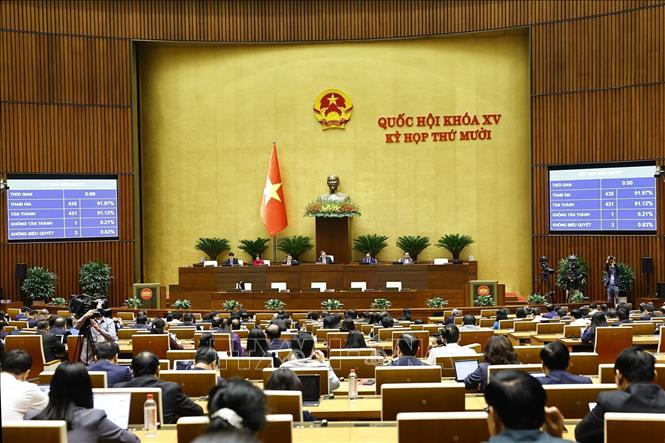
Hanoi has a Master Plan for the Capital City.
Hanoi will create a single master plan based on the integration of the Capital City Plan and the General Capital City Plan, which will be the Capital City Master Plan. The authority to approve and adjust the Capital City Master Plan rests with the Chairman of the Hanoi People's Committee. The Capital City Master Plan has a long-term vision (potentially up to 100 years).
To ensure rigor, transparency, feasibility, and to prevent losses, waste, and corruption, the Resolution on piloting some specific mechanisms and policies for implementing large and important projects in the Capital City has added a provision assigning the City People's Council the responsibility of prescribing the dossiers, conditions, criteria, procedures, and processes for implementing these policies; and simultaneously, being responsible for supervision during the implementation of the Resolution.
The Capital City Law No. 39/2024/QH15 has been enacted with many specific mechanisms for the capital city, but the decentralization and delegation of power are not yet complete or comprehensive, failing to create proactive governance; especially in the context of Hanoi's planned implementation of several very large-scale projects with a very wide scope and short timeframe. Therefore, to concretize the policy of maximum decentralization and delegation of power according to the motto "local authorities decide, local authorities do, local authorities are responsible," Hanoi has the authority to decide on the policy for public investment projects for the City People's Council, including projects with a serious risk of impacting the environment, except for projects using central government budget funds.
When implementing compensation, support, and resettlement projects independently before approving the investment policy, the City People's Council shall stipulate the criteria, documents, conditions, procedures, and processes for implementation...” and “...bear full responsibility for land acquisition... ensuring a harmonious balance of interests between the people, the state, and businesses, preventing losses, waste, and group interests, creating consensus among the people, and preventing complex incidents, mass complaints, and disruptions to public order and safety.”
Regarding the renovation and reconstruction of apartment complexes, based on the City People's Council's decision on the list of urban renovation, upgrading, and reconstruction projects, the City People's Committee decides on the renovation and reconstruction plan for apartment complexes after conducting a representative inspection and assessment of the apartment buildings and determining that they are subject to demolition. In such cases, a full inspection and assessment of the entire apartment complex is not required.
Specifically, the Hanoi City People's Committee decides on coercive measures in cases where the investor has obtained the consent of over 75% of homeowners or land users, equivalent to at least 75% of the area designated for urban renovation, upgrading, and reconstruction.
Professor Nguyen Thi Lan (Hanoi Delegation) assessed that the resolution is an objective and timely requirement, addressing long-standing difficulties in the development and exploitation of large-scale projects in the Capital. The resolution strongly decentralizes power to the Hanoi government to shorten processes and increase proactiveness, while remaining within the legal framework and under the supervision of the National Assembly and the Government . The resolution focuses on core issues such as planning, investment procedures, land acquisition, and urban reconstruction, creating conditions to accelerate urgent projects with significant ripple effects.
Making institutional breakthroughs, establishing the Ho Chi Minh City Free Trade Zone.
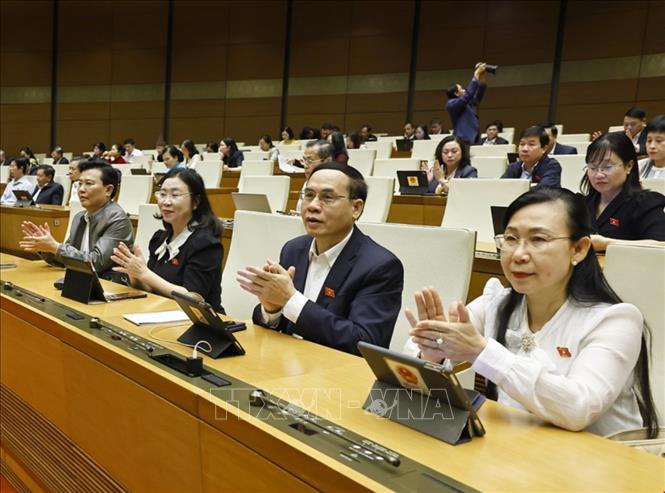
With the Resolution amending and supplementing a number of articles of Resolution No. 98/2023/QH15 passed by the National Assembly, one of the notable contents relates to the application of special investment procedures. The City People's Council decided to use local budget funds to implement independent public investment projects to carry out compensation, support, and resettlement for investment projects according to separate urban design plans, urban planning of areas adjacent to railway stations along railway lines approved by competent authorities, and areas adjacent to traffic junctions along the Ring Road 3 within the city's territory. This includes land acquisition, urban renovation and development, resettlement, and creating land funds for auctioning land use rights to implement urban development, commercial, and service investment projects in accordance with the law, or to pay investors implementing railway projects using Build-Transfer (BT) contracts as stipulated by law on investment under the public-private partnership method…
The resolution stipulates that railway station areas, depots, and areas adjacent to traffic junctions along the Ring Road 3 will be developed by the Ho Chi Minh City People's Committee according to the TOD (Transit-Oriented Development) model. The People's Committee is authorized to decide on combined investments in housing, commerce, services, public and service facilities, while flexibly determining land use, economic, and technical indicators that differ from national standards, but still ensuring technical infrastructure, social infrastructure, and environmental safety.
Specifically, the recently passed Resolution adds Article 7a on the establishment and operation of the Ho Chi Minh City Free Trade Zone. The City People's Council stipulates the procedures for establishing, expanding, and adjusting the boundaries of the Free Trade Zone. The City People's Committee decides on the establishment, expansion, and adjustment of the boundaries of the Free Trade Zone associated with the Cai Mep Ha seaport area. At the same time, the decision to establish, expand, or adjust the boundaries of the Free Trade Zone is considered a decision to make local adjustments to the city's master plan, overall city plan, etc.
Regarding land policy for the Free Trade Zone, except for commercial housing construction investment projects, the Chairman of the City People's Committee is authorized to allocate and lease land without auctioning land use rights or bidding to select investors for projects using land within the Free Trade Zone as stipulated in this Resolution. The City People's Committee shall decide on the price framework for leasing infrastructure within the Free Trade Zone.
Regarding investment incentive policies, the Resolution stipulates that the operating time of investment projects for the construction and business of infrastructure in functional areas within the Free Trade Zone, and projects of investors leasing land in the Free Trade Zone, shall be applied as investment projects in economic zones according to the provisions of the law on investment.
The resolution stipulates a 50% reduction in personal income tax for 10 years for experts, scientists, and highly skilled workers employed in the Free Trade Zone. Simultaneously, infrastructure construction and business projects within this zone will enjoy preferential land and water lease rates similar to those in functional zones within economic zones.
According to delegate Tran Hoang Ngan (Ho Chi Minh City delegation), from July 1, 2025, Ho Chi Minh City will don a "new look" with many potentials and advantages from the three growth poles of the former Southern key economic region: Ho Chi Minh City - Binh Duong - Ba Ria - Vung Tau, with a population of approximately 14 million people, plus about 20 million transient visitors each year. The city is among the top 20 megacities in the world, with an economic scale of over 120 billion USD, contributing one-third of the total state budget revenue and nearly half of the central government budget revenue…
Given this position, delegate Tran Hoang Ngan affirmed that the city urgently needs a compatible institution and a superior mechanism to address bottlenecks in traffic, flooding, environment, and housing for its people. The fact that the 15th National Assembly today passed a resolution amending and supplementing Resolution No. 98/2023/QH15 is a great joy. The resolution will provide additional resources and mechanisms for Ho Chi Minh City to further develop its role as the leading economic, cultural, medical, scientific, and educational hub of the country, while also enabling it to compete with major cities around the world.
Da Nang promotes outstanding investment with its Free Trade Zone.
The Da Nang Free Trade Zone is also defined in the Resolution amending and supplementing several articles of Resolution No. 136/2024/QH15 as an area with a defined geographical boundary, established to pilot superior and groundbreaking mechanisms and policies to attract high-quality investment, finance, trade, and services to promote exports, industry, research and development activities, and attract high-quality human resources.
The Da Nang Free Trade Zone is organized into functional zones, including: production zones, logistics centers, port and port logistics zones, trade and service zones, and other types of functional zones as prescribed by law. Functional zones within the Free Trade Zone that meet the conditions of a duty-free zone as prescribed by law are guaranteed customs inspection, supervision, and control by the customs authorities and state management activities.
Regarding land policy for the Da Nang Free Trade Zone, except for commercial housing construction investment projects, the City People's Committee is authorized to allocate and lease land without auctioning land use rights or bidding on land-use projects for investment projects.
The resolution encourages investment in strategic sectors and key infrastructure, including: building innovation centers, data centers, R&D linked to training; research and transfer of high technology; semiconductor chip technology, integrated circuits, electronic components, new battery technologies, new materials, and the defense industry. At the same time, priority is given to investing in infrastructure for the Da Nang Free Trade Zone, logistics centers, manufacturing zones, medical facilities, education and training facilities; seaports and airports, with projects having capital ranging from 2,000 to 10,000 billion VND or more.
The strategic investor developing the infrastructure of the Da Nang Free Trade Zone will connect the functional zones with the airport, seaport, and international border gates through a Public-Private Partnership (PPP) model. Projects within the zone will be exempt from all land and water surface lease fees (except for residential and commercial/service land). New businesses investing in the zone will apply a 10% income tax rate for 30 years, with a 4-year exemption and a 50% reduction for the following 9 years.
Da Nang's preferential policies not only attract experienced foreign investors in the aviation logistics sector but also promote linkages with international financial centers, contributing to the realization of the development goals of the City Party Congress 2025-2030 and creating momentum for Da Nang to take off in the new era. At the same time, this policy affirms the city's strong commitment to foreign investors.
Source: https://baotintuc.vn/thoi-su/cu-hich-moi-voi-loat-nghi-quyet-tao-co-che-dac-thu-cho-ha-noi-tp-hcm-va-da-nang-20251211123210578.htm


![[Photo] Prime Minister Pham Minh Chinh holds a phone call with the CEO of Russia's Rosatom Corporation.](/_next/image?url=https%3A%2F%2Fvphoto.vietnam.vn%2Fthumb%2F1200x675%2Fvietnam%2Fresource%2FIMAGE%2F2025%2F12%2F11%2F1765464552365_dsc-5295-jpg.webp&w=3840&q=75)

![[Photo] Closing Ceremony of the 10th Session of the 15th National Assembly](/_next/image?url=https%3A%2F%2Fvphoto.vietnam.vn%2Fthumb%2F1200x675%2Fvietnam%2Fresource%2FIMAGE%2F2025%2F12%2F11%2F1765448959967_image-1437-jpg.webp&w=3840&q=75)
































![[OFFICIAL] MISA GROUP ANNOUNCES ITS PIONEERING BRAND POSITIONING IN BUILDING AGENTIC AI FOR BUSINESSES, HOUSEHOLDS, AND THE GOVERNMENT](https://vphoto.vietnam.vn/thumb/402x226/vietnam/resource/IMAGE/2025/12/11/1765444754256_agentic-ai_postfb-scaled.png)



































Comment (0)