

Exploiting potential markets outside of traditional markets
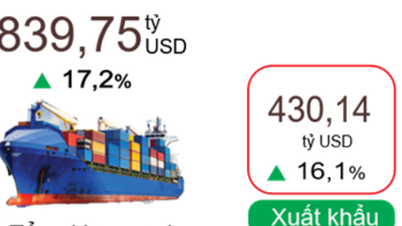
The strong recovery of Vietnam's exports is clearly shown through the data for the first 11 months of 2025, when the total import-export turnover reached 839.75 billion USD, up 17.2% over the same period. Of which, exports increased by 16.1%, with a trade surplus of 20.53 billion USD. The United States continued to be the largest export market with 138.6 billion USD, while China played the role of the main supplier with an import turnover of 167.5 billion USD. The trade picture shows great room but also poses an urgent need to expand export space to reduce risks in the face of global fluctuations.
Import and export maintained stable growth momentum at a high level
The WTO forecasts global trade growth to reach only 0.9% in 2025. This is an unusually low growth rate, coupled with trade tensions and greening demands that have made many traditional consumer markets increasingly demanding. As a result, finding new areas with stable purchasing power has become a strategic direction for Vietnam.
Among the prominent regions, the Middle East is considered a “new growth zone” with a total import value of more than 1,200 billion USD per year. In particular, the Gulf countries (GCC) are heavily dependent on imports, especially food, agricultural products, seafood, wooden furniture and consumer goods. Many large retail chains such as Lulu Hypermarket, Al Othaim Markets, Choithrams or Citi Hypermarkets show strong interest in high-quality goods from Vietnam. The event "Vietnam International Sourcing" held continuously for the past 3 years in Ho Chi Minh City has become an important bridge for Vietnamese enterprises to directly access the distribution system in the region, expanding opportunities to sign long-term contracts.
Eastern Europe has also emerged as a potential market, with standard requirements generally matching the production capacity of domestic enterprises. In Belarus, importers of food, household appliances, textiles and fast-moving consumer goods are increasingly looking for supplies from Vietnam. The transit advantage to the Eurasian Economic Union helps this market become a gateway for Vietnamese goods to penetrate deeper into the region. Similarly, Hungary and Bulgaria have recorded increased demand for food, beverage, nutritional and household products. If they effectively utilize import hubs, Vietnamese enterprises can expand to the Central and Eastern European and Balkan markets - where competition is moderate, price ranges are stable and flexibility is high.
Take advantage of incentives from the FTA network and improve response capacity
The market diversification strategy is only effective when businesses simultaneously improve their competitiveness. According to the Department of Foreign Market Development ( Ministry of Industry and Trade ), the network of 17 FTAs with more than 60 countries has created a solid foundation for Vietnam's exports. Thanks to that, in the first 11 months of 2025, exports increased by 17.2%, with a trade surplus of 20.53 billion USD.
However, the large market potential still comes with many challenges. Some key processing and manufacturing industries still depend on imported raw materials, limiting the ability of businesses to meet large orders and high technical requirements. Many industries are also under pressure from trade defense measures, such as anti-dumping taxes or requirements to tighten rules of origin.
Therefore, businesses need to invest more heavily in technology, deep processing, improve traceability and meet green standards. Solutions such as applying blockchain in supply chain transparency, developing environmentally friendly products or improving packaging are the key to helping Vietnamese goods gain a stronger foothold.
On the management side, the Ministry of Industry and Trade focuses on expanding exports to new markets such as India, Russia, the Middle East and Latin America... At the same time, promoting the development of supporting industries to reduce dependence on imported raw materials. Trade connection events, international fairs and market information programs will continue to be implemented in a practical way to support businesses in finding new partners. At the same time, enhancing the capacity to forecast and warn early about trade defense risks in key markets that also contain many technical barriers.
Regarding trade promotion, Mr. Vu Ba Phu - Director of the Trade Promotion Department - Ministry of Industry and Trade said that Vietnam has signed 17 free trade agreements (FTAs), but in reality, in many large markets, Vietnamese goods still account for a very small proportion, so promotion activities to diversify markets are still continued (focusing on the US, EU, Canada, China, the Middle East, etc.), thereby supporting businesses to improve the efficiency of exploiting FTAs. In addition, increasing business connections with customers in emerging markets such as South Asia, UAE, Africa, Mexico, etc., combined with strengthening the national trade promotion network, standardizing the model of professional and interconnected local trade promotion centers. These solutions are expected to help businesses diversify export markets and increase export turnover in the coming time.
In recent years, Vietnam has signed and implemented many important bilateral and multilateral free trade agreements such as the Agreement on enhancing economic and trade cooperation with partners in the Americas (CPTPP), the Vietnam-EU Free Trade Agreement (EVFTA), the Vietnam-UK Free Trade Agreement (UKVFTA), the Regional Comprehensive Economic Partnership Agreement (RCEP)... These agreements open up many great opportunities for businesses in expanding export markets, taking advantage of tariff incentives, attracting investment and enhancing the position of Vietnamese goods.
Bao Ngoc
Source: https://congthuong.vn/cung-co-nen-tang-xuat-khau-bang-chien-luoc-mo-rong-thi-truong-433784.html

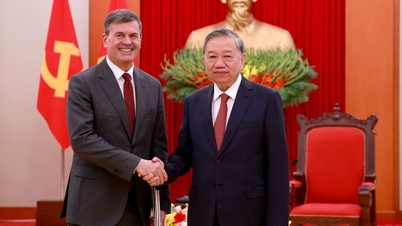
![[Photo] General Secretary To Lam receives the Director of the Academy of Public Administration and National Economy under the President of the Russian Federation](/_next/image?url=https%3A%2F%2Fvphoto.vietnam.vn%2Fthumb%2F1200x675%2Fvietnam%2Fresource%2FIMAGE%2F2025%2F12%2F08%2F1765200203892_a1-bnd-0933-4198-jpg.webp&w=3840&q=75)

















































































Comment (0)