

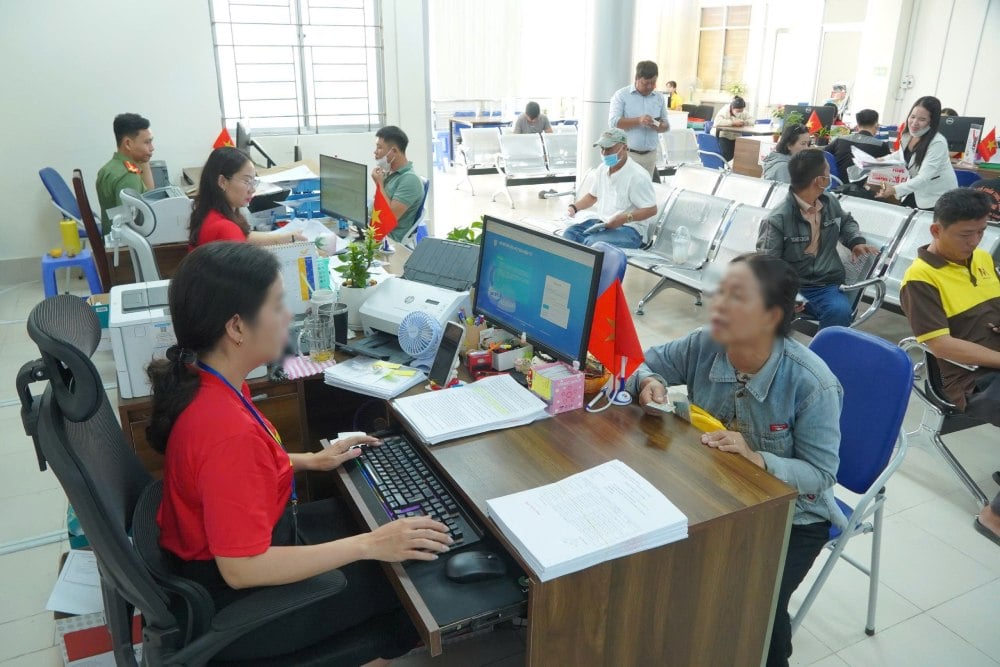
Preparations are underway to implement KPIs in civil servant performance evaluations and establish a clear scoring system. Photo: Ta Quang
The evaluation of civil servants based on KPIs (Key Performance Indicators) will begin on January 1, 2026.
The Ministry of Interior is currently seeking feedback on the draft Decree regulating the mechanism for evaluating state administrative agencies and civil servants, and is submitting it to the Ministry of Justice for appraisal before presenting it to the Government for promulgation.
The draft Decree adds a method for monitoring and evaluating civil servants on a periodic basis (monthly, quarterly), with the application of KPIs and a transparent scoring formula.
The evaluation method will be based on two main principles: Quantification of work products: Each product/task is converted to a "standard product/task unit" according to criteria such as volume, complexity, progress, technical aspects, etc., in order to create a basis for consistent evaluation and avoid individualization; Evaluation based on three criteria: Quantity, quality, and progress.
The monitoring and evaluation score is calculated using the formula: (Total score of general criteria x 30%) + (Total KPI score x 70%), ensuring that qualitative general criteria (30%) are recognized; while emphasizing the actual performance of tasks (70%).
Based on the total score, civil servants are classified into four levels: Excellent performance: 90 points or more; Good performance: 70 to under 90 points; Satisfactory performance: 50 to under 70 points; Unsatisfactory performance: Below 50 points or disciplinary violations, moral degradation, failure to set a good example, etc.
The results of monitoring, evaluating, and ranking civil servants will be used as a direct basis for determining additional income and bonuses; considering appropriate job placement and transfer; and screening and removing from the system those who do not meet job requirements.
With this new approach, each official and civil servant will be "measured" by their competence, output, and actual performance, creating motivation for striving and encouraging innovation and creativity.
Speaking with Lao Dong newspaper, National Assembly representative Ta Thi Yen (from Dien Bien province) emphasized that evaluating performance based on the results of assigned tasks and work on a monthly, quarterly, and six-monthly basis, through quantitative criteria such as the quantity, quality, and progress of products for each job position, is a breakthrough and necessary step in administrative reform .
The female delegate argued that this is a modern approach, shifting from subjective qualitative criteria to clear quantitative criteria, similar to the KPI model in the business sector.
Using specific indicators for evaluation helps to accurately, transparently, and fairly reflect the work performance of officials and civil servants – a particularly important factor in the current context of the need to improve the quality of public service.
Currently, many KPI evaluation software programs are used in the business sector in Vietnam, and some of them have the potential to be adapted for application in the public sector.
Previously, Mr. Nguyen Quang Dung - Director of the Civil Servant and Public Employee Department ( Ministry of Interior ) - stated that currently, the evaluation of civil servants is largely superficial, with the majority being classified as "having performed their duties well." Meanwhile, the private sector has long applied KPIs because of the easier ability to quantify work performance.
Developing KPIs in the public sector is more challenging due to the measurable nature of administrative work. Therefore, KPI evaluation in the public sector requires a combination of quantitative and qualitative factors, including: processing progress, document quality, and citizen satisfaction levels.
Previously, Khanh Hoa province pioneered the issuance of a set of tools for measuring and evaluating work performance (KPI) for officials, civil servants, and public employees, contributing to overcoming limitations in personnel evaluation; Ninh Thuan province is also implementing a roadmap for applying KPIs.
According to Tien Phong Newspaper
Source: https://baotuyenquang.com.vn/xa-hoi/202510/danh-gia-cong-chuc-theo-kpi-khac-phuc-tinh-trang-cham-diem-cam-tinh-cuoi-nam-35b6790/







































































Comment (0)