

Several private investors have proposed undertaking the project.
On the afternoon of June 25th, the Government submitted to the National Assembly a proposal to add a new investment model for the North-South high-speed railway project.
Regarding this matter, the Government proposes that the National Assembly approve the addition of other investment forms (public-private partnership (PPP), business investment, etc.) for the high-speed railway project on the North-South axis, in addition to public investment.
Based on that, the Government will select the investment form and investor in accordance with regulations. In case there are other mechanisms or policies that exceed its authority, it will report to the National Assembly.
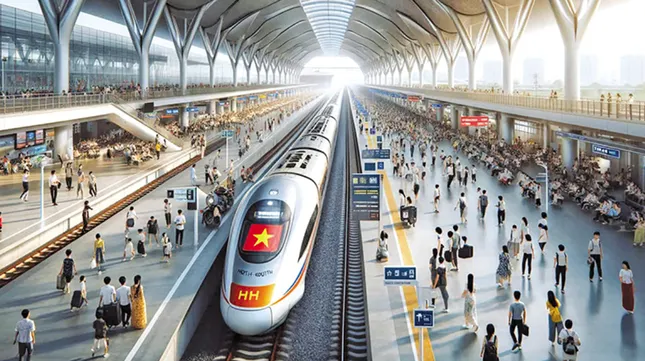 |
Proposals have been made for private investors to build the high-speed railway. |
This proposal comes amidst Vietnam's planned investment in the North-South high-speed railway project. The Politburo has agreed on the investment policy for this project under the public investment model, and the National Assembly has approved the investment policy and public investment model in Resolution 172 dated November 30, 2024.
The government stated that, starting in April 2025, it and local authorities began preparing for land clearance; selecting investors to provide project management consulting; and reviewing and translating 31 sets of standards.
In addition, the Government is also working with domestic and foreign organizations and businesses to encourage their participation in the project, as well as developing and issuing decrees and schemes for developing railway resources and a railway industry development plan.
The government stated that it has received investment proposals from several investors for this project. The investors proposed investing through private investment (according to the Investment Law), with a faster timeline than that outlined in Resolution 172/2024 of the National Assembly.
Budgetary funds will be used for land clearance, resettlement support, and handing over cleared land to investors…
At the time the Politburo approved the investment plan for the North-South high-speed railway line under the public investment model, no investors had expressed interest or proposed investing in this project.
Following Resolution 68 on breakthroughs in private economic development, several investors have shown interest in investing in the project.
However, according to Resolution 172/2024 of the National Assembly, there is no provision for direct private investment or other forms of investment.
Therefore, the Government proposes that the National Assembly allow the addition of other forms of investment besides public investment. In cases where policies exceeding the Government's authority are needed, the Government will report to the National Assembly.
Continue using the place names and locations before and after the merger.
Later that afternoon, the National Assembly discussed solutions for continuing the implementation of the planning in conjunction with the reorganization of administrative units.
The government proposes that ministries and localities prepare, research, and revise planning within their assigned functions and responsibilities. Ministries and localities are permitted to use recurrent expenditure, public investment capital, and other sources of funding to carry out the preparation and revision of planning.
Notably, localities that have merged provincial-level administrative units will have two or three planning documents. Meanwhile, localities that have not merged may also have outdated content regarding geographical scope, place names, or development orientations and spatial organization.
The government proposes that national, regional, and provincial planning schemes for the period up to 2030 that were approved before the effective date of the Resolution of the 9th Session will continue to be implemented until a replacement or revised plan is issued.
Speaking at the session, delegate Nguyen Truc Son (Ben Tre) argued that, in the context of provincial and city mergers, the need to adjust planning is necessary.
According to him, before the Planning Law was amended, the biggest issue faced by localities after mergers was the adjustment of programs and projects.
Therefore, it is essential to allow localities after mergers to adjust their planning implementation plans, especially those related to connecting transportation projects and the construction and renovation of government offices at both levels.
Therefore, delegates expressed their desire for the Government to provide specific guidelines so that localities can implement the process in a coordinated manner, with more time for preparation in allocating funds and conducting procedures for selecting consulting firms.
In his subsequent explanation, Minister of Finance Nguyen Van Thang stated that the Government had implemented solutions to carry out planning work in conjunction with the reorganization of administrative units.
For localities where administrative units have been merged, when implementing plans and projects for which investment policies have been approved, the place names and locations used both before and after the merger will continue to be permitted.
In addition, ministries, departments, and localities are now allowed to use recurrent expenditures, public investment funds, and other sources to develop and adjust planning… instead of relying solely on public investment funds as before.
Source: https://tienphong.vn/de-xuat-cho-phep-dau-tu-tu-nhan-du-an-duong-sat-toc-do-cao-bac-nam-post1754554.tpo
![[Image] Close-up of the newly discovered "sacred road" at My Son Sanctuary](/_next/image?url=https%3A%2F%2Fvphoto.vietnam.vn%2Fthumb%2F1200x675%2Fvietnam%2Fresource%2FIMAGE%2F2025%2F12%2F13%2F1765587881240_ndo_br_ms5-jpg.webp&w=3840&q=75)







































































Comment (0)