

Trash and water hyacinths surround the beach.
Bai Dau is one of the upscale tourist destinations in the Ba Ria - Vung Tau area, boasting numerous restaurants, cafes, and resorts favored by visitors. However, the appearance of ocean trash has significantly impacted businesses. The owner of a 5-star resort shared that ocean trash invading Vung Tau's beaches affects urban aesthetics and the marine environment. Due to the rocky shoreline, trash collection is difficult, sometimes only once a week, resulting in a foul odor.
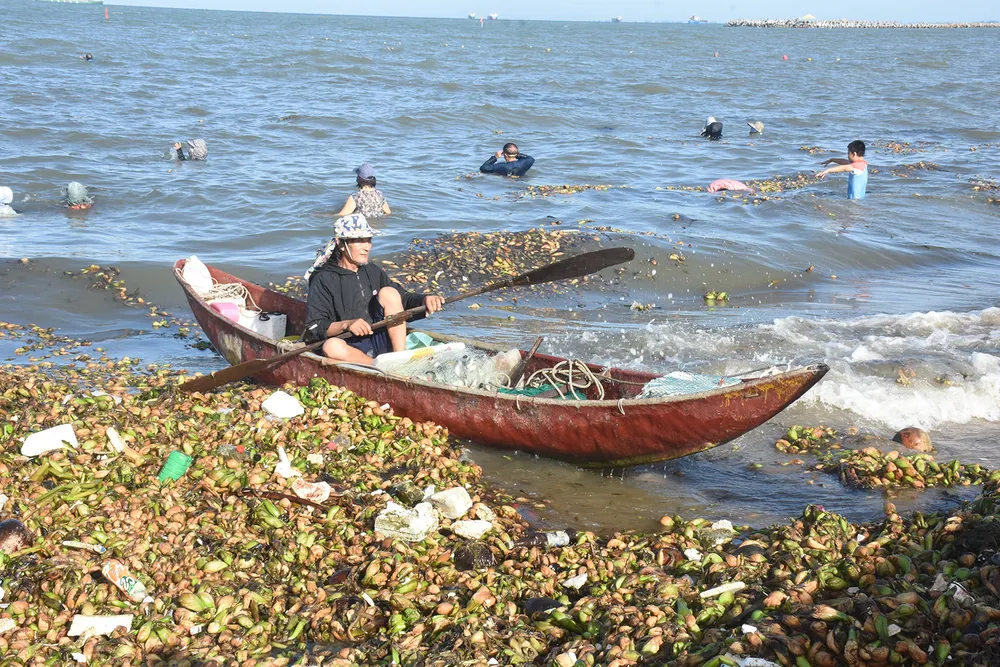
Meanwhile, in the central area, the environmental sanitation force of Vung Tau Urban Environmental Services and Construction Joint Stock Company (VESCO) is constantly struggling to remove garbage. Mr. Nguyen Xuan Hau, Deputy General Director of VESCO, said that on days when garbage overflows onto the beach, the amount of garbage needing to be processed increases from 15-20 tons, and on some days it even increases to 50-60 tons.
The large amount of trash has led to increased transportation and processing costs. With the current processing price of 374,269 VND/ton, on days when beach litter accumulates, the waste disposal cost can increase by 5.6-22 million VND/day. “Previously, for about 1km of beach area, VESCO only needed 3 workers to clean it. But since the appearance of ocean litter and water hyacinth, the company has to mobilize 30-40 workers every day, working continuously from 4 am to 5 pm to keep up,” said Mr. Nguyen Xuan Hau.
Another tourist destination, Binh Chau beach, also suffers from massive amounts of garbage stretching for hundreds of meters along the embankment from May to October each year, mixed with seaweed and sand. Mr. Huynh Van Thanh, a resident of Binh Hoa hamlet, Binh Chau commune, said that in previous years, Binh Chau beach also experienced garbage washing ashore, but never before has it been as much as this year. The Binh Chau commune authorities have mobilized local forces such as militia, youth union members, and other organizations to carry out a "beach cleanup" campaign. Mechanical equipment such as excavators and dump trucks have also been deployed to collect the large and bulky amount of garbage.
Dr. Pham Ngoc Thinh, Branch Campus of the University of Water Resources in Binh Duong :
To effectively prevent the influx of waste onto Vung Tau's tourist beaches, Ho Chi Minh City needs to develop plans, survey the terrain, and prepare the necessary equipment to proactively collect the amount of waste washed ashore at specific times. It is essential to build a system for monitoring and early warning of waste washing ashore using fixed cameras, UAVs, and mathematical simulation models to predict when waste will wash ashore a certain amount of time in advance, enabling management agencies to proactively respond and collect the waste.
Located in the middle of the ocean, the Con Dao Special Economic Zone faces a similar situation. Ms. Le Mong Thuy, Director of the Public Works Management Board of the Con Dao Special Economic Zone, recounted that during the monsoon season from September to February of the following year, a large amount of ocean debris washes ashore on Con Dao's beaches, especially in areas like Bai Vong, Suoi Ot, Ben Dam, Dam Trau, and Bai Nhat… making beach cleanup work much more difficult, with the amount of collected waste reaching several hundred tons each year. “Here, the collected waste mainly consists of nets, ropes, packaging, and buoys… used in fishing that are buried deep under the sea, swept into coral reefs and marine vegetation, and entangled in mangrove forests,” Ms. Le Mong Thuy stated.
In addition, at many times, Vung Tau has to mobilize hundreds of workers and machines to clear hundreds of tons of water hyacinth that wash ashore each day to clean the beaches. When the tide recedes, the company cleans the sand with manual tools; where there is still water, they use excavators, then load the waste onto specialized trucks to compress it and transport it to the processing plant. But then, when the tide rises, the water hyacinth washes back ashore again.
Finding a solution is a difficult task.
Given this situation, local authorities, despite continuously implementing solutions, have only been able to respond to and handle the situation, rather than prevent it at its root. How can we address the problem of trash and water hyacinth washing ashore at its source?
Recently, the Ho Chi Minh City Department of Science and Technology submitted a document to the City People's Council and People's Committee proposing several solutions to protect the Vung Tau coastline and prevent marine debris from washing ashore. Analysis shows that the beaches of Ba Ria - Vung Tau experience 2-3 waves of ocean debris washing ashore annually, especially in the Bai Truoc area, with each wave potentially lasting a week. The peak periods are from late May to mid-July when the weather changes to the Southwest monsoon and from late August to late October when the wind shifts from Southwest to Northeast, combined with high tides. The debris comes from fishing and aquaculture activities, mainly consisting of styrofoam containers, plastic buoys, fishing nets, light bulbs, plastic trays, other plastic items, bamboo, and wood used in fishing vessels.
Regarding water hyacinths that drift ashore in Vung Tau during the period from May to July each year, they originate from the Dong Nai - Saigon and Vam Co river systems; from August to October, they originate from the Tien and Hau rivers, with a small remaining portion originating from the Dong Nai - Saigon and Vam Co rivers and from the Can Gio mangrove forest and other mangrove forests along the Mekong Delta coast.
Regarding solutions, the Ho Chi Minh City Department of Science and Technology proposed controlling waste at its source, with the cooperation of Dong Nai and Tay Ninh provinces in preventing emissions into rivers. Localities in the Mekong Delta need to minimize the amount of waste flowing from upstream towards the sea. In addition, localities in Ho Chi Minh City need to widely disseminate information to individuals and organizations that are likely to increase plastic waste emissions into rivers and canals; reduce plastic waste from daily activities; and handle cases of environmental discharge according to regulations.
The Department of Science and Technology proposed that Ho Chi Minh City assign the Department of Construction to take the lead, in coordination with the Department of Agriculture and Environment and other advisory units, in promoting garbage collection on rivers and canals approved by the Ho Chi Minh City People's Committee. Notably, the Department of Agriculture and Environment should take the lead, in coordination with the Border Guard and other units, in developing an action program to reduce waste from fishing and aquaculture activities; raise awareness through public campaigns; and prioritize garbage control on ships when departing and arriving at ports. This includes preparing equipment and surveying the terrain to proactively collect garbage washed ashore at specific times, or establishing a monitoring and early warning system for garbage washing ashore in Vung Tau to improve collection efforts.
Khanh Hoa: Installing trash screens in Binh Son beach.
Recently, Khanh Hoa province has installed a trash barrier system at Binh Son beach (Dong Hai ward). This is considered an effective and practical solution to prevent waste from the ocean, aquaculture activities, and tourism from drifting ashore.
According to the Department of Agriculture and Environment of Khanh Hoa province, the Binh Son beach area receives a large amount of waste annually, especially during windy and high tide seasons, seriously affecting the aesthetics and quality of beach tourism. A system of trash screens has been installed along the beach area, ensuring the safety of tourists while preventing tons of plastic waste, plastic bags, and floating debris from drifting ashore. The installation of these screens, along with regulations on marine environmental protection and awareness campaigns encouraging residents and tourism businesses not to litter, is part of a comprehensive set of solutions that Khanh Hoa province is implementing to promote green and sustainable tourism development.
NGUYEN TIEN
Source: https://www.sggp.org.vn/du-lich-bien-ba-ria-vung-tau-cang-thang-vi-rac-xam-chiem-bo-cat-post816856.html



![[Photo] Closing Ceremony of the 10th Session of the 15th National Assembly](/_next/image?url=https%3A%2F%2Fvphoto.vietnam.vn%2Fthumb%2F1200x675%2Fvietnam%2Fresource%2FIMAGE%2F2025%2F12%2F11%2F1765448959967_image-1437-jpg.webp&w=3840&q=75)


































![[OFFICIAL] MISA GROUP ANNOUNCES ITS PIONEERING BRAND POSITIONING IN BUILDING AGENTIC AI FOR BUSINESSES, HOUSEHOLDS, AND THE GOVERNMENT](https://vphoto.vietnam.vn/thumb/402x226/vietnam/resource/IMAGE/2025/12/11/1765444754256_agentic-ai_postfb-scaled.png)









































Comment (0)