

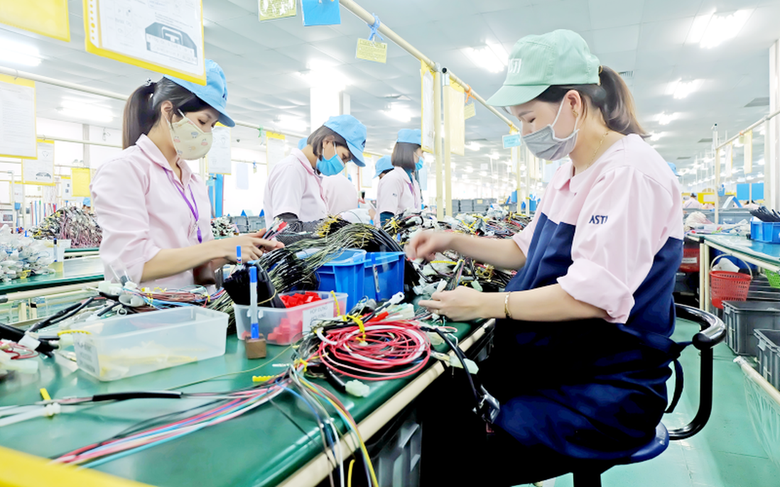
As the economy undergoes digital transformation, female workers in the manufacturing industry will face the risk of job loss due to the adoption of automation and robotization in many tasks. (Illustrative image)
Presenting her paper at the national workshop "Digital Transformation in the Activities of the Vietnam Women's Union," Ms. Vu Thu Hong - Program Officer for Women, Peace and Security, United Nations Entity for Gender Equality and Women's Empowerment (UN Women) in Vietnam - highlighted the current state of labor skills and challenges regarding employment security for Vietnamese women in the context of digital transformation, and proposed solutions for the Vietnam Women's Union to support its members and women in general.
Current skill levels and challenges for female workers in Vietnam.
According to Ms. Vu Thu Hong, although the female workforce in Vietnam is large in number, the proportion of trained women is low, thus failing to meet the demands of the period of accelerated industrialization, modernization, and deep international integration, especially in the rapidly growing digital economy. The "Labor and Employment Survey Report 2020" by the General Statistics Office indicated that 49.4% of female workers lacked professional qualifications, concentrated among rural women, middle-aged women, and women from ethnic minorities; and 94.7% of the total employed workforce consisted of women working in household jobs.
Women, especially young women, face difficulties in entering the high-quality workforce or in professions with ample opportunities for managerial and leadership appointments due to discrimination and gender stereotypes. Furthermore, occupational segregation and limitations on advancement, as well as persistent gender gaps in science, technology, engineering, and mathematics (STEM) education at the secondary and university levels, persist.
A recent study on gender and academic performance in Vietnam indicates that while girls generally perform better in mathematics, they believe they are less academically inclined than boys. International experience also shows that children themselves believe that arts and languages are "feminine" activities and that science , technology, engineering, and mathematics (STEM) are "masculine." Due to a lack of statistical data on STEM academic performance in Vietnam, we cannot have accurate information on whether male or female students perform better in STEAM subjects. However, with these biases in place, not many girls are currently encouraged to develop in this field.
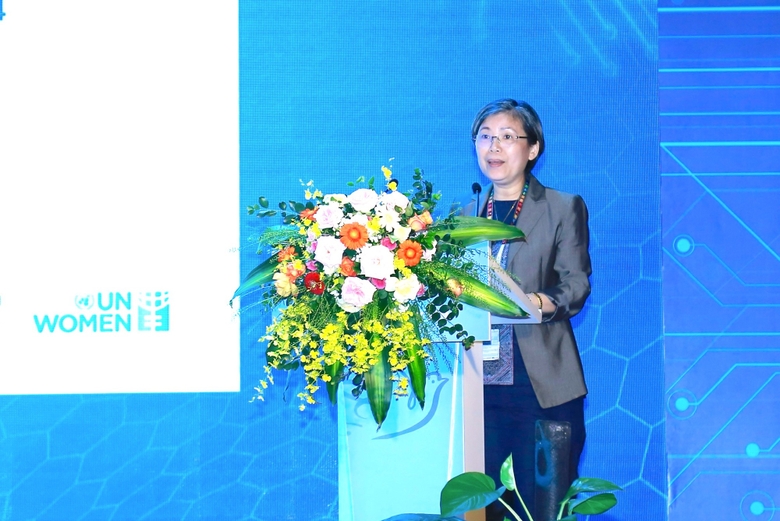
Ms. Vu Thu Hong, Program Officer for Women, Peace and Security, United Nations Entity for Gender Equality and Women's Empowerment (UN Women) in Vietnam, presented a paper at the workshop.
This is further evidenced by the ILO report (ASEAN in Transition), which shows that Vietnamese men often choose engineering (20.8%) and information, communication, and technology (18.6%). However, less than 10% of Vietnamese women surveyed pursued these two fields of study.
Alongside this reality, female workers also face numerous challenges as the digital economy becomes the dominant force in modern societies. Manufacturing industries such as garment, electronics, and assembly often have a high proportion of female labor. With the adoption of automation and robotics, the decline in demand for manual labor will put many women at risk of job losses. Similarly, the retail and customer service sectors may replace jobs such as cashiers and sales consultants with automated or online solutions, impacting the job retention of women working in these industries, sometimes even eliminating unskilled female workers and retaining only managerial positions.
In fields such as information and communication technology, healthcare, education, and administrative work, digital technology can create many new opportunities but may also require highly skilled and technical expertise. Women may face job loss or unemployment if they lack sufficient technical skills. The difficulty in advancing to higher positions in these fields also poses a challenge, forcing women to work much harder to avoid being left behind, excluded, or discriminated against in the workplace.
Some recommendations for the Vietnam Women's Union.
Prime Minister Pham Minh Chinh - Chairman of the National Committee on Digital Transformation - presided over the 8th session of the National Committee on Digital Transformation on April 24, 2024, and requested Ministers and Chairpersons of People's Committees at all levels to show greater determination, make greater efforts, and focus on decisively directing the implementation of national digital transformation and the development of the digital economy; with the spirit of "5 key areas of acceleration". On March 11, 2024, Vice President Vo Thi Anh Xuan emphasized at the 68th session of the Commission on the Status of Women (CSW68-2024) of the United Nations Economic and Social Council (ECOSOC) in New York, USA, the need to strengthen the empowerment of women and girls in science, technology, and digital transformation.
With all the potential and advantages of the country, along with the close attention and guidance of the Party, State, and Government, the Vietnam Women's Union can consider implementing a number of activities to enhance the participation of women and girls in the digital transformation process and the digital economy, specifically:

Central Committee member and President of the Vietnam Women's Union, Ha Thi Nga (center), discusses with contestants participating in the "Application of Information Technology in Organizing Women's Union Activities" competition.
- The Vietnam Women's Union is carrying out propaganda and campaigns to completely eliminate discrimination against girls in education, against women in labor and employment, and to eliminate gender-based violence in cyberspace. Simultaneously, it is conducting communication campaigns to raise awareness and change prejudices regarding the choice of academic fields and career orientation for girls and young women, ensuring the "rights" of women and children; and improving the understanding of families and schools about future professions compared to traditional occupations with strong gender biases or those that reinforce gender-based discrimination.
- Through the Women's Union, schools can organize career talks and counseling sessions in STEM fields, integrated circuits, semiconductors, AI, etc., for female students, aiming to broaden the demand for vocational training and career guidance for female students at all levels.
- Women's Unions at all levels can also coordinate with relevant agencies to provide career counseling and job information for women and female students through a one-stop service model, and organize job fairs to connect employers and female workers...
- Conducting research and collecting data on the participation of women and youth in the digital economy is crucial to identifying advantages, threats, challenges, risks, and opportunities. From this, the Association can develop specific activities and propose policy proposals to ensure timely interventions that protect the legitimate rights and interests of women.
- Women's Unions at all levels need to continue advocating for policies, participating in gender mainstreaming, and enhancing the effectiveness of the Law on Gender Equality, the Law on Employment, the Law on Labor, etc., to promote gender equality and diversify the workforce. In the current "labor shortage," this solution also provides a basis for the Government to utilize all human resources for the digital transformation process and the development of the digital economy, especially human resources with diversity in gender, income, age, race, ethnicity, gender identity, and sexual orientation.
- The Association needs to continue to have programs supporting technology businesses owned by women and strengthen domestic cooperation, public-private partnerships, cooperation with social organizations, non-governmental organizations, professional organizations, associations, as well as international cooperation to build or support vocational training programs in technical skills, science and technology, and digital skills for women-owned businesses in particular and the female workforce in general to improve the quality of labor and ensure stable employment for them.
- Highlighting and honoring female leaders in the digital economy, and successful business models that utilize digital tools for business development, marketing, e-commerce, and financial management, is also a way to inspire and motivate women on their journey to participate in digital transformation.
Through these activities, the Vietnam Women's Union can actively support narrowing the gender gap in the digital economy and enhance the empowerment of women and female students, supporting the maximum utilization of Vietnam's human resources to ensure sustainable economic and social development.
Source

![[Photo] The captivating scenery of the fragrant maple forest in Quang Tri](/_next/image?url=https%3A%2F%2Fvphoto.vietnam.vn%2Fthumb%2F1200x675%2Fvietnam%2Fresource%2FIMAGE%2F2025%2F12%2F10%2F1765353233198_lan09046-jpg.webp&w=3840&q=75)


![[Photo] Explore the US Navy's USS Robert Smalls warship](/_next/image?url=https%3A%2F%2Fvphoto.vietnam.vn%2Fthumb%2F1200x675%2Fvietnam%2Fresource%2FIMAGE%2F2025%2F12%2F10%2F1765341533272_11212121-8303-jpg.webp&w=3840&q=75)




























![[Video] The craft of making Dong Ho folk paintings has been inscribed by UNESCO on the List of Crafts in Need of Urgent Safeguarding.](https://vphoto.vietnam.vn/thumb/402x226/vietnam/resource/IMAGE/2025/12/10/1765350246533_tranh-dong-ho-734-jpg.webp)






























































Comment (0)