

|
Museum staff are meticulously crafting animal specimens, gradually restoring them for display. |
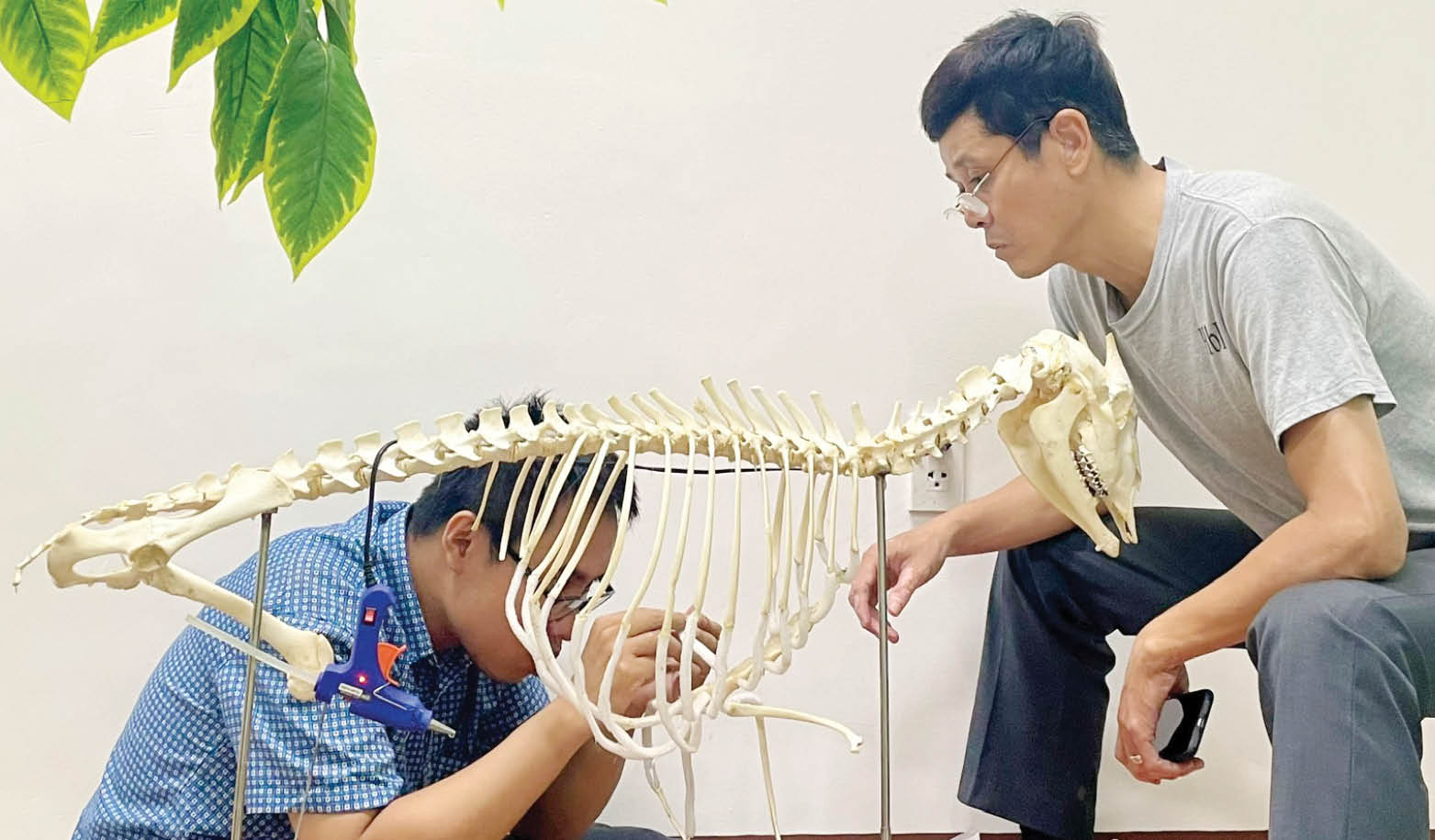
Nature is revived.
Behind the neatly arranged specimens of sun bears, pangolins, and king cobras on display stands lies a story of meticulous "resurrection." Nguyen Ngoc Hoa, Deputy Head of the Research and Collection Department, who was directly involved in the process, recounts: "When we received them, most were just raw animal carcasses, sometimes already partially decomposed. To transform them into specimens, our staff had to separate each layer of skin, clean the soft tissue, treat them with chemicals to prevent mold, and only then could we begin the sculpting process." For many large specimens, such as bears or pythons, just the process of removing fat and preventing oil from seeping to the surface took months.
In 2024, the museum completed the creation of many rare specimens, including the gray-footed langur – an endangered endemic primate species, five king cobras, one sun bear (including skin and bones), and one Javan pangolin for traveling exhibitions. A special feature is that many specimens are not just stuffed skins, but also complete skeletons for both scientific research and display.
Mr. Le Nguyen Thoi Trung, Deputy Director in charge of the Museum, emphasized: "A specimen is only considered successful when it accurately preserves the anatomical characteristics while creating a sense of familiarity for the viewer. The public must see it as an animal that once lived, not an artificial model." Therefore, the crafting process requires a blend of biological knowledge, conservation techniques, and the aesthetic sense of the experts.
This work is also inseparable from the support of research institutes. MSc. Ha Thanh Tung (expert at the Museum of Biology, Institute of Life Sciences, Lam Dong province) said: “The humidity in Central Vietnam is very high. If not processed properly, the bones will become moldy and yellow, the skin will rot, and the hair will fall out. Therefore, from the initial processing stage, careful handling and adherence to the correct procedures are necessary to ensure that the bone and skin specimens can last a long time under the weather conditions here, instead of deteriorating after only a few years.”
Not only officials and experts, but also contributions from the community and relevant agencies have contributed to the richness of the exhibits at the Museum. Specimens of pangolins or king cobras often come from confiscated items in wildlife trafficking cases. Some specimens are donated or transferred from research institutes and agencies inside and outside the city. Each exhibit therefore carries a story about its journey from an individual that died in the wild to being "brought back to life" in the Museum.
Preservation - keeping specimens alive
With over 5,000 specimens and samples currently in storage, museum staff must maintain a rigorous monitoring process year-round. They check the alcohol and formalin levels in the vials, change the solution when cloudy, clean off dust and dirt, dry the plants, protect against pests, replace the desiccant beads for the insect specimens, spray chemicals to prevent hair-eating insects on skin specimens, and monitor the freezer temperature for bones and tissues.
Each year, the museum conducts numerous regular inspections with a series of specific measures: processing fish and coral specimens; re-drying wood specimens; controlling weathering of geological and paleontological specimens; and reinforcing specimens with detached glue. The entire process is supported by air conditioning, dehumidifiers, drying cabinets, and freezers—equipment that must operate almost continuously to withstand the harsh climate of Central Vietnam.
Mr. Nguyen Ngoc Hoa stated that preserving specimens is like caring for a living organism, requiring patience and constant observation. This meticulous attention to detail ensures that each specimen not only survives but also retains its original form, serving the public for many years to come.
Mr. Le Huu Hai (Thuy Xuan ward, Hue city) shared after his visit: “Seeing the specimens of the sun bear and pangolin in almost perfect condition, I finally understood the effort behind their preservation. They are not just exhibits, but also a message about respecting nature.”
In the context of digital transformation, the Central Coastal Nature Museum has implemented a specimen data management system, assigning unique identification codes to each specimen and regularly updating its preservation status.
Mr. Thoi Trung stated: “The rare specimens at the Museum allow the public to clearly see the meticulousness and attention to detail in each stage of processing, crafting, and restoration. They are not only ‘living proof’ of the biodiversity value of nature but also hold intellectual value in anatomy and taxonomy. Furthermore, digitizing the specimens provides viewers with additional data and scientific information vividly recreated, increasing curiosity and exploration, especially for younger generations who enjoy hands-on learning experiences.”
Article and photos: Dinh Van
Source: https://huengaynay.vn/van-hoa-nghe-thuat/hanh-trinh-hoi-sinh-mau-vat-tu-phong-che-tac-den-khong-gian-trung-bay-160798.html








![[E - Magazine] Journey of value creation - Connecting far and wide](https://vphoto.vietnam.vn/thumb/402x226/vietnam/resource/IMAGE/2025/11/25/1764042907045_e-magazine-hanh-w1200t0-di2547d199d2104747t12787l1-ts-30-nam-026.webp)



























![[OFFICIAL] MISA GROUP ANNOUNCES ITS PIONEERING BRAND POSITIONING IN BUILDING AGENTIC AI FOR BUSINESSES, HOUSEHOLDS, AND THE GOVERNMENT](https://vphoto.vietnam.vn/thumb/402x226/vietnam/resource/IMAGE/2025/12/11/1765444754256_agentic-ai_postfb-scaled.png)










































Comment (0)