

- Aspiration for a green economy
- Developing a green economy: A sustainable path forward for the people of Ca Mau.
- Towards a green economy
Advantages in brand reputation and quality.
Ca Mau is the largest key aquaculture region in the country in terms of area, production, and export value; its brands such as "Ca Mau shrimp," "ecological shrimp," and "mangrove shrimp" are internationally recognized, creating a distinct advantage in terms of reputation and quality.
With a total aquaculture area of over 450,000 hectares in the province (of which shrimp farming accounts for approximately 415,000 hectares), the province has not only focused on increasing shrimp production but also implemented many solutions to improve product quality and value while protecting the environment.
According to Mr. Truong Minh Ut, Deputy Head of the Fisheries Sub-Department, specifically for the shrimp industry, the province has developed and expanded many farming methods such as: shrimp-mangrove, shrimp-rice, multi-species combinations; and intensive and super-intensive farming. Annual aquaculture production exceeds 800,000 tons, with farmed shrimp production alone reaching over 500,000 tons.
Currently, the province has 109 factories, enterprises, and workshops, including 89 seafood processing plants for export... with the capacity for deep processing and investment in raw material areas, building a closed-loop supply chain from breeding - farming - processing - consumption. This important foundation helps the province gradually build a modern shrimp industry capable of international competitiveness and, in particular, brings in seafood export value exceeding 2 billion USD/year, accounting for a large proportion of the country's total seafood export turnover.

Shrimp and shrimp products from Ca Mau have attracted the attention of customers both domestically and internationally.
Not only does Ca Mau shrimp lead in production scale, but it also possesses a significant competitive advantage thanks to its abundant and stable raw material sources and the establishment of numerous internationally certified shrimp brands such as Naturland, EU Organic, Canada Organic, Selva Shrimp, Mangrove Shrimp, Bio Suisse, Seafood Watch, BAP, and ASC. This creates a distinct advantage in terms of reputation and quality. Furthermore, its high-tech processing enterprises, meeting international standards, are capable of meeting the increasingly stringent demands of markets such as the EU, the US, and Japan.
Strengthening value chain linkages
To enhance value and efficiency in production as well as protect the environment, the province is promoting value chain linkages. Currently, the cooperation model between processing enterprises, cooperatives, and farmers contributes to ensuring input materials and traceability.
“To date, the unit has issued registration numbers to 32,116 aquaculture establishments covering an area of over 80,606 hectares. We have supported localities in achieving 100% certification for aquaculture enterprises and cooperatives, and this is a key target group included in criterion number 13 on new rural development and advanced new rural development,” Mr. Ut added.

The Ba Dinh Agricultural , Fisheries and Service Cooperative, located in Cau Do hamlet, Vinh Loc commune, currently has many distinctive products with stable outlets.
With 278 members, the Ba Dinh Agricultural, Fisheries and Services Cooperative in Cau Do hamlet, Vinh Loc commune, currently cultivates approximately 706 hectares. To improve the efficiency of its members' production, the cooperative has developed 16 services to serve its members and the local community.
Mr. Nong Van Thach, Chairman of the Board of Directors of Ba Dinh Cooperative, shared that thanks to the application of safe and clean production processes following organic farming methods, rice produced in the cooperative's production area has now achieved OCOP 3-star certification. In addition, the cooperative has established links with three companies supplying input materials and marketing output, thereby not only solving the problem of agricultural product sales but also increasing profits for members by 15-20%.
To date, the province has 37,816 hectares of shrimp farms that have received international certification, with nearly 8,000 participating households, contributing to affirming the position of the "Ca Mau Shrimp" brand globally. Furthermore, the province is continuing to promote the development of the shrimp industry towards improved efficiency and sustainable development, applying high technology and expanding the integrated chain of farming, processing, and export.
Besides aquaculture, with a production area of over 1,588 hectares, the salt industry is gradually asserting its position with the production model using tarpaulins. Accordingly, in the 2024-2025 season, more than 12,454 tons will be produced using the tarpaulin method, while the remaining 45,000 tons will be produced using traditional methods. Notably, the salt product has a geographical indication brand, Bac Lieu edible salt, with two products achieving OCOP 5-star rating and is being developed into a high-quality product, showcasing the beauty and cultural essence of the Ca Mau region.

Salt is being developed into high-quality food products.
Diverse models
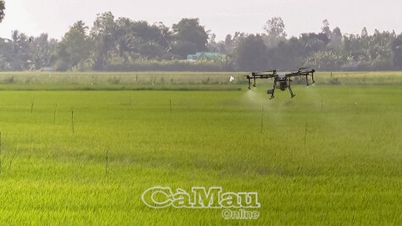
Currently, two important production zones have been established in the province: a high-tech, intensive farming zone applying IoT (intelligent technology in production) and water recirculation technology; and an improved extensive farming zone with specific ecological models such as shrimp-rice and shrimp-mangrove, covering hundreds of thousands of hectares. This combination provides dual economic value while protecting the environment and adapting to climate change. This harmonious combination creates a diverse, modern, sustainable aquaculture development picture that aligns with international market trends.
Furthermore, the province's shrimp-rice farming model, covering over 90,000 hectares, not only contributes to reducing chemical use, improving soil and water quality, and reducing greenhouse gas emissions, but also helps increase farmers' profits by 15-30%. The shrimp-mangrove farming model, covering nearly 30,000 hectares, produces internationally certified "ecological shrimp" that is favored in high-end markets. Similarly, closed-loop recirculating aquaculture models using biological filtration, microorganisms, and tilapia to treat wastewater are effectively applied in farming areas, reducing pollution and stabilizing productivity...
All these models are being continuously implemented by the province with the aim of developing a circular economy and reducing emissions in line with a green and circular economy to adapt to climate change and achieve sustainable development.
Nguyen Phu
Source: https://baocamau.vn/kinh-te-xanh-nang-gia-tri-nong-san-a124567.html

![[Photo] Closing Ceremony of the 10th Session of the 15th National Assembly](/_next/image?url=https%3A%2F%2Fvphoto.vietnam.vn%2Fthumb%2F1200x675%2Fvietnam%2Fresource%2FIMAGE%2F2025%2F12%2F11%2F1765448959967_image-1437-jpg.webp&w=3840&q=75)


![[Photo] Prime Minister Pham Minh Chinh holds a phone call with the CEO of Russia's Rosatom Corporation.](/_next/image?url=https%3A%2F%2Fvphoto.vietnam.vn%2Fthumb%2F1200x675%2Fvietnam%2Fresource%2FIMAGE%2F2025%2F12%2F11%2F1765464552365_dsc-5295-jpg.webp&w=3840&q=75)



























































Comment (0)