

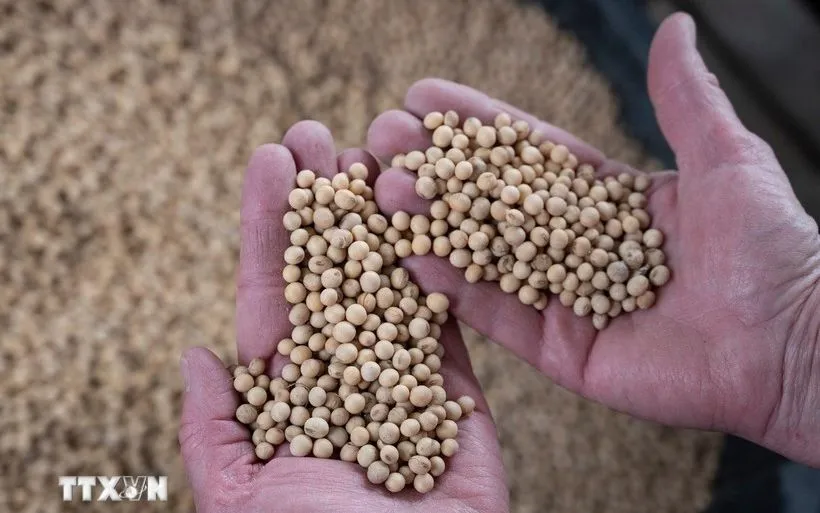
Farmers harvest soybeans at a farm in Scribber, Nebraska, USA. (Photo: AFP/VNA)
Conversely, imports from South America surged compared to the same period last year, as Chinese buyers actively avoided US agricultural products due to trade tensions between the world's two largest economies .
According to data released by China's General Administration of Customs on October 20, soybean imports from the United States last month fell to zero, compared to 1.7 million tons in the same period last year. This decline is attributed to two main factors. First, the high tariffs that China is imposing on imports from the US. Second, the supply of soybeans from the previous US harvest (also known as old-crop soybeans) has essentially been sold out. China is the world's largest soybean importer.
Meanwhile, customs data shows that soybean imports from Brazil last month surged 29.9% year-on-year to 10.96 million tons, accounting for 85.2% of China's total soybean imports. Soybean imports from Argentina also increased by 91.5% to 1.17 million tons, representing 9% of total imports. China's total soybean imports in September 2025 reached 12.87 million tons, the second highest level ever recorded.
Between January and September this year, China imported 63.7 million tons of soybeans from Brazil, up 2.4% year-on-year, and 2.9 million tons from Argentina, up 31.8% year-on-year. The data also shows that, although Chinese buyers are pausing purchases of soybeans from the new US harvest, thanks to deals made in early 2025, total US soybean imports year-to-date still reached 16.8 million tons, a 15.5% increase.
To date, China has not purchased any soybean shipments from the US harvest. Opportunities for US agricultural products are closing, as Chinese importers have finalized orders through the end of November, primarily from two major suppliers: Brazil and Argentina. Notably, Argentina's temporary preferential tariff policy has also contributed to this trend.
Without a breakthrough in trade negotiations, American farmers could face billions of dollars in losses as Chinese oil mills continue to source from South America. However, China could also face supply shortages early next year, before Brazil's new crop comes to market.
Johnny Xiang, founder of Beijing-based consulting firm AgRadar, predicts a soybean supply gap could emerge in China between February and April next year if no trade agreement is reached. He noted that Brazil has already exported a huge volume, and no one knows how much of the previous crop's inventory remains.
Trade negotiations between China and the US appear to be showing signs of improvement after weeks of repeated threats of new tariffs and export controls. US President Donald Trump recently stated that he believes an agreement on soybeans will be reached.
Source: https://vtv.vn/lan-dau-tien-trong-7-nam-trung-quoc-khong-nhap-khau-dau-tuong-tu-my-100251020135015974.htm












































































Comment (0)