

On September 15, 2025, the Prime Minister issued Decision No. 33/2025/QD-TTg on the Dedicated Data Transmission Network serving Party and State agencies, which provides detailed guidance on the organization, management, and operation of a centralized network connecting the central government to the grassroots level. This is considered a strategic step in the process of building a unified national digital infrastructure, ensuring safety, security, and efficiency in the exchange and sharing of information throughout the entire political system.

New regulations on the operation of the dedicated data transmission network serving Party and State agencies.
Unified connectivity infrastructure – the "backbone" of digital government .
According to the Decision, the Dedicated Data Transmission Network is a national-scale information system connecting the central government to the commune level, serving Party and State agencies, the Vietnam Fatherland Front , and socio-political organizations. The network allows for interconnected data sharing and exploitation, contributing to the promotion of digital transformation in the State's management and administration.
The system consists of two main components: the national backbone network and the access network.
i) The backbone network serves as the backbone, connecting data centers and information systems of agencies, organizations, and localities nationwide.
The backbone network has three regional centers located in Hanoi, Da Nang, and Ho Chi Minh City, along with backup centers to ensure continuous and safe operation in all situations.
ii) The access network is divided into two levels: Level I (connecting the central government to the province) and Level II (connecting the province to the commune), helping to expand the connectivity to the grassroots level, ensuring that all levels of government can participate in, utilize, and operate digital services in a synchronized manner.
In addition, the system has a Network Operations Center located in Hanoi along with three operational centers in the three regions of Vietnam, helping to monitor, coordinate, and maintain all network operations nationwide through a modern centralized management platform.
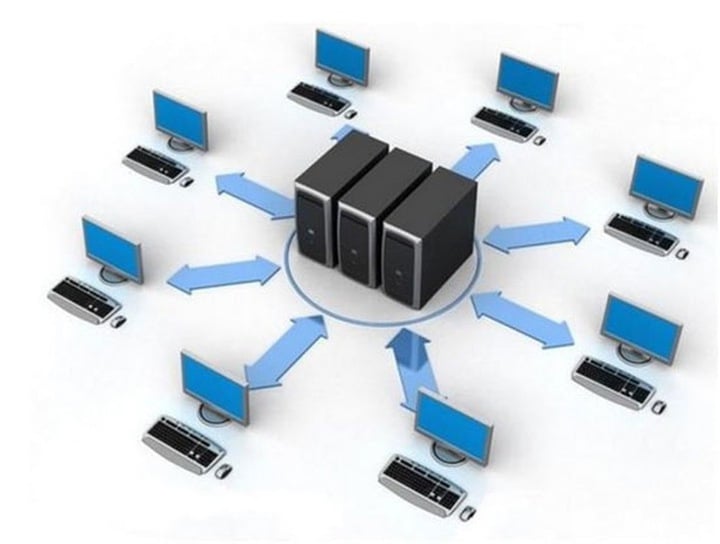
Illustrative image.
Shared infrastructure – Reduce waste, increase efficiency
Notably, the dedicated data transmission network not only serves Party and State agencies, but also creates a shared infrastructure foundation for deploying virtual private networks (VPNs) for each agency and organization within the political system.
This helps to create a unified "intranet ecosystem" that meets the requirements for transmitting sensitive, highly secure data, while optimizing investment and operating costs.
The network will connect and serve many critical systems such as the Party's Wide Area Network, the Government's CPNet, the National Assembly network, the Vietnam Fatherland Front, the People's Courts, the People's Procuracy, ministries, branches, and localities. This will create a unified infrastructure foundation, enabling the sharing of data, deployment of online public services, online meetings, electronic documents, and digital governance quickly, securely, and reliably.
In the context of an increasingly complex cyberspace environment, Decision 33/2025/QD-TTg particularly emphasizes the requirement to ensure information security and cybersecurity at the highest level. Each regional center has a backup center and a data recovery mechanism after an incident, along with a system of security equipment, network monitoring, and modern encryption technology.
Network operation and monitoring are carried out through centralized management platforms, enabling early detection and timely handling of risks, ensuring stable and smooth network operation—a key element in the operation of digital government and online public administrative services.
Upgrading and expanding the dedicated data transmission network is seen as an "infrastructure lever" for comprehensive digital transformation in the political system, contributing to the building of a digital government, a digital parliament, a digital party, and a digital society.
Once completed, the network will ensure a synchronized transmission infrastructure for national data integration and sharing platforms, facilitating data interoperability between central and local agencies, and improving the efficiency of leadership, management, and services for citizens and businesses.
More than just technical infrastructure, the Dedicated Data Network is also a symbol of connectivity, synchronization, and unity within the political system, reflecting the Government's vision of creating a modern, safe, transparent, and efficient digital working environment.
Decision 33/2025/QD-TTg takes effect from September 15, 2025. The synchronized and effective deployment of the dedicated data transmission network is expected to create a solid foundation for the national digital transformation process, contributing to building a more service-oriented, honest, modern, and people-friendly administration.
Source: https://mst.gov.vn/nang-cap-mang-truyen-so-lieu-chuyen-dung-tao-nen-tang-ket-noi-thong-nhat-cho-chinh-phu-so-197251023105218675.htm




























































































Comment (0)