

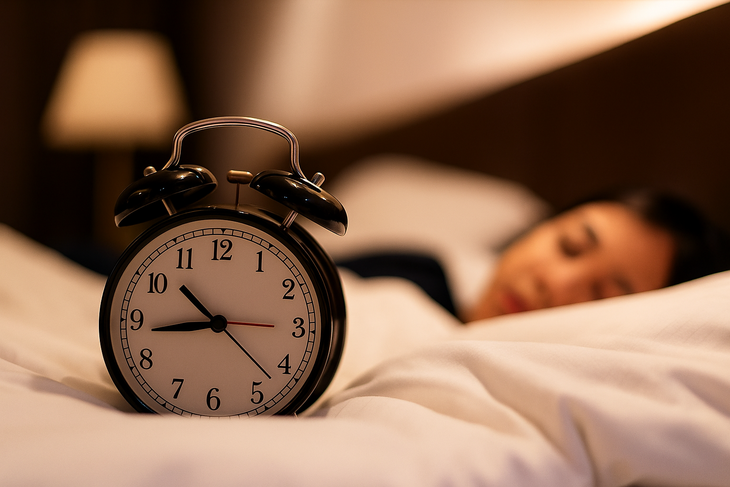
People in many European countries begin to get an extra hour of sleep when their places switch to winter time.
Winter time has been adopted in many parts of Europe since 1976 to save energy. However, this change has had significant impacts on people's health and daily lives, similar to a mild "jet lag."
The human body operates on a 24-hour circadian rhythm, regulating activities such as sleep and eating primarily based on natural light.
According to the French Institute for Medical Research (Inserm), the biological clock is located in the hypothalamus of the brain, consisting of nerve cells that oscillate in a day-night cycle and are controlled by about 15 "clock" genes. Thanks to this mechanism, the hormone melatonin, which helps maintain deep sleep, is secreted at the end of the day.
When there is a change in time zones, the circadian rhythm is temporarily disrupted, causing feelings of fatigue, sleep disturbances, and reduced concentration.
Changing the clocks can disrupt melatonin production, leading to difficulty falling asleep, waking up, or poor sleep quality. Studies have shown that after clock changes, both traffic accidents and workplace accidents tend to increase due to reduced alertness.
In fact, the human biological clock is about 10 minutes slow each day, so adjusting it forward by 1 hour requires a strong adaptation from the body, leading to lack of energy, fatigue, and reduced work performance.
Some people may also experience attention deficit disorder and memory loss in the first few days after changing time zones.
Sleep deprivation or circadian rhythm disruption can also negatively impact mood, leading to irritability, sadness, or mood swings. The adjustment period typically lasts from 1 to 7 days, and the degree of impact varies from person to person.
Vulnerable groups include young children, the elderly, teenagers, night shift workers, and those with sleep disorders. Scientists warn that the shift in hours could also increase the risk of depression and cardiovascular diseases such as heart attacks or strokes.
Although the European Union proposed abolishing time zone changes in 2018 and the European Parliament supported this in 2021, member states still maintain the practice of adjusting their clocks twice a year to conform to tradition and internal regulations.
Currently, switching to Winter Time allows people to get an extra hour of sleep, causing less disruption compared to Summer Time, which takes an hour to adjust.
Source: https://tuoitre.vn/nguoi-dan-nhieu-nuoc-chau-au-bat-dau-duoc-ngu-them-1-gio-20251026150828881.htm











































































Comment (0)