

In the 2024-2025 winter-spring crop, Thuy Ba Tay Cooperative, Vinh Thuy Commune, Vinh Linh District (now Vinh Thuy Commune, Quang Tri Province) was supported to implement 29 hectares of rice cultivation model to reduce emissions with alternate wetting and drying (AWD). Instead of keeping rice fields constantly flooded, AWD guides farmers to alternately let the fields dry - then flood again.
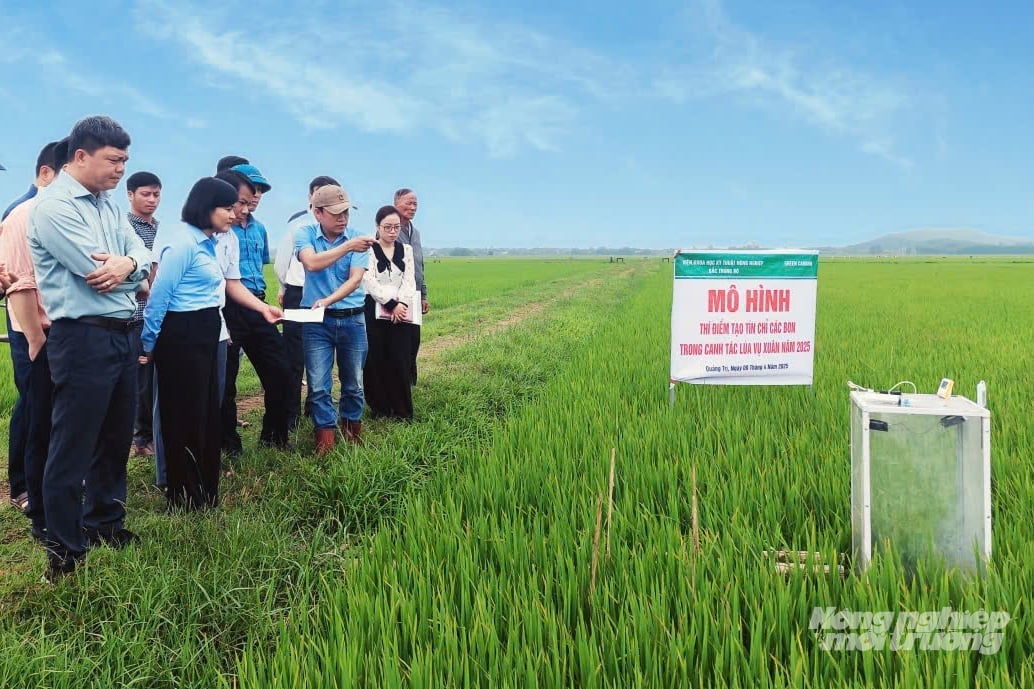
Quang Tri farmers have the opportunity to increase profits when participating in the carbon credit market thanks to rice cultivation to reduce emissions. Photo: Vo Dung.
The tool to measure the moisture and water needs of rice is the AWD water level measuring tube. When the water level in the tube drops to -15 cm from the ground, the rice field has reached the threshold for irrigation. At this time, farmers will pump water into the field, slightly flooding it 3-5 cm. This cycle is repeated throughout the crop, except during the flowering and green stage, when water must be kept stable.
 Deploying 1,500 hectares of high-tech rice associated with the carbon credit model
According to Mr. Nguyen Van Lam, Director of Thuy Ba Tay Cooperative, the AWD model helps farmers save 20-30% of irrigation water; rice is well-ventilated, roots are strong and productivity is still maintained stably. The AWD model helps farmers reduce investment costs, increase profits, is beneficial to the environment and opens up a direction for sustainable rice cultivation. In the summer-autumn crop of 2025, the AWD model will continue to be implemented in Vinh Thuy commune and will be enthusiastically received by farmers.
“Through two low-emission rice production seasons, it has shown that costs have decreased, efficiency has increased, and more importantly, it is moving towards sustainable, environmentally friendly agricultural production. If there is a mechanism to sell carbon credits in the future, farmers will be further motivated. The important thing to replicate this model is to change farmers' habits and synchronize irrigation infrastructure to proactively open and close water sources,” said Mr. Lam.
According to information from the Department of Agriculture and Environment (DARD) of Quang Tri province, the AWD model is the result of coordination between the DARD of Quang Tri province, the North Central Institute of Agricultural Science and Technology and Green Carbon Japan Company. In the 2024-2025 winter-spring crop, the area applying the AWD model in Quang Tri is 60 hectares in two communes of Vinh Thuy and Truong Ninh. In the 2025 summer-autumn crop, the area will increase to more than 2,000 hectares in the province's key rice growing areas such as Trieu Phong, Trieu Binh, Vinh Thuy, Truong Ninh, Ninh Chau, Quang Ninh.
Not only ensuring productivity, AWD technique helps rice plants grow better, produce strong tillers, hard stems, limit lodging and significantly reduce the number of waterings. On average, farmers only need to water 3.5 times per crop, 1.4 times less than continuous flooding, contributing to lower production costs, saving labor and water usage. Rice yield at the model implementation sites is equal to or higher than traditional rice cultivation.
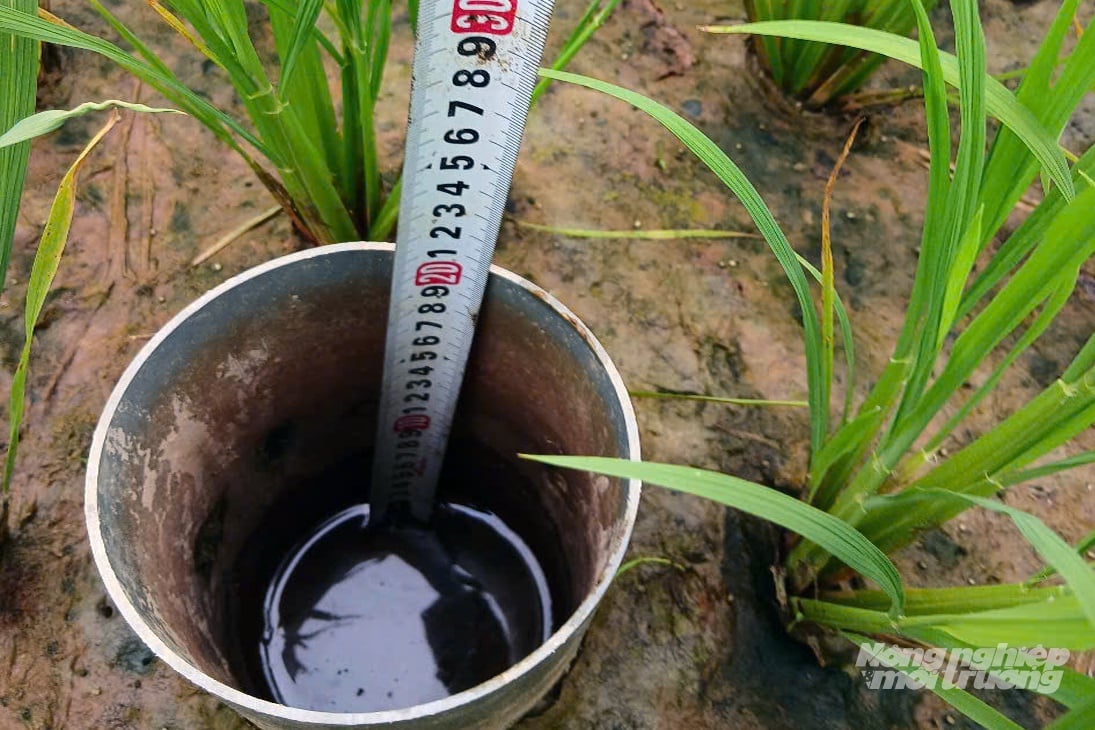
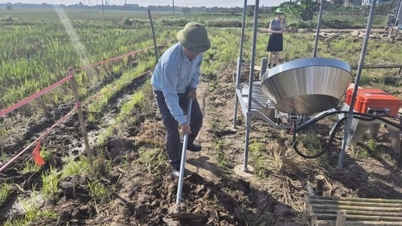
Irrigation water demand for rice fields is determined through the AWD water level measuring tube. Photo: Vo Dung.
A notable result of the program is the ability to reduce greenhouse gas emissions, especially methane (CH₄). On average, the AWD technique helps reduce CH₄ emissions by over 54%; each hectare applying the technique reduces an average of 7.08 tCO₂e/year compared to the current carbon flow (CF). With a total area of nearly 2,120 hectares in 2025, the program has contributed to reducing more than 8,277 tCO₂e, opening up the potential to build a rice model towards carbon credit collection in the future.
Ms. Nguyen Hong Phuong, Deputy Director of the Department of Agriculture and Environment of Quang Tri province, said that with more than 102,000 hectares of rice cultivated annually, Quang Tri has great potential to participate in the carbon credit market. The whole province currently has nearly 600 hectares of organic rice production, concentrated in the communes of Vinh Thuy, Ben Hai, Hieu Giang, Gio Linh, Trieu Binh, and Trieu Co. This is considered a favorable foundation for integrating the organic model with the emission reduction model, forming a low-carbon rice production area with high value. When these two directions are combined, the product not only meets food safety standards but is also a factor attracting the attention of the international market.
In the coming time, Quang Tri province will focus on synchronizing techniques and technology to turn rice into a “carbon asset”. The key solution is to promote the use of organic fertilizers and biological products, reduce chemicals in production; apply AWD techniques, agroforestry, and advise farmers not to burn straw and vegetation after harvest to reduce emissions.
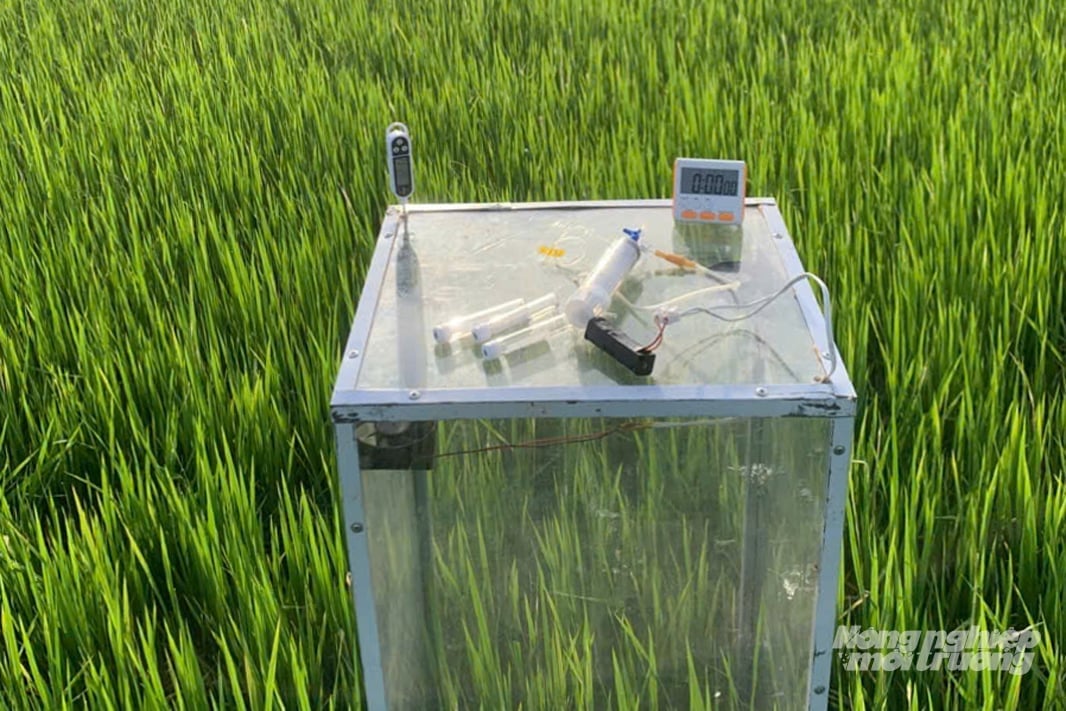
Greenhouse gas emission measuring device. Photo: Vo Dung.
In the immediate future, the agricultural sector of Quang Tri province will continue to strengthen the transfer and training of techniques to help farmers master environmentally friendly farming processes; perfect the online growing area management platform, connect data from sensors, drones and satellite images to ensure transparency. Farmers and cooperatives will have their capacity to access the carbon market improved to be proactively ready when the carbon trading floor officially comes into operation...
Strive for 100% of key crops to reduce emissions
Quang Tri aims to reduce carbon emissions by 15-20% by 2035 compared to 2020; the area implementing emission reduction will reach 35,000 hectares, of which the rice area will reach 30,000 hectares. By 2050, the locality will strive to build a database of the province's emission reduction cultivation areas, with 100% of the main crop area implementing emission reduction.
Source: https://nongnghiepmoitruong.vn/nguoi-trong-lua-quang-tri-huong-tuoi-thi-truong-tin-chi-cac-bon-d787773.html


![[Photo] Cat Ba - Green island paradise](/_next/image?url=https%3A%2F%2Fvphoto.vietnam.vn%2Fthumb%2F1200x675%2Fvietnam%2Fresource%2FIMAGE%2F2025%2F12%2F04%2F1764821844074_ndo_br_1-dcbthienduongxanh638-jpg.webp&w=3840&q=75)





![Varieties Revolution: [Part 2] Tissue-cultured bananas overcome challenges](https://vphoto.vietnam.vn/thumb/402x226/vietnam/resource/IMAGE/2025/12/04/1764821852127_3654-102650723_2939528996132898_3129898509587505636_n-1-nongnghiep-113643.jpeg)





![Tue Tinh gets rich from the fields: [Article 3] Chili plants take root to reduce poverty](https://vphoto.vietnam.vn/thumb/402x226/vietnam/resource/IMAGE/2025/12/02/1764640627872_img_5015-221526_666-085700.jpeg)













![[VIMC 40 days of lightning speed] Hai Phong Port determined to break through, reaching the target of 2 million TEUs by 2025](https://vphoto.vietnam.vn/thumb/402x226/vietnam/resource/IMAGE/2025/12/04/1764816441820_chp_4-12-25.jpeg)






























Comment (0)