

In the mountainous and disadvantaged areas of Quang Tri province, the digital transformation to build e-government still faces many significant obstacles.
Local authorities are striving to overcome difficulties and remove bottlenecks in digital transformation to promote the socio -economic development of their localities.
Identifying digitalization barriers in highland areas.
Level 2 electronic identification is a mandatory requirement for carrying out online public administrative procedures. However, in the mountainous border communes of Quang Tri province, achieving Level 2 identification for residents is facing considerable difficulties.
Although local authorities have made many efforts to resolve the difficulties, this is not a problem that can be solved overnight.
The border commune of Thuong Trach has approximately 3,600 inhabitants, 90% of whom are ethnic minorities. Eleven out of 20 villages in the commune lack access to the power grid, and many areas have no telecommunications infrastructure; the level of education is limited, and the economic lives of the people face many difficulties. These are truly significant obstacles to building an e-government system in the commune.

Mr. Ho Ngoc Thanh, Chairman of Thuong Trach commune, said that there are approximately 1,678 citizens in the locality aged 14 and above who are eligible to install level 2 identification. However, currently only 250 people have registered SIM cards and smartphones to install level 2 identification. This is one of the difficulties for the local government and people.
Dân Hóa commune has 2,054 households; however, only 39% have been identified at level 2, while more than 60% have not yet been identified at level 2.
Meanwhile, the majority of the population does not have smartphones and is not proficient in using technology. The furthest village is 29km from the commune center, along a rugged, mountainous road; making it difficult for officials to reach and assist the people.
Mr. Cao Xuan Thai, Deputy Director of the Public Administrative Service Center of Dan Hoa border commune, shared that in mountainous areas, it is not easy for people to access information technology to perform level 2 identification.
However, Level 2 identification is now mandatory for conducting online public administrative procedures. Overcoming these difficulties is very challenging and requires the coordinated efforts of the government and many specialized agencies.
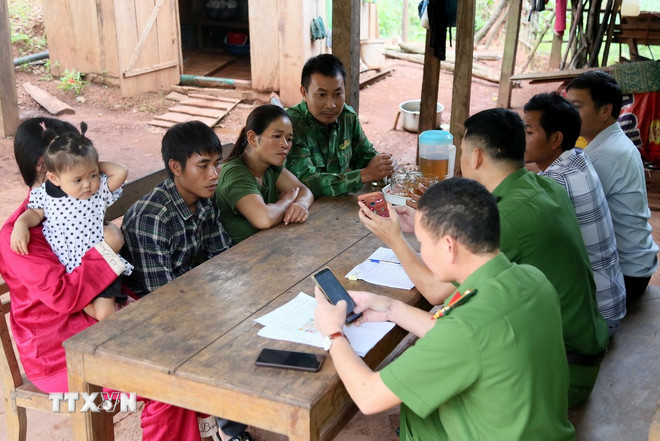
It is evident that level 2 electronic identification in the mountainous and border communes of Quang Tri province is facing numerous obstacles, ranging from infrastructure and economic conditions to the educational level of the local population.
However, this is an important task, both urgent and fundamental, for the mountainous localities of Quang Tri province to move towards building e-government and promoting comprehensive digital transformation.
Working together to solve the problem.
Authorities in mountainous and highland communes of Quang Tri province are focusing on removing obstacles to implement level 2 electronic identification.
In Thuong Trach commune, the local government mobilized social resources to provide approximately 1,000 free SIM cards to residents. Along with providing SIM cards, officials lent smartphones to residents so they could complete level 2 identification; local police forces went to remote villages to support the people in the area.
Ms. Nguyen Y Nuong, from Ca Roong 1 village, Thuong Trach commune, shared her gratitude to the local authorities and the staff of the Military Industry and Telecommunications Group for their support in donating SIM cards and lending her a device to set up the identification process. Once she completes the Level 2 identification, future administrative procedures will be much easier and less cumbersome than before.
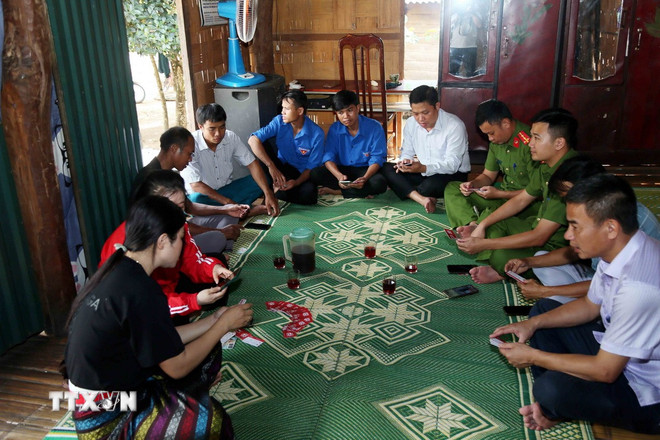
In Dan Hoa commune, the local government has established 28 digital technology teams in 28 villages to support residents in handling administrative procedures and electronic identification.
These teams consist of Youth Union officials, police officers, border guards, and some officials from local government departments and offices... their main task is to directly support people in villages and hamlets.
Mr. Cao Xuan Thai, Deputy Director of the Public Administrative Service Center of Dan Hoa commune, said that every week, the local digital technology teams travel through treacherous mountainous terrain to two villages to support ethnic minority people.
In each village, the team's officers will assist approximately 20-30 households, partially resolving the difficulties in digital transformation at the local level and saving people the trouble of traveling all the way to the commune's Public Administration Center.
In the mountainous and border communes of Quang Tri province, local officials and authorities are working hard every day to overcome difficulties in digital transformation and building e-government.
Amidst numerous challenges, grassroots officials have proactively learned from and shared experiences with each other, actively applying information technology to their daily work. In addition, telecommunications companies in the province have actively supported localities in overcoming difficulties in digital transformation.

Mr. Nguyen Van Phong, Director of VNPT Quang Ninh, Quang Tri province, said that in many mountainous localities, the staff of the Public Administrative Service Center were initially quite unfamiliar with handling online procedures.
In response to this situation, the unit dispatched a team of permanent staff to provide on-site support to local authorities. Following this support, officials and civil servants in the localities under its management are now able to handle their work smoothly.
According to Mr. Pham Trung Dong, Secretary of the Party Committee of Quang Ninh commune, Quang Tri province, to promote the digital transformation process in the locality, in addition to removing difficulties related to infrastructure and telecommunications networks, the human factor plays a crucial role.
Local authorities urgently need a team of officials proficient in applying science and technology, capable of operating digital systems effectively.
Local authorities have proposed to the province that short-term training courses be organized soon, creating conditions for commune officials and civil servants to participate in training, improve their skills and professional qualifications, thereby meeting the increasingly high demands of the current digital transformation.
Quang Tri province has identified the development of e-government as a crucial step in its socio-economic development in the coming period.
The province is implementing a digital literacy campaign starting with the smallest steps, such as supporting people in disadvantaged areas, raising awareness among citizens and businesses about applying digital technology to life, gradually upgrading infrastructure, improving the skills of officials, and removing bottlenecks in digital transformation.
Source: https://www.vietnamplus.vn/nhan-dien-rao-can-de-giup-nguoi-dan-vung-cao-tiep-can-chuyen-doi-so-post1069407.vnp

![[Photo] Prime Minister Pham Minh Chinh holds a phone call with the CEO of Russia's Rosatom Corporation.](/_next/image?url=https%3A%2F%2Fvphoto.vietnam.vn%2Fthumb%2F1200x675%2Fvietnam%2Fresource%2FIMAGE%2F2025%2F12%2F11%2F1765464552365_dsc-5295-jpg.webp&w=3840&q=75)

![[Photo] Closing Ceremony of the 10th Session of the 15th National Assembly](/_next/image?url=https%3A%2F%2Fvphoto.vietnam.vn%2Fthumb%2F1200x675%2Fvietnam%2Fresource%2FIMAGE%2F2025%2F12%2F11%2F1765448959967_image-1437-jpg.webp&w=3840&q=75)













































![[OFFICIAL] MISA GROUP ANNOUNCES ITS PIONEERING BRAND POSITIONING IN BUILDING AGENTIC AI FOR BUSINESSES, HOUSEHOLDS, AND THE GOVERNMENT](https://vphoto.vietnam.vn/thumb/402x226/vietnam/resource/IMAGE/2025/12/11/1765444754256_agentic-ai_postfb-scaled.png)













































Comment (0)