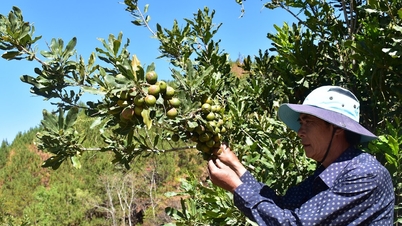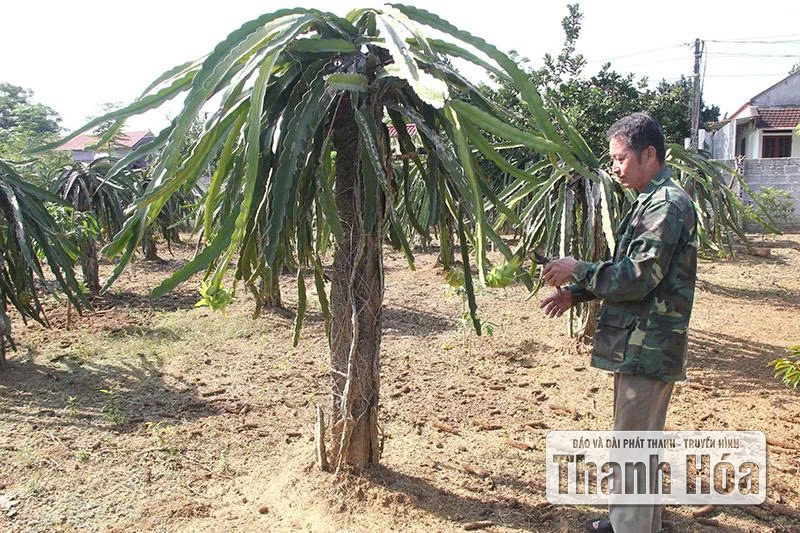
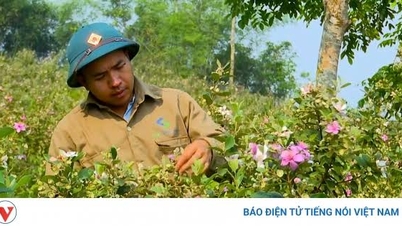
Mr. Ha Trung Dung takes care of dragon fruit plants in his garden.
In Tom village, Dien Lu commune, Ms. Nguyen Thi Lam's integrated farm has become a model of local economic development. Ten years ago, she leased a 30-year lease to reclaim a barren, forested hillside. With the industrious nature of someone from the lowlands who had moved to the area decades ago to build a livelihood, she and her family began clearing the land, developing livestock farming, and cultivating fruit trees and agricultural crops.
Maintaining production and using short-term gains to gradually reinvest, she has completed the infrastructure of her production area. Even at the age of 60, she remains active in seeking out new crops and suitable livestock to develop, aiming for maximum efficiency. In 2020, she converted her farm to cultivate 1 hectare of green pomelo, 1 hectare of seedless guava, and 10 acres of jackfruit. By 2023, the new crops were bearing fruit thanks to adherence to scientific production processes. Over the past two years, her family has harvested approximately 7 tons of pomelo worth 210 million VND, 10 tons of guava worth 200 million VND, and 3 tons of jackfruit worth 60 million VND annually. The yield of the crops has gradually increased each year as the trees continue to mature, and traders come directly to the farm to purchase the produce.

Continuing to introduce new crops, her family now has 4 sao (approximately 0.4 hectares) of custard apple trees and 1 hectare of Siamese coconut trees, both in their 4th and 5th years, beginning to bear fruit. On the gently sloping, lower land at the foot of the hill, she has converted it to sugarcane cultivation under a partnership with Lam Son Sugar Company, ensuring a sustainable product buyback after harvest. To date, a green production area totaling 4.3 hectares has been established, utilizing agricultural by-products and farmland for livestock farming. Waste and discarded parts of crops after harvest are collected and composted into organic fertilizer. Without hiring experts or formal training, her self-taught knowledge of new crop cultivation has brought her success. According to the owner of the hillside farm, the economic model generates over 1.5 billion VND in revenue annually; after deducting labor, fertilizer, and other investments, the profit is nearly 1 billion VND.
Returning for the second time, Mr. Ha Trung Dung's integrated economic model in Xuan Thang village, Thuong Xuan commune, has become increasingly well-invested and scientifically organized. Despite being a member of an ethnic minority group, his dynamism in economic development has transformed his small garden of less than 3,000 square meters into a model of integrated farming (VAC) in the local hilly area. On the flat land in front of his house, he developed a dragon fruit orchard with 120 trees, yielding multiple harvests annually with a total value of nearly 50 million VND. The gently sloping land further away is planned for planting pink-fleshed pomelos and jackfruit. Under the fruit trees, he cares for dozens of bee colonies daily, providing sweet honey and helping to pollinate the fruit trees for higher yields. On the lowest land bordering the forest, he dug a pond for fish farming, which also serves as a reservoir for year-round irrigation. The livestock farming brings in over 800 million VND annually for the family, thanks to a modern system of barns equipped with biogas tanks and waste treatment facilities. Along the paths and around the ponds, he also takes advantage of the space to plant peony bushes, bougainvillea, and other ornamental plants, both to create a beautiful landscape and to generate additional income at various times of the year.
Mr. Ha Trung Dung shared: “Previously, the garden only grew acacia and cassava like other families in the area. Realizing the low economic value, in 2013, after attending training and visiting various places with the former Thuong Xuan District Gardening and Farming Association, I decided to improve the land. Each time I introduced new crops, I had to test them to see if they were suitable for the soil and climate. Now, the profit from production in my garden reaches about 400 million VND per year, showing that it is entirely possible to get rich in mountainous areas if you know how to apply techniques to introduce new crops instead of just sticking to acacia and cassava...”
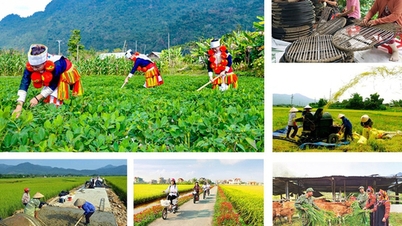
According to information from the Thanh Hoa Provincial Association of Gardening and Farming, after three years of organizing the "Beautiful Garden, Model Farm" competition, approximately 50 models of beautiful and efficient gardens and farms in the mountainous areas of the province have participated. Many models have applied new technical advancements in cultivation, yielding results comparable to those in the lowlands. More importantly, these highland economic models have created a ripple effect, encouraging the movement to renovate neglected gardens and forest hills to develop a more efficient economy.



Text and photos: Linh Truong
Source: https://baothanhhoa.vn/nhieu-dien-hinh-kinh-te-vung-cao-260056.htm
![[Photo] National Assembly Chairman Tran Thanh Man attends the Conference to announce the Master Plan for Hanoi Capital City with a 100-year vision.](https://vphoto.vietnam.vn/thumb/1200x675/vietnam/resource/IMAGE/2026/06/29/1782709639728_ndo_br_1-jpg.webp)
![[Image] A look back at the capital's preparations for the century-long master plan.](https://vphoto.vietnam.vn/thumb/1200x675/vietnam/resource/IMAGE/2026/06/29/1782750453122_quy-hoach-100-nam-minh-duy-1-2118-jpg.webp)
![[Photo] General Secretary and President To Lam works with the Party Committee of the Government on the work of preventing and combating storms, floods, extreme natural disasters and climate change.](https://vphoto.vietnam.vn/thumb/1200x675/vietnam/resource/IMAGE/2026/06/29/1782729441945_a1-bnd-0385-9454-jpg.webp)















































![[Image] Building an elevated road through the Ma Da forest.](https://vphoto.vietnam.vn/thumb/402x226/vietnam/resource/IMAGE/2026/06/29/1782724737750_anh-man-hinh-2026-06-29-luc-16-18-43.png)