

Paris has inspired major cities around the world by reducing car traffic in its central area (Ile de France) from 12.8% of vehicles in 2010 to just 6% in 2020.
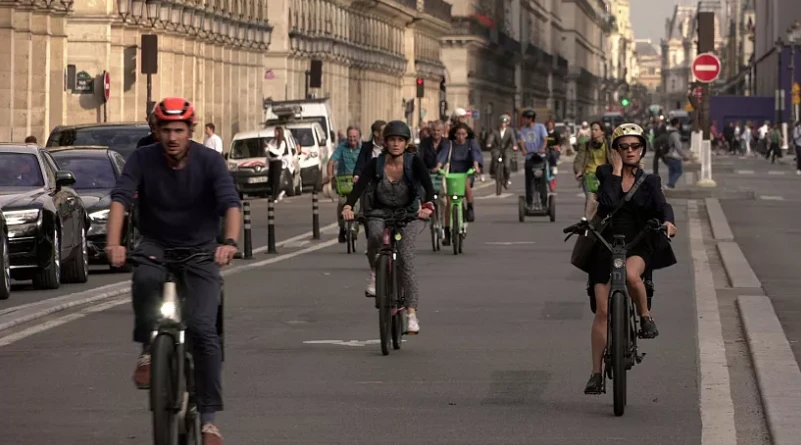
This city is densely populated and has one of the world's leading subway systems. But the most striking aspect of the transformation is the increase in cycling and walking during this period (rising from 55.4% in 2010 to 68% in 2020).
Numerous programs implemented by the three levels of government have prioritized reducing the number of vehicles and parking spaces to make room for bicycle lanes; taxing and restricting more polluting vehicles. Car advertising must include messages promoting more environmentally friendly modes of transport and offer incentives for bicycle repair and customization. The central area of Paris is built on the Ile de France island, limiting the available land for construction to approximately 60 km² with a population of around 10-11 million people. Since 2007, Paris has launched Vélib, one of the world's largest public bicycle sharing programs.
In 2008, France began taxing the purchase of used cars with high emissions, based on CO2 emissions, engine power, and the vehicle's first registration. In 2014, Anne Hidalgo was elected mayor of Paris, pledging to tackle the city's notorious air pollution problem. Paris now boasts over 1,300km of dedicated bike lanes, 500km of which were completed between 2014 and 2020. 30km of new lanes have been added both in and outside the city center to serve the 2024 Summer Olympics.
A spokesperson for Deputy Mayor Emmanuel Grégoire said that driving in Paris requires a great deal of patience. In contrast, cycling is quick and safe, as the increased lanes mean people don't get lost in a "sea of cars." According to a recent study by the urban planning agency, more Parisians now cycle through the city center than drive. During his 2020 re-election campaign, Mayor A. Hidalgo announced plans for a "15-minute city," where people could meet most, if not all, of their needs within a short walk or bike ride from home. The city eliminated 72% of on-street parking and made all streets bicycle-friendly.
The space created by removing on-street parking will be transformed into bike lanes, green spaces, vegetable plots, and playgrounds. All of this is built upon the Velo Plan, which promises that every street will have a bike lane, every bridge will have a bike lane, and every citizen will be able to walk or bike to get whatever they need. Paris's approach to the Olympics also emphasizes sustainability. For the first time, the tournament is being held primarily in the city center and 26 districts.
A spokesperson said: “It’s a way to create playgrounds for everyone and to show that in the age of climate change, we can continue to hold events in the city in a different way, since you can get to the competition venues on foot, by public transport and by bike.”
LAM DIEN
Source: https://www.sggp.org.vn/paris-tang-toc-chuyen-doi-giao-thong-ben-vung-post746480.html






















![[Photo] Prime Minister Pham Minh Chinh holds a phone call with the CEO of Russia's Rosatom Corporation.](/_next/image?url=https%3A%2F%2Fvphoto.vietnam.vn%2Fthumb%2F1200x675%2Fvietnam%2Fresource%2FIMAGE%2F2025%2F12%2F11%2F1765464552365_dsc-5295-jpg.webp&w=3840&q=75)














































Comment (0)