

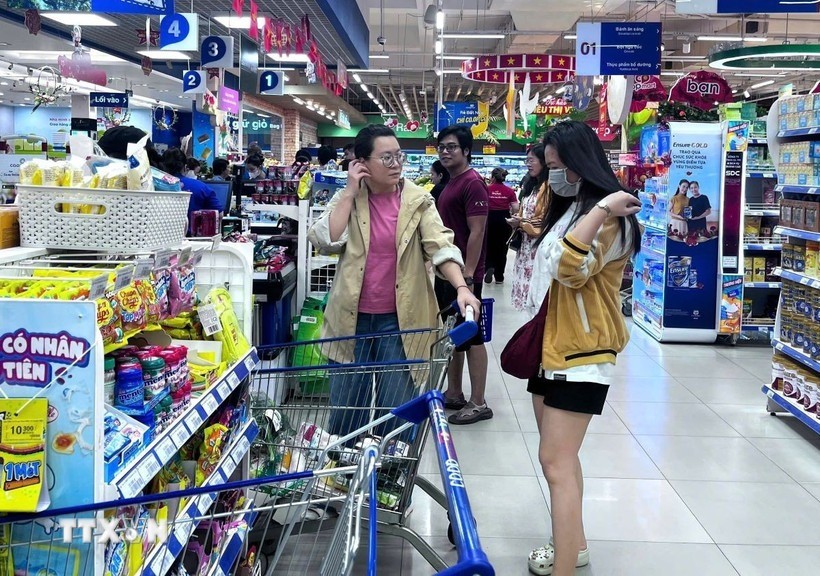
Deputy Prime Minister Bui Thanh Son signed Decision No. 2326/QD-TTg dated October 21, 2025, of the Prime Minister approving the Strategy for the Development of Vietnam's Retail Market until 2030, with a vision to 2050.
The Strategy aims to develop a civilized, modern, and sustainable retail market, aligned with the development of domestic trade; strictly adhering to international commitments to which Vietnam is a signatory; conforming to the development trends of e-commerce, the digital economy , the green economy, and the sharing economy; effectively connecting production with consumption; increasing domestic purchasing power while stimulating demand for Vietnamese products in the international market; contributing to enhancing the value and competitiveness of goods, and creating a foundation for retail businesses to participate more deeply in the global retail market.
The goal is to achieve an average annual increase of 11.0-11.5% in total retail sales of goods and consumer service revenue. The strategy aims for an average annual increase of 11.0-11.5% in total retail sales of goods and consumer service revenue (excluding price factors) by 2030.
E-commerce is developing rapidly with a complete legal framework, the application of modern technology and infrastructure, along with comprehensive support tools, ensuring safety and convenience for businesses and consumers during transactions. E-commerce sales are projected to increase by an average of 15-20% per year, accounting for 15-20% of total retail sales of goods and consumer services nationwide by 2030. The goal is to have approximately 40-45% of small and medium-sized enterprises (SMEs) participating in e-commerce platforms.
Policies on retail market development are being gradually improved; the business environment is being enhanced, aiming to form and develop a fair and transparent competitive market, attracting capable and reputable retailers to participate; encouraging Vietnamese businesses to innovate and develop according to modern retail models around the world ...
Diversify market participants and innovate business models.
The Strategy's orientation is to encourage businesses of all economic sectors to participate in the development of the retail market in appropriate forms and scales; and to form a core domestic distribution force through initial incentives in terms of mechanisms, financial policies, and land.
Forming large corporations/enterprises in the distribution sector, primarily domestic enterprises, including those with foreign investment, while identifying private enterprises as the core force creating important momentum and contributing to market development; encouraging and supporting small businesses, commercial cooperatives, household businesses, and individual businesses to participate in the retail market.
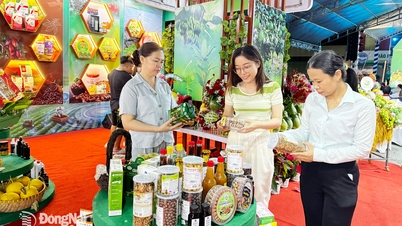
Diversify retail business models, especially those capable of linking with and promoting domestic production development, in line with Vietnam's integration process. Implement a shift in the retail distribution system towards modern distribution models such as supermarkets, shopping malls, convenience stores, and specialized stores, ensuring harmonious development between different models and suitability for each market segment in the face of increasing competition from foreign retailers.
Developing a combination of modern retail business models, multi-channel models, and e-commerce with traditional retail models; combining inventory retail with promotional campaigns to stimulate consumer demand; investing in the development of integrated commercial and service areas with traditional markets as the core, combined with commercial streets, that are both modern and preserve traditional business culture.
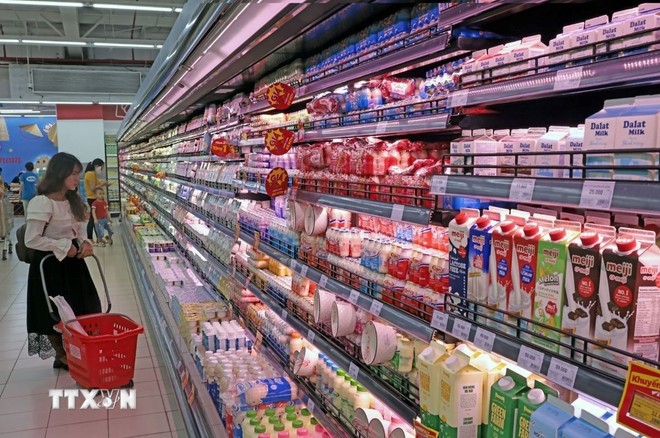
Developing modern retail formats, expanding and strengthening the management of retail chains, franchise models of Vietnamese and international brands, and large-scale centralized retail outlets invested in by domestic corporations and distribution businesses.
Developing sustainable production and distribution chains.
Forming linkages to connect production with goods distribution, focusing primarily on essential agricultural and food supply chains to ensure stable supply and demand, effectively managing the quality and safety of food circulating in the market; organizing and operating an efficient distribution system for essential goods in the market; building and forming sustainable production and distribution linkages, in which strengthening linkages within the supply chain is linked to the effective implementation of regulations on quality, food safety, and traceability; developing supply chains for environmentally friendly products with eco-labels...
Develop supply chains through franchising and voluntary partnerships among small supermarkets and specialty stores to enhance competitiveness.
For small businesses, commercial cooperatives, individual business households, and individual entrepreneurs, it is encouraged to form single-sector or multi-sector linkages, establish vertical linkages (links forming the supply chain of one or a group of products or goods) and horizontal linkages (between businesses in the same industry or field), and strengthen close links between manufacturers, distributors, and support service providers to create a quality supply for the retail market.
Promoting the development of e-commerce and electronic trading platforms.
The strategy focuses on strongly developing modern commercial business models such as e-commerce and digital-based electronic trading platforms; developing diverse retail methods, with particular emphasis on omnichannel retail, mobile retail, television retail, and social media applications based on the Internet environment... to meet the requirements and shopping trends of consumers in the future.
Complete the legal framework, establish clear pilot mechanisms, and create favorable conditions for businesses to research and operate e-commerce platforms based on advanced technology applications, ensuring equal treatment among different types of retail businesses in the context of the Fourth Industrial Revolution, in accordance with international laws and practices on e-commerce transactions. Promote the development of public services supporting e-commerce.
Develop a healthy, competitive, and sustainable e-commerce market. Expand the market for goods through e-commerce applications; encourage the application and support of digital transformation in businesses; and promote e-commerce transactions in border areas and across borders.
Source: https://baolaocai.vn/phat-trien-thi-truong-ban-le-viet-nam-phu-hop-voi-xu-the-phat-trien-post885079.html


![[Photo] Prime Minister Pham Minh Chinh holds a phone call with the CEO of Russia's Rosatom Corporation.](/_next/image?url=https%3A%2F%2Fvphoto.vietnam.vn%2Fthumb%2F1200x675%2Fvietnam%2Fresource%2FIMAGE%2F2025%2F12%2F11%2F1765464552365_dsc-5295-jpg.webp&w=3840&q=75)


![[Photo] Closing Ceremony of the 10th Session of the 15th National Assembly](/_next/image?url=https%3A%2F%2Fvphoto.vietnam.vn%2Fthumb%2F1200x675%2Fvietnam%2Fresource%2FIMAGE%2F2025%2F12%2F11%2F1765448959967_image-1437-jpg.webp&w=3840&q=75)




































![[OFFICIAL] MISA GROUP ANNOUNCES ITS PIONEERING BRAND POSITIONING IN BUILDING AGENTIC AI FOR BUSINESSES, HOUSEHOLDS, AND THE GOVERNMENT](https://vphoto.vietnam.vn/thumb/402x226/vietnam/resource/IMAGE/2025/12/11/1765444754256_agentic-ai_postfb-scaled.png)




































Comment (0)