

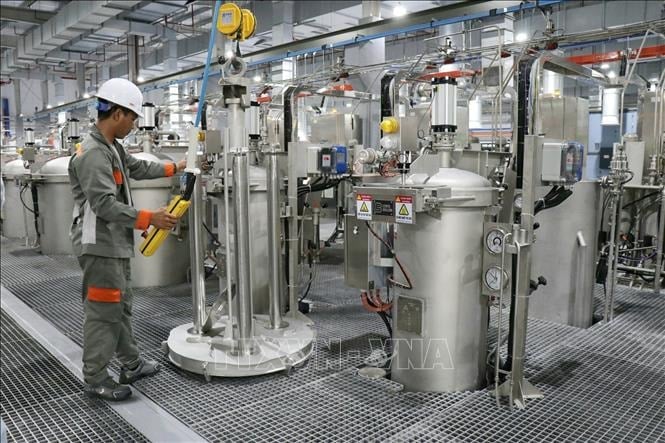
The Government has just issued Decree No. 239/2025/ND-CP amending and supplementing a number of articles of Decree No. 31/2021/ND-CP dated March 26, 2021 of the Government detailing and guiding the implementation of a number of articles of the Investment Law.
Identifying investment incentive areas based on a two-tiered local government model.
Article 21 of Decree No. 31/2021/ND-CP stipulates the principles for determining investment incentive areas in cases where a new administrative unit is established according to a Resolution of the Standing Committee of the National Assembly or the Government on adjusting administrative boundaries (division, separation, or upgrading of old administrative units currently located in investment incentive areas) due to the rearrangement or adjustment of boundaries of commune-level administrative units in areas with different socio -economic conditions. However, this regulation applies to district-level administrative units and is not truly consistent with the policy of rearranging administrative units and organizing local governments at two levels. Therefore, Decree 239/2025/ND-CP amended and supplemented the provisions in Article 21 of Decree 31/2021/ND-CP to stipulate the principles for determining investment incentive areas for commune-level administrative units established on the basis of rearranging administrative units and local government organizations at two levels.
According to the new regulations in Decree 239/2025/ND-CP, the determination of investment incentive areas for commune-level administrative units established on the basis of reorganizing administrative units and local government organizations at two levels is carried out as follows:
Commune-level administrative units under the district level are areas with particularly difficult socio-economic conditions before the implementation of administrative unit reorganization and the two-level local government organization, and are identified as areas with particularly difficult socio-economic conditions.
Commune-level administrative units under the district level are areas with difficult socio-economic conditions before the implementation of administrative unit reorganization and the two-level local government organization, and are identified as areas with difficult socio-economic conditions.
Newly established commune-level administrative units, formed from multiple commune-level administrative units located in areas with varying socio-economic conditions before the reorganization of administrative units and the two-tier local government structure, are determined as follows: The newly established commune-level administrative unit is determined to be an investment-incentive area based on the majority of the existing commune-level administrative units. If the number of commune-level administrative units in areas with particularly difficult socio-economic conditions and areas with difficult socio-economic conditions are equal, the newly established commune-level administrative unit is determined to be in an area with particularly difficult socio-economic conditions. If the number of commune-level administrative units in areas with difficult socio-economic conditions and areas not designated as investment-incentive areas are equal, the newly established commune-level administrative unit is determined to be in an area with difficult socio-economic conditions. If the number of commune-level administrative units in areas with particularly difficult socio-economic conditions and areas not designated as investment-incentive zones are equal, then the newly established administrative unit shall be determined to have particularly difficult socio-economic conditions.
Newly established commune-level administrative units, based on resolutions of the National Assembly Standing Committee, through the division, separation, or upgrading of old administrative units located in investment-incentive areas, or through the rearrangement or adjustment of boundaries of commune-level administrative units in areas with different socio-economic conditions, shall determine investment-incentive areas in accordance with the provisions of Clause 3 above.
Provincial People's Committees identify and announce investment incentive areas and areas with special investment incentives at the commune level and send the information to the Ministry of Finance for monitoring and compilation.
Remove the regulation that prohibits the extension of the operating period for investment projects when the machinery age exceeds 10 years.
Regarding the operating period of investment projects, according to point b, clause 10, Article 27 of Decree No. 31/2021/ND-CP, investment projects using outdated technology, posing a potential risk of environmental pollution, and being resource-intensive are not allowed to have their operating period adjusted or extended as stipulated in point a, clause 4, Article 44 of the Investment Law, which includes: "Projects using machinery and equipment for production with HS codes belonging to Chapters 84 and 85 of the Vietnamese Export and Import Goods List that are over 10 years old or whose operation does not meet the regulations of the National Technical Standard on safety, energy saving, and environmental protection. In cases where there is no national technical standard on safety, energy saving, and environmental protection related to the machinery and equipment of the project, the technical indicators shall be applied according to the national standard of Vietnam or the national standard of one of the G7 countries or South Korea." Regarding safety, energy efficiency, and environmental protection.
The Ministry of Science and Technology has issued guidelines for identifying machinery and equipment in certain fields that are more than 10 years old but do not belong to outdated technology, pose a risk of environmental pollution, or are resource-intensive.
Practical experience shows that each investment project involves a wide variety of machinery and equipment (in terms of quantity, type, and purpose of use) that may be changed, improved, or upgraded throughout the project's operation; not all machinery and equipment over 10 years old are outdated technology, posing a risk of environmental pollution or resource depletion. Furthermore, requiring the assessment of each piece of machinery and equipment under Chapters 84 and 85 within the entire project when the project is nearing its end would be very difficult for relevant agencies to implement and would be costly for businesses to have each piece of machinery and equipment inspected individually.
On the other hand, to date there are no guidelines defining machinery and equipment in certain sectors that are over 10 years old but do not belong to the category of outdated technology, posing a potential risk of environmental pollution or resource depletion; leading to a lack of basis for evaluating machinery and equipment during the process of extending the operating period of investment projects.
To address the above shortcomings, Decree 239/2025/ND-CP amends and supplements point b, clause 10, Article 27 of Decree 31/2021/ND-CP by removing the regulation on machinery and equipment older than 10 years and implementing management according to the National Technical Standard on safety, energy saving, environmental protection or the capacity and efficiency of machinery and equipment as follows: "Projects using machinery and equipment not arranged in a technological line for production with commodity codes (HS codes) belonging to Chapters 84 and 85 of the Vietnamese Export and Import Goods List, when operating, do not meet the regulations of the National Technical Standard on safety, energy saving, environmental protection or the capacity and efficiency of the machinery and equipment are below 85% compared to the design capacity and efficiency; or the consumption of raw materials, energy exceeds 15% compared to the design capacity and efficiency." design. In the absence of national technical standards on safety, energy efficiency, and environmental protection related to the project's machinery and equipment, the technical specifications shall be applied according to Vietnamese national standards or national standards of one of the G7 countries or South Korea regarding safety, energy efficiency, and environmental protection."
In addition, Decree 239/2025/ND-CP also amends and supplements Article 61 of Decree No. 31/2021/ND-CP on investment in construction and business of infrastructure in industrial parks, export processing zones, high-tech zones and economic zones as follows:
Investment activities in the construction and operation of infrastructure in industrial parks, export processing zones, and concentrated digital technology zones must conform to the construction planning of these zones approved by competent authorities.
For areas with difficult socio-economic conditions, based on the specific conditions of the locality, the Provincial People's Committee shall submit to the Prime Minister for decision the establishment or assignment to a revenue-generating public service unit to act as the investor for the construction and business of infrastructure projects in industrial parks, export processing zones, and concentrated digital technology zones.
Investors undertaking projects to build and operate infrastructure in industrial parks, export processing zones, high-tech zones, concentrated digital technology zones, and functional zones within economic zones are permitted to carry out the following activities: Constructing factories, offices, and warehouses for sale or lease; determining land lease prices, sublease prices for land with built technical infrastructure; infrastructure usage fees; rental and sale prices of factories, offices, warehouses, and other service fees as prescribed by law and registered with the Management Board of the industrial park, export processing zone, high-tech zone, concentrated digital technology zone, or economic zone regarding the price framework and infrastructure usage fees. Registration of the price framework and infrastructure usage fees is carried out periodically every six months or in case of adjustments to the registered price framework and infrastructure usage fees; collecting infrastructure usage fees. Transferring land use rights, leasing land, and subleasing land with built technical infrastructure in industrial parks, export processing zones, high-tech zones, concentrated digital technology zones, and functional zones within economic zones to other investors in accordance with the law on land and the law on real estate business; and other activities as prescribed by the Investment Law, this Decree, Government regulations on industrial parks, export processing zones, high-tech zones, concentrated digital technology zones, economic zones, and relevant laws.
Source: https://baohaiphong.vn/sua-doi-bo-sung-mot-so-quy-dinh-ve-dau-tu-520023.html





















































































Comment (0)