

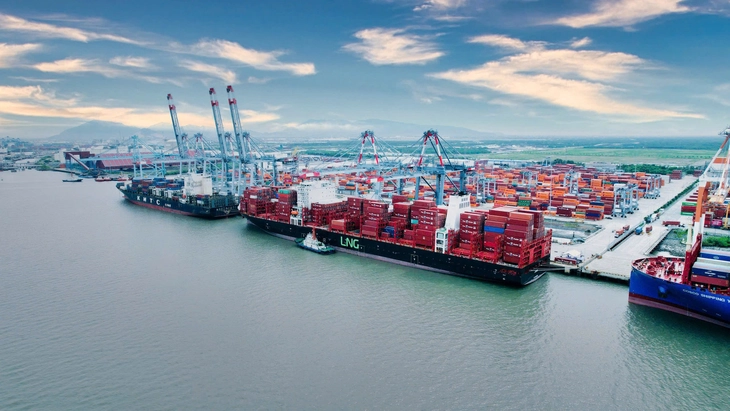
Cai Mep Port welcomes super-large tonnage ships - Photo: NGUYEN NAM
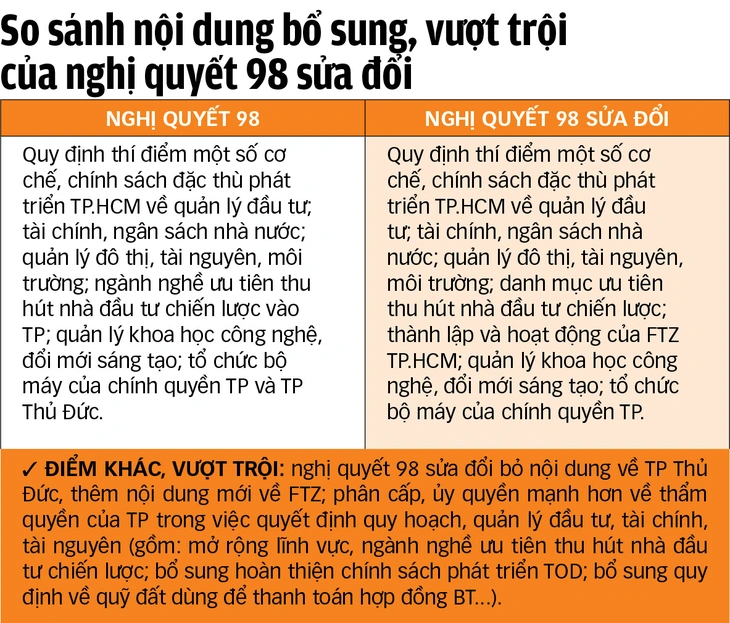
Ho Chi Minh City currently meets many conditions, of which the prerequisite is the regulation on free trade zones (Free Trade Zone - FTZ) recorded in the draft resolution of the National Assembly amending and supplementing a number of articles of Resolution No. 98/2023/QH15 on piloting a number of specific mechanisms and policies for the development of Ho Chi Minh City (Resolution 98 amended) being examined and approved by the National Assembly .
Speaking to Tuoi Tre, Mr. Le Van Danh, Deputy Director of the Department of Industry and Trade of Ho Chi Minh City, said: "This is the first time Ho Chi Minh City has built a mechanism and policy for the establishment and operation of FTZs as stipulated in the draft of the revised resolution 98. Basically, the content of FTZs in the draft of the revised resolution 98 meets the requirements for the formation and operation of FTZs."
Superior mechanism, flexible procedures
* How do you evaluate the superiority of the FTZ mechanism and policies that Ho Chi Minh City is asking the National Assembly to approve?

Mr. Le Van Danh
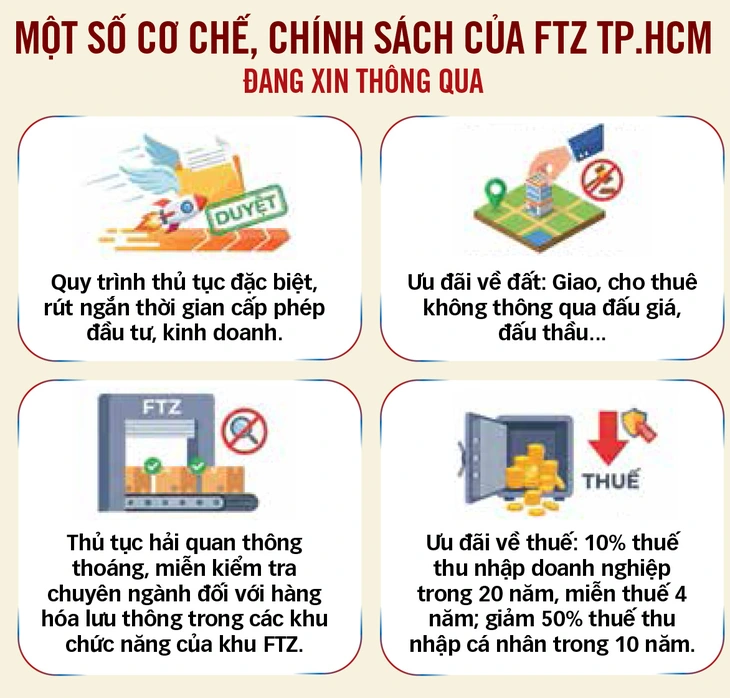
- Some outstanding policies such as administrative procedure reform to shorten the time for investment and business licensing. Projects in FTZ will be implemented according to special procedures. This helps investors quickly implement projects in FTZ as soon as possible.
Regarding customs procedures, control is also quite open, exempting specialized inspection for goods circulating in functional areas of FTZ. We also do not implement foreign trade management measures for goods in FTZ.
In addition, strong decentralization is given to the head of the customs agency in charge of the FTZ to license or exempt certain activities in the FTZ.
Along with that is the preferential tax policy. We will give tax incentives: 10% corporate income tax for 20 years, tax exemption for 4 years; 50% reduction of personal income tax for 10 years for experts, scientists, high-quality workers... This is a preferential level superior to current economic zones.
Another highlight is the preferential land policy for investment activities in FTZ. Infrastructure investors have the same rights and obligations as investors in building and operating industrial park infrastructure; land is allocated and leased without auction or bidding... for investment projects in FTZ (except commercial housing projects) to accelerate investment attraction and infrastructure development in the zone.
These are some of the outstanding policies that ensure the attractiveness of FTZ. Because the most important thing that investors care about in FTZ is the open and outstanding policies and administrative procedures that ensure the smooth and long-term operation of the investing enterprises, while tax incentives are an additional incentive support.
And FTZ is inherently a place where goods from all over the world from economic zones, duty-free zones, and other FTZs will be brought in and facilitated. That is the global trade flow, and procedures must be ensured to be smooth for the flow of goods to be fast.
Graphics: TAN DAT
* According to you, what are the advantages of the process of building and proposing to establish Cai Mep Ha FTZ for Ho Chi Minh City?
- Cai Mep Ha FTZ planning is associated with Cai Mep port area with favorable location and existing seaport ecosystem. This creates favorable conditions to attract a lot of attention from domestic and foreign investors and experts.
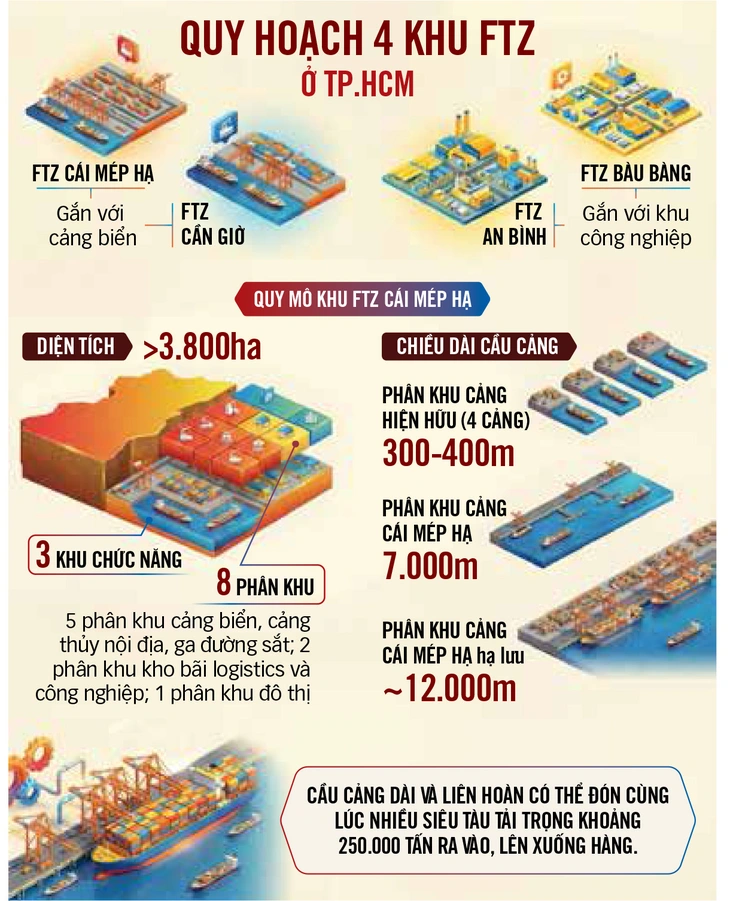
Up to now, Cai Mep Ha is among the best deep-water ports in the world and has a port system and infrastructure that is very convenient for many super-heavy ships with a capacity of up to 250,000 TEU to enter and exit at the same time.
The transport infrastructure connecting Cai Mep Ha area is also very convenient such as Cai Mep - Thi Vai inter-port road; Bien Hoa - Vung Tau and Ben Luc - Long Thanh expressways; belt roads 3 and 4; railway system from Trang Bom to Cai Mep and the upcoming Bau Bang - Cai Mep railway; inland waterway system collecting small goods in industrial parks and export processing zones to Cai Mep connecting with Long Thanh airport (Dong Nai).
During the process of building the project "Research on FTZ associated with seaports in Cai Mep Ha area", it also received a lot of attention and appreciation from many domestic and foreign investors, businesses and experts.
Many advantages of FTZ development
* With the superior policy mechanism stated in the revised Resolution 98, what do you think about the competitive advantage between Cai Mep Ha FTZ of Ho Chi Minh City and FTZs in the region and the world?
- Currently, Ho Chi Minh City plans four FTZs including Cai Mep Ha FTZ and Can Gio FTZ associated with seaports, and FTZs in Bau Bang and An Binh associated with industrial parks.
Of which, the Cai Mep Ha FTZ project has been completed and submitted to the Government and the National Assembly. Thus, up to this point, it can be said that Cai Mep Ha FTZ is in the most feasible progress for early implementation. The remaining three FTZs according to the plan will continue to be studied for implementation when suitable conditions are met.
Regarding competitive advantages compared to FTZs in the region and the world, as analyzed, the position, potential, infrastructure advantages... of Cai Mep Ha FTZ are highly appreciated by many investors and researchers.
Besides, Ho Chi Minh City is also a very large market with a corresponding economic scale, converging all the conditions of human resources and connectivity to create attractiveness for Cai Mep Ha FTZ. The competitive advantage is great, but Ho Chi Minh City cannot be subjective and must continue to research and propose more specific and outstanding policy mechanisms to attract investment in FTZ.
As many corporations, experts and scientists have commented, Ho Chi Minh City not only needs the revised and supplemented Resolution 98 but also needs more specific policies and stronger decentralization to make a breakthrough, increase attractiveness and efficiency.
* So what is the role of this FTZ in Ho Chi Minh City and what is the prospect of developing three more FTZs in Ho Chi Minh City in the near future, sir?
- Looking around, countries like Singapore, Malaysia, Indonesia, South Korea... have been ahead of us for many years in establishing and operating FTZs, achieving good results. Although we developed later, we have also learned the new generation FTZ model with complex characteristics from Dubai.
The Cai Mep Ha FTZ model of Ho Chi Minh City does not simply provide port services but also integrates industrial parks, logistics centers, commercial service areas (maritime services, insurance services...), and urban areas instead of previous countries where FTZs were mainly organized in association with seaports or industrial parks.
Currently, many corporations have shown interest in investing in Cai Mep Ha FTZ. For example, Dubai's DP World Group is a leading port corporation, with experience investing in more than 20 FTZs worldwide, and has signed a memorandum of understanding on investment (with the former Ba Ria - Vung Tau) with the desire to be a strategic investor in the near future when they want to invest in all eight functional zones. Or Vingroup Group also wants to invest in three zones, and Geleximco Group, Truong Hai Group...
* When the National Assembly approves and implements Cai Mep Ha FTZ, what do you expect regarding the completion of the legal framework and related legal policies in the future?
- According to the roadmap of the draft revised resolution 98, the implementation of specific policy mechanisms must be summarized after 5 years of implementation. As for the FTZ mechanism and policy, the period of 10 years will be summarized and evaluated because the implementation time of FTZ is longer.
After summarizing and evaluating, we will propose to add more favorable policy mechanisms through resolutions to amend or build separate laws for FTZ.
Currently, the Ministry of Finance is drafting a project to build a law on FTZs for the whole country. Good experiences from implementing FTZs in Ho Chi Minh City in particular will contribute to the development of this law.
Graphics: TAN DAT
Learning from successful FTZ models
Before merging with Ho Chi Minh City, Cai Mep Ha FTZ was researched and proposed for establishment by the People's Committee of the former Ba Ria - Vung Tau province.
According to Mr. Le Van Danh - Deputy Director of the Department of Industry and Trade of Ho Chi Minh City, before and during the process of building the project, the old Ba Ria - Vung Tau province organized study tours to learn about the experience of organizing FTZs in other countries.
Among them, the FTZ model in Busan and Incheon of Korea are also successful FTZ models. In addition, the FTZ model in Dubai is also studied by Ba Ria - Vung Tau province to prepare for the project to establish Cai Mep Ha FTZ.
"Initially, the FTZ in Dubai was attached to the airport. During the development process, they added and expanded the development of a new generation of complex FTZ models. In which, the FTZ focuses on integrating functions of logistics, trade, services, urban areas... We also have the opportunity to learn from successful models when we develop the FTZ later.
At the same time, Ba Ria - Vung Tau province previously invited professors and experts from leading Korean universities to organize classes to teach knowledge and skills on organizing, operating, and managing FTZs and to grant certificates to officials and civil servants who attended the courses...", Mr. Danh said.
Mr. NGUYEN TRUNG CHINH (Chairman of the Board of Directors of CMC Group Joint Stock Company):
Adding specific industries to FTZ
For Ho Chi Minh City FTZ, it is recommended to add specific industries such as artificial intelligence, information technology, digital infrastructure, cloud computing, telecommunications infrastructure and cyber security. In fact, countries with complete and comprehensive FTZs are shifting their focus from traditional industries and logistics to the new Free Innovation Zone model, combining trade and logistics functions with research, innovation and digital technology, R&D.
Typical examples include the "high-tech FTZ" model in Shanghai, Dubai Silicon Oasis (UAE) or Incheon Free Economic Zone (Korea). Adding digital technology industries to the Ho Chi Minh City FTZ will help position Ho Chi Minh City as the country's leading digital technology and commerce center, leading the national technology and innovation ecosystem, in line with the national orientation on digital economy and knowledge economy.
Dr. NGUYEN VAN HOI (Director of the Institute for Strategy and Policy Research on Industry and Trade, Ministry of Industry and Trade):
Create a complete economic ecosystem
Ho Chi Minh City needs to form an FTZ associated with the Can Gio international transit port project connecting the Cai Mep Ha area. The Can Gio - Cai Mep Ha port cluster will form a large inter-regional FTZ following a modern model (including industrial functional areas, logistics warehouses, trade services, urban areas...) to create a complete economic ecosystem.
As planned, Ho Chi Minh City FTZ including Cai Mep Ha FTZ (area of 3,800ha) has room to expand the FTZ connection in Can Gio to increase the total FTZ area, creating an economic cluster that competes with the leading logistics centers in the region (such as Singapore port, Klang port, Malaysia).
Many localities established FTZs
According to information from the drafting team to supplement and amend the resolution, this morning (December 3), the Ministry of Finance will submit to the National Assembly a draft resolution to amend and supplement a number of articles of Resolution 98 on piloting a number of special mechanisms and policies for the development of Ho Chi Minh City. The same afternoon, the group will discuss, on December 8, it will discuss in the hall, and on December 11, the amended and supplemented resolution will be passed.
This includes allowing Ho Chi Minh City to establish Cai Mep Ha FTZ to pilot outstanding, breakthrough mechanisms and policies to attract investment, finance, trade, high-quality services to promote exports, industry, research and development (R&D) activities, and attract high-quality human resources.
Previously, the National Assembly passed a resolution on specific policies for Hai Phong and Da Nang, allowing these two localities to establish FTZs. Basically, the FTZ model and specific policy mechanisms for FTZs in Hai Phong, Da Nang and Ho Chi Minh City are similar and consistent. Following that, Dong Nai province is also promoting the proposal to establish FTZs associated with Long Thanh airport.
Many countries "transformed" from the success of FTZ
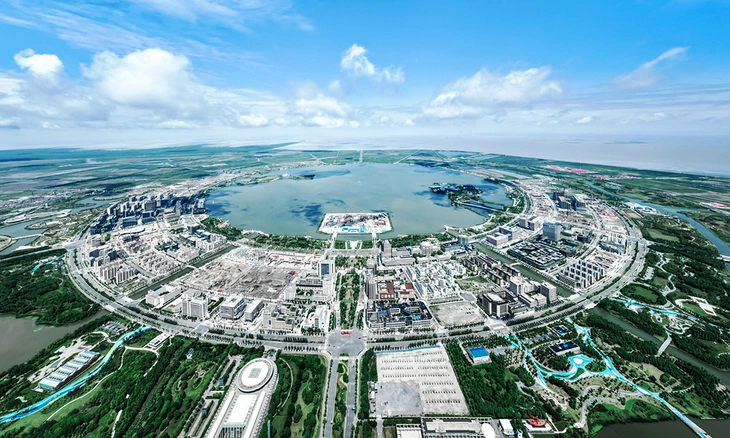
An area in the Shanghai FTZ, China - Photo: Global Times
The free trade zone (FTZ) model is no longer strange to many countries in the world. To date, there are more than 3,500 FTZs in 130 countries and territories in the world.
The contribution of the success of the FTZ model to the economies of localities, territories and countries around the world has been proven through the formation and development process of this model.
Typically, since its establishment in 1985, the Jebel Ali FTZ has been a turning point for the development of Dubai and has become a model for FTZs today. This FTZ is attached to the Jebel Ali port, the largest container port in the Middle East and one of the largest ports in the world, which has contributed to Dubai's development as a global trade and logistics center. Currently, this area supports more than 11,000 businesses from 157 countries, contributing to 36% of Dubai's GDP of 190 billion USD (in 2024), according to DP World.
Following the successful model of FTZ in Dubai, the United Arab Emirates (UAE) has developed the above model. To date, with more than 46 FTZs focusing on specific industries, they have contributed about 40% of the total export turnover of the UAE, playing a key role in the economic development of the UAE.
Realizing the potential of FTZ, many countries in the world also replicated this model and achieved corresponding success.
Typically, China started to pilot the establishment of the first FTZ in Shanghai in 2013. The experience at the Shanghai FTZ directly contributed to the Foreign Investment Law of China in 2019 for replication nationwide. Only 12 years later, the country had 22 FTZs (many of which were successful in Tianjin, Shenzhen, Hainan...), accounting for 1/5 of the total foreign trade turnover by 2024.
"FTZs provide strong institutional support for China's deeper integration into the global economic system," Liu Xiaohong, dean of the Shanghai University of Political Science and Law, told China Daily.
Singapore also relies on its port economy and FTZs to transform from a resource-poor island nation into a leading transit point in the world, helping the country to be among the countries with the highest GDP per capita in the world at about 80,000 USD. Or South Korea with its FTZ model in Busan and Incheon is also a successful model. Since 1999, this country has built a law on duty-free zones and has been perfected over time to develop FTZs.
Source: https://tuoitre.vn/sua-doi-bo-sung-nghi-quyet-98-mui-dot-pha-kinh-te-tu-khu-thuong-mai-tu-do-20251203084446088.htm

![[Photo] National Assembly Chairman Tran Thanh Man attends the VinFuture 2025 Award Ceremony](/_next/image?url=https%3A%2F%2Fvphoto.vietnam.vn%2Fthumb%2F1200x675%2Fvietnam%2Fresource%2FIMAGE%2F2025%2F12%2F05%2F1764951162416_2628509768338816493-6995-jpg.webp&w=3840&q=75)


![[Photo] 60th Anniversary of the Founding of the Vietnam Association of Photographic Artists](/_next/image?url=https%3A%2F%2Fvphoto.vietnam.vn%2Fthumb%2F1200x675%2Fvietnam%2Fresource%2FIMAGE%2F2025%2F12%2F05%2F1764935864512_a1-bnd-0841-9740-jpg.webp&w=3840&q=75)


































































Comment (0)