

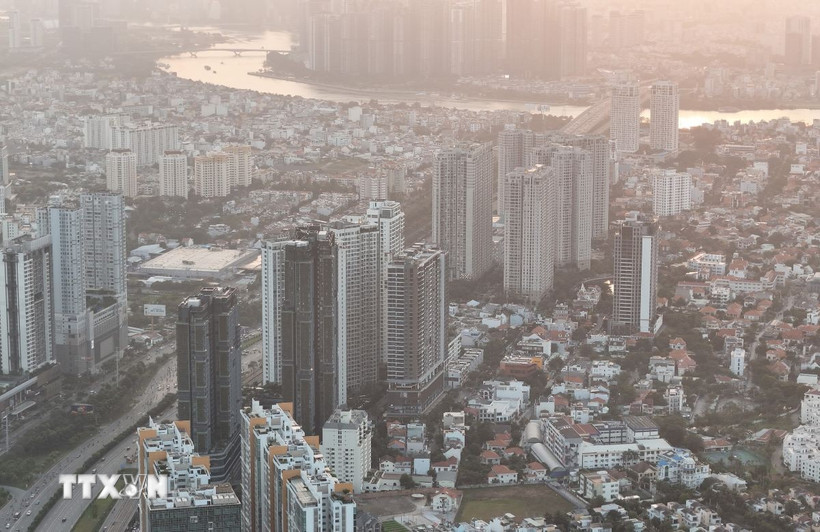
Along with Hanoi, Ho Chi Minh City is one of the localities ranked among the most polluted cities in the world , showing that finding solutions to improve air pollution in Ho Chi Minh City is very urgent. Accordingly, changing to a new multi-sectoral approach, accelerating the green transition process, and accelerating clean transportation are effective solutions to build green cities, aiming to achieve zero net emissions by 2050.
Traffic - the "hidden culprit" of air pollution
In Ho Chi Minh City, from October to February every year, urban fog, essentially fine dust covering the city in the early morning, occurs more and more frequently, affecting people's daily activities and quality of life.
Data from IQAir (an organization that provides real-time air quality information globally) shows that in 2024, the average PM2.5 concentration in Ho Chi Minh City will reach 20.9 µg/m³, more than four times higher than the recommendation of the World Health Organization (WHO).
On the morning of October 9, 2025, PM2.5 measured around 35 µg/m³, 7 times higher than the safe threshold. Air quality will worsen during temperature inversions, low rainfall or peak traffic periods.
According to Dr. Hoang Duong Tung, Chairman of the Vietnam Clean Air Network, in the first six months of 2025, Ho Chi Minh City recorded 65 days of air quality exceeding the safety threshold, including a time when the air quality index (AQI) reached 194, placing it among the most polluted cities in the world. This is a clear warning sign of an environmental crisis that could have long-term impacts on public health, labor productivity and urban quality of life.
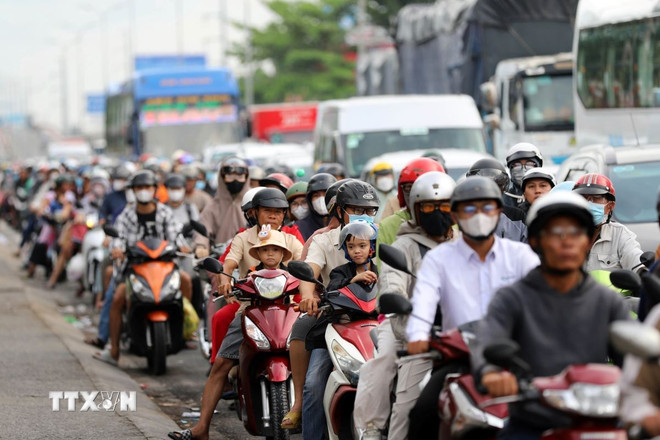
Among the sources of pollution, road traffic is identified as the biggest culprit. Currently, the city has nearly 13 million personal vehicles, the majority of which are motorbikes. According to data from the Department of Agriculture and Environment of Ho Chi Minh City, traffic accounts for about 63% of total PM2.5 emissions; motorbikes generate up to 91% of CO emissions and more than 70% of PM2.5 fine dust, with emissions accumulating more on frequently congested roads.
“Monitoring results from 2020 to present show that at some times, the concentration of total dust (TSP) and fine dust (PM10 and PM2.5) at locations with high traffic density exceeded the allowable threshold by 1.5-2 times,” said Ms. Ngo Nguyen Ngoc Thanh, Deputy Head of the Department of Environmental Protection, Department of Agriculture and Environment of Ho Chi Minh City.
Industry and construction also contribute significantly to pollution. In the old Ho Chi Minh City area alone, there are nearly 3,000 manufacturing facilities, and this has increased sharply after the merger, along with construction activities - especially when the City boosted investment in infrastructure, metro, and apartments - creating a large amount of dust, posing even greater challenges to the problem of environmental pollution.
“The biggest problem today is not only the increase in emissions, but also the approach and determination of authorities at all levels. Awareness of the harmful effects of air pollution and political determination to solve the problem in some places is not high, it seems to only be at the city level, the responsibility only belongs to specialized agencies, the role of the local district/county level (old) is very absent. Meanwhile, the nature of air pollution is widespread in all fields: transportation, industry, construction, energy, planning,” Dr. Hoang Duong Tung emphasized.
Environmental experts also pointed out that financial resources are also a big challenge. Investing in automatic monitoring networks, exhaust treatment technology, converting to green transportation and industrial renovation requires a large amount of money, while the City is prioritizing investment in key traffic infrastructure. Emission fee collection mechanisms or incentives for businesses to invest in clean technology are still limited, leading to a slow conversion rate.
In addition, the regional connectivity between Ho Chi Minh City and neighboring provinces makes it difficult to control emission sources. Many activities of burning waste, burning agricultural by-products or industrial production in neighboring provinces can directly affect the air quality of the City, but the coordination and data sharing mechanism is still fragmented.
Changing the multi-sectoral approach, green transformation, accelerating clean transport
Faced with this worrying situation, experts say Ho Chi Minh City needs to shift to a new management mindset, placing air pollution as an important target in the socio-economic development plan for the 2026-2030 period. When air quality becomes a system-wide goal, the responsibility for emission reduction will be more clearly allocated to each industry, each locality and each field.
According to Dr. Trinh Bao Son, Ho Chi Minh City Institute for Development Studies, the city has many programs and plans to control pollution emissions from traffic activities, the biggest culprit of the current environmental pollution. Specifically, the city is accelerating the completion of a project to convert gasoline vehicles to electric vehicles for about 400 technology and delivery drivers. It is expected that by 2030, 100% of buses, technology and delivery motorbikes, state agency cars and motorbikes of civil servants and public employees will be converted to electric vehicles.
“I think the City needs to focus on green urban planning - green infrastructure, including metro infrastructure, buses, and inner-city waterways, reducing dependence on private vehicles, while giving priority to zero-emission vehicles such as taxis, motorbikes, and electric bicycles in low-emission areas; applying stricter emission standards for vehicles using fossil fuels... Thus, we will gradually solve the current environmental pollution challenge,” Dr. Trinh Bao Son shared.
Sharing the same view, Associate Professor - Doctor Nguyen Dinh Tho, Deputy Director of the Institute of Strategy and Policy on Agriculture and Environment (Ministry of Agriculture and Environment) said that it is necessary to tighten regulations on standards and norms for road motor vehicle emissions; build a wide-coverage and convenient support infrastructure mechanism for people so that they actively respond to public transport.
“It is necessary to build and upgrade a high-quality public transport system that covers all urban areas, helping people easily choose public transport instead of private vehicles, and at the same time establish areas that restrict private vehicles during rush hours, concentrated in densely populated areas and the city center,” Associate Professor, Dr. Nguyen Dinh Tho stated his opinion.

Meanwhile, Dr. Hoang Duong Tung, Chairman of the Vietnam Clean Air Network, emphasized that the trend of air pollution cannot be stopped, but on the contrary, this situation will continue to increase if the old approach and solution are maintained. Therefore, it is necessary to change the approach and way of doing things, with breakthrough policies.
“A multi-sectoral, multi-local, multi-level approach with breakthrough solutions based on digital platforms to improve air quality; resolutely solving problems, taking advantage of opportunities and practices in each solution and step to stop the increase in air pollution,” said Dr. Hoang Duong Tung.
A new approach that is being increasingly discussed is to manage emissions along the chain rather than by geographic boundaries. For example, the transport-port-logistics chain is proposed to be managed as a “unified emissions stack.” The implementation of higher emission standards for inter-regional transport is also proposed as a mandatory solution, which is seen as the most visible and fastest way to cut emissions in the medium term.
In addition, experts also analyzed that for other emission sources, such as the industrial sector, collecting emission fees and requiring businesses to apply clean technology are considered inevitable steps. Some industrial zones need to convert to ecological models, while tightening dust control at construction sites through requirements for covering, water spraying and mandatory monitoring.
Green urban planning is also an important pillar, in which experts recommend that Ho Chi Minh City needs to increase green space, expand parks, develop green belts, improve the ecosystem along the Saigon River and canals, and encourage green and energy-saving buildings to harmonize development and environmental protection.
The Prime Minister has just approved the National Action Plan on pollution control and air quality management for the period 2026 - 2030 with a vision to 2045, with the goal of controlling, preventing and gradually overcoming pollution in key areas. The political determination and direction are clear, the rest is the effort of large cities such as Ho Chi Minh City in reducing environmental pollution, building green and sustainable urban areas, contributing to the goal of building a green Vietnam in the near future./.
Source: https://ttbc-hcm.gov.vn/thanh-pho-ho-chi-minh-cap-bach-tim-loi-giai-cho-bai-toan-o-nhiem-khong-khi-1020124.html


![[Infographic] 3 important milestones of the "Quang Trung Campaign"](https://vphoto.vietnam.vn/thumb/402x226/vietnam/resource/IMAGE/2025/12/04/1764800248456_fb_ava-2.jpeg)









![[Photo] Worshiping the Tuyet Son statue - a nearly 400-year-old treasure at Keo Pagoda](/_next/image?url=https%3A%2F%2Fvphoto.vietnam.vn%2Fthumb%2F1200x675%2Fvietnam%2Fresource%2FIMAGE%2F2025%2F12%2F02%2F1764679323086_ndo_br_tempimageomw0hi-4884-jpg.webp&w=3840&q=75)
![[Photo] Parade to celebrate the 50th anniversary of Laos' National Day](/_next/image?url=https%3A%2F%2Fvphoto.vietnam.vn%2Fthumb%2F1200x675%2Fvietnam%2Fresource%2FIMAGE%2F2025%2F12%2F02%2F1764691918289_ndo_br_0-jpg.webp&w=3840&q=75)



















































Comment (0)