

The US clean energy industry is nearing a turning point, especially as major tech companies like Amazon, Google, and Microsoft are seeking clean energy to power their data centers, which are the backbone of the internet and artificial intelligence (AI) applications.
According to a May 2024 research report by investment bank UBS, technology companies Amazon, Microsoft, Meta, and Google alone accounted for 40% of the demand for large-scale solar energy projects in the US over the past five years. UBS states that the demand for renewable energy from these companies, all committed to using 100% clean energy, is trending upwards as AI requires ten times more electricity than Google's conventional search.
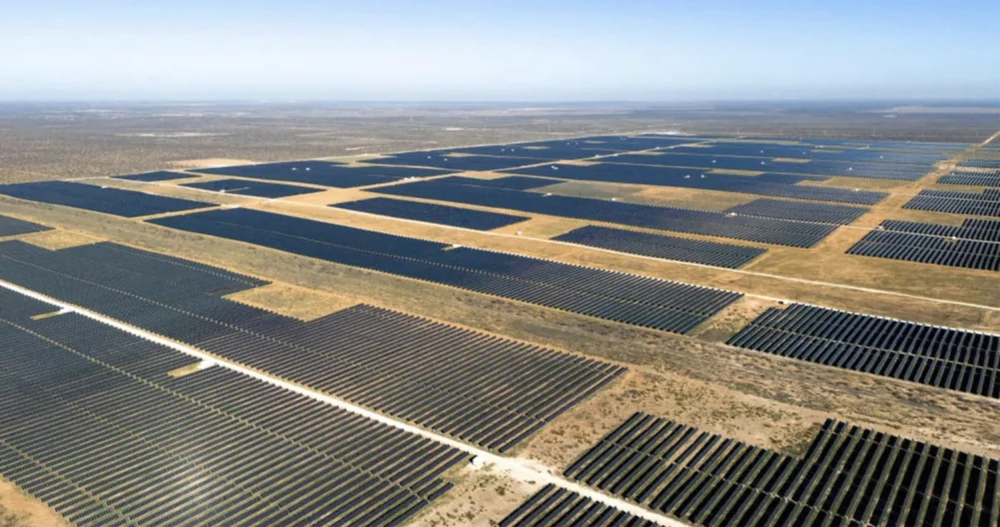
Meanwhile, data from the U.S. Department of Energy (DOE) indicates that solar power currently accounts for only 3.9% of the nation's total electricity supply in 2023, compared to 43% from natural gas. However, according to DOE estimates, solar power is projected to account for 58% of new electricity installations in the U.S. by 2024. Conversely, only 2.5 gigawatts of natural gas power are expected to be installed by 2024, representing only 4% of the planned 62.8 gigawatts of additional electricity and the lowest level in 25 years.
Besides Big Tech companies building energy-intensive data centers to support the AI revolution, the surge in electricity demand is also driven by incentives to bring manufacturing back to the US and the growing use of electric vehicles. According to Kelley Blue Book, although electric vehicle adoption slowed in late 2023, a record 1.2 million people bought electric cars last year, accounting for 7.6% of the US car market – up from 5.9% in 2022. A Wells Fargo analysis from April 2024 predicted that, as these trends converge, US electricity demand could increase by 20% by 2030, while Goldman Sachs stated that data centers are expected to account for 8% of electricity consumption by the end of the decade, more than double the current level.
The booming demand for energy poses a challenge to the Biden administration's goal of transforming the U.S. power grid to 100% clean energy by 2035. However, according to a series of reports published by the Goldman School of Public Policy and GridLab at the University of California Berkeley, the U.S. could achieve 90% clean electricity by 2035 if approximately 1,400 gigawatts of wind and solar capacity are deployed. Amol Phadke, a senior scientist at Goldman and Lawrence Berkeley, stated that the pace of renewable energy deployment in the U.S. would need to increase at least threefold to reach 90% clean electricity in the next decade.
Another challenge facing renewable energy is generating enough power to meet demand when sunlight and wind conditions are not at their peak. Batteries are key to addressing this problem by collecting energy during peak weather conditions and distributing it later in the day when it is most needed. Currently, most lithium-ion batteries on the market typically store energy for 4 hours, although this varies depending on the project. Analysts say this is insufficient to provide reliable power for an entire day. Batteries needing to store energy for 8 hours or more are essential at a commercial scale.
KHANH HUNG
Source: https://www.sggp.org.vn/thoi-diem-buoc-ngoat-post745575.html















































































Comment (0)