

On the morning of November 28th, with 94.13% of delegates voting in favor, the National Assembly passed the amended Law on Real Estate Business, effective from January 1st, 2025.
One new point in the draft law recently passed by the National Assembly concerns the form and scope of real estate business conducted by Vietnamese people residing abroad.

Chairman of the Economic Committee Vu Hong Thanh reported on the revisions and amendments to the draft Law on Real Estate Business before its approval by the National Assembly.
Accordingly, the Law on Real Estate Business has been expanded to allow Vietnamese citizens residing abroad (those holding Vietnamese nationality) who are permitted to enter Vietnam to engage in real estate business just like domestic citizens.
Accordingly, Vietnamese people residing abroad who are also Vietnamese citizens will be allowed to invest in the construction of houses and buildings for sale, rent, or lease-purchase.
Vietnamese people residing abroad are Vietnamese citizens who invest in the construction of technical infrastructure in real estate projects for the purpose of transferring, leasing, or subleasing the right to use land with existing technical infrastructure.
Specifically, for people of Vietnamese origin residing abroad who are not Vietnamese citizens (i.e., do not hold Vietnamese nationality), they are only allowed to engage in real estate business in the forms stipulated by current law.
Specifically, people of Vietnamese origin residing abroad who are not Vietnamese citizens may invest in the construction of housing and construction works associated with land use rights for sale, lease, or lease-purchase through real estate projects, provided that the form, purpose, and duration of land use comply with the provisions of land law.
Vietnamese nationals residing abroad who are not Vietnamese citizens may invest in the construction of technical infrastructure in real estate projects for the purpose of transferring, leasing, or subleasing the right to use land with existing technical infrastructure, in accordance with the form, purpose, and duration of land use as prescribed by land law…
Deposit not exceeding 5%
In addition to the aforementioned regulations, the Law on Real Estate Business also includes new provisions regarding deposits and payments for the purchase and sale of housing units under construction (on paper).
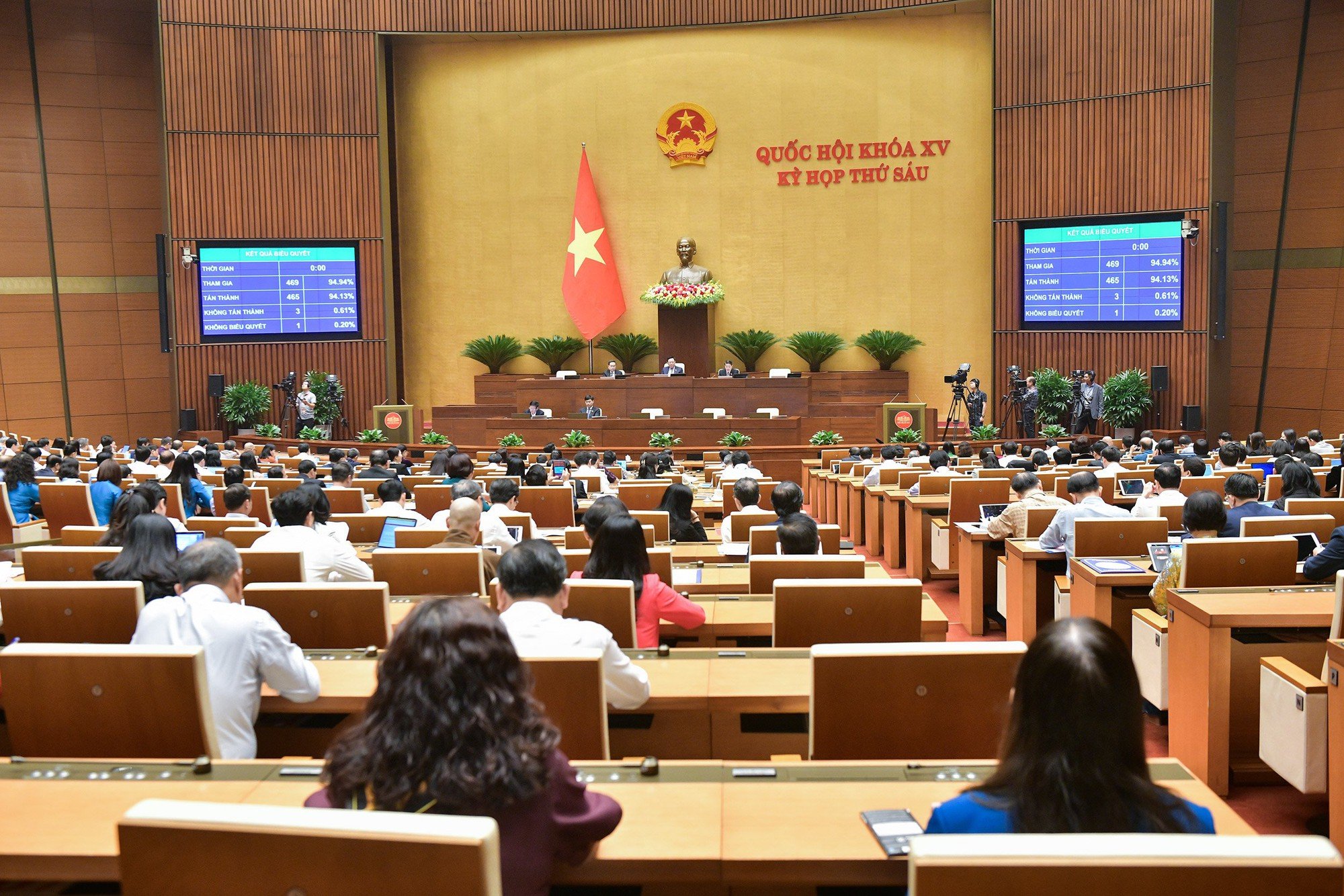
The National Assembly passed the amended Law on Real Estate Business.
Accordingly, the Law on Real Estate Business stipulates that the investor of a real estate project may only collect a deposit of no more than 5% of the selling price or lease-purchase price from customers when the housing or construction project has met all the conditions for being put into business.
The deposit agreement must clearly state the sale price, lease-purchase price of the house, construction project, and the floor area of the construction project.
Regulations regarding deposits are not yet stipulated in current law. According to the report on the amendments made by the Standing Committee of the National Assembly, the 5% deposit requirement is intended to accurately reflect the nature of the deposit while limiting risks for the buyer or leaseholder, who is often the weaker party in real estate transactions.
Regarding payment methods in the sale of off-plan housing, although there were many differing opinions during the discussion, the payment method in the draft submitted to the National Assembly for approval on the morning of November 28th remains unchanged from the current law.
Accordingly, if the buyer or lessee has not yet been granted a certificate of land use rights or ownership of assets attached to the land in accordance with the law on land, the seller or lessor is not allowed to collect more than 95% of the contract value.
The remaining value of the contract will be paid when the competent state agency has issued a certificate of land use rights and ownership of assets attached to the land in accordance with the land law to the buyer or lessee.
However, compared to current law, the Law on Real Estate Business recently passed by the National Assembly adds regulations on payment for lease-purchase of housing on paper. Accordingly, until the handover of the house, customers only pay 50% of the value of the leased or purchased property. The remaining amount is calculated as monthly rent to be paid to the lessor for a specified period.
The law will come into effect on January 1, 2025.
Source link


![[Photo] Closing Ceremony of the 10th Session of the 15th National Assembly](/_next/image?url=https%3A%2F%2Fvphoto.vietnam.vn%2Fthumb%2F1200x675%2Fvietnam%2Fresource%2FIMAGE%2F2025%2F12%2F11%2F1765448959967_image-1437-jpg.webp&w=3840&q=75)

![[Photo] Prime Minister Pham Minh Chinh holds a phone call with the CEO of Russia's Rosatom Corporation.](/_next/image?url=https%3A%2F%2Fvphoto.vietnam.vn%2Fthumb%2F1200x675%2Fvietnam%2Fresource%2FIMAGE%2F2025%2F12%2F11%2F1765464552365_dsc-5295-jpg.webp&w=3840&q=75)
















































![[OFFICIAL] MISA GROUP ANNOUNCES ITS PIONEERING BRAND POSITIONING IN BUILDING AGENTIC AI FOR BUSINESSES, HOUSEHOLDS, AND THE GOVERNMENT](https://vphoto.vietnam.vn/thumb/402x226/vietnam/resource/IMAGE/2025/12/11/1765444754256_agentic-ai_postfb-scaled.png)














































Comment (0)