

The Poison Control Center at Bach Mai Hospital ( Hanoi ) reported that doctors are treating a 31-year-old male patient (residing in Long Luong commune, Van Ho district, Son La province) who suffered carbon monoxide poisoning and brain damage. The patient was transferred to Bach Mai Hospital on December 31, 2023, in a comatose state, with kidney failure and muscle damage.
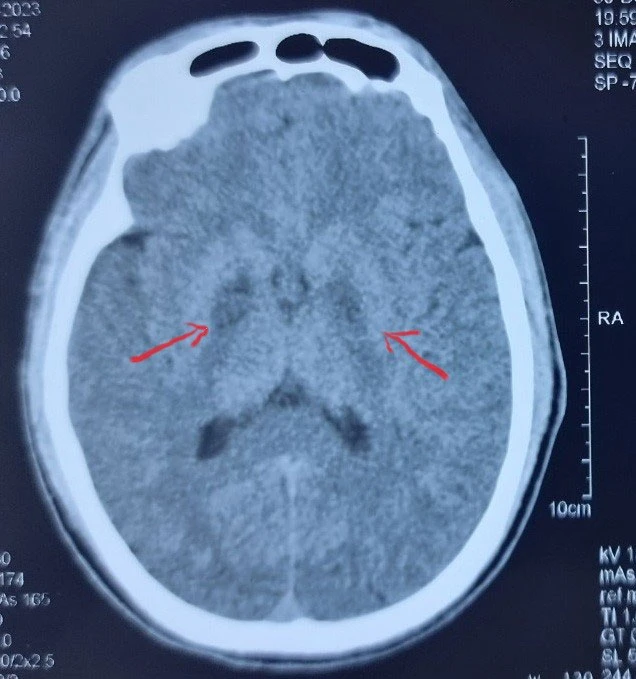
Brain damage images of a patient with carbon monoxide poisoning.
According to information from the patient's family, on the night of December 29, 2023, due to the cold weather, the patient burned charcoal in a closed room to warm up before going to sleep. Around 4 a.m., family members discovered the patient unconscious and rushed him to a local hospital, after which he was transferred to Bach Mai Hospital.
According to Dr. Nguyen Trung Nguyen, Director of the Poison Control Center at Bach Mai Hospital, when burning carbon-containing fuels such as firewood, charcoal, honeycomb charcoal, gasoline, etc., in an open, airy space, the fuel burns completely and basically produces gases that have little impact on health; however, if burned in a closed area, the fuel burns incompletely and produces carbon monoxide (CO), which is a very toxic gas. CO gas is colorless and odorless, making it very difficult to detect, especially when sleeping, as people in that space will gradually become unconscious without knowing it.
Dr. Nguyen informed: The patient mentioned above is now conscious and more alert, but this is a very serious case with clear signs of bilateral brain damage, muscle damage, kidney failure, and a very high risk of long-term psychiatric and neurological complications (memory loss, mental disorders, tremors, muscle spasms, paralysis...). The Poison Control Center is applying intensive treatment measures to minimize complications.
According to scientific studies, even in the mildest cases of carbon monoxide poisoning, nearly 50% will experience complications related to mental health, neurological disorders, and brain damage later on. The mildest symptoms may include varying degrees of memory impairment, while more severe cases can lead to coma or complete amnesia.
According to Dr. Nguyen, the current housing structures of the people have serious ventilation problems. Most are self-built and self-designed, and very airtight; they lack ventilation systems or at least ventilation openings, and there are no ways to pump air in from the outside and extract air from the inside. To fundamentally address the issue, management agencies need to control the design and construction of people's houses to ensure adequate and safe ventilation for residents.
Dr. Nguyen Trung Nguyen advises: Absolutely do not burn fuels such as honeycomb charcoal, firewood, charcoal, or gas in enclosed spaces. If you must use them, do not use them in a closed room; open the doors and windows to ensure adequate air circulation. It is best to choose another method of heating.
If someone is found to be suffering from asphyxiation, open the doors and windows to ventilate the area. If the patient is breathing weakly, unconscious, or their heart and lungs have stopped functioning, perform artificial respiration or chest compressions (cardiopulmonary resuscitation), then transport them to the nearest medical facility.
Source link

![[Photo] Prime Minister Pham Minh Chinh holds a phone call with the CEO of Russia's Rosatom Corporation.](/_next/image?url=https%3A%2F%2Fvphoto.vietnam.vn%2Fthumb%2F1200x675%2Fvietnam%2Fresource%2FIMAGE%2F2025%2F12%2F11%2F1765464552365_dsc-5295-jpg.webp&w=3840&q=75)


![[Photo] Closing Ceremony of the 10th Session of the 15th National Assembly](/_next/image?url=https%3A%2F%2Fvphoto.vietnam.vn%2Fthumb%2F1200x675%2Fvietnam%2Fresource%2FIMAGE%2F2025%2F12%2F11%2F1765448959967_image-1437-jpg.webp&w=3840&q=75)













































![[OFFICIAL] MISA GROUP ANNOUNCES ITS PIONEERING BRAND POSITIONING IN BUILDING AGENTIC AI FOR BUSINESSES, HOUSEHOLDS, AND THE GOVERNMENT](https://vphoto.vietnam.vn/thumb/402x226/vietnam/resource/IMAGE/2025/12/11/1765444754256_agentic-ai_postfb-scaled.png)













































Comment (0)