

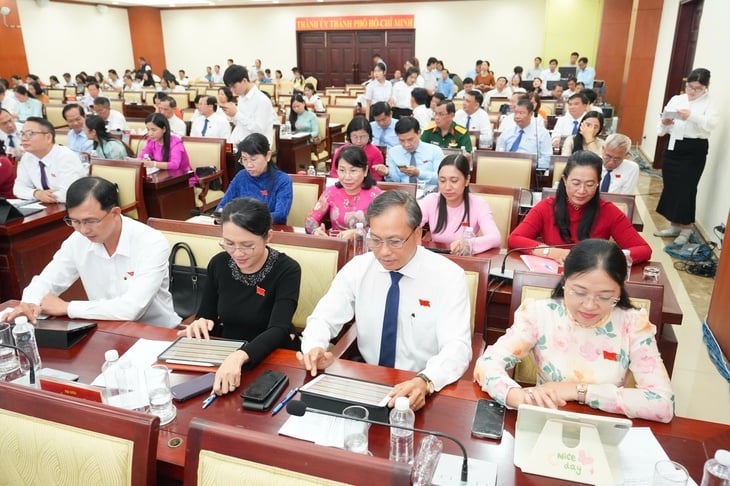
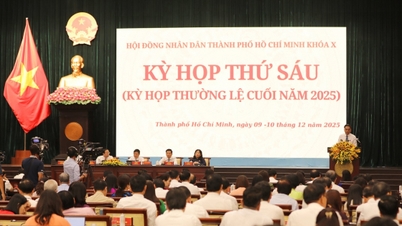
Representatives of the Ho Chi Minh City People's Council approve the draft resolution - Photo: HUU HANH
On the afternoon of August 28th, the Ho Chi Minh City People's Council passed a resolution on policies for developing preschool education in areas with industrial zones and a large workforce in Ho Chi Minh City.
Increase the support amount from 160,000 VND to 240,000 VND per month per child.
Notably, the resolution stipulates support for preschool children of workers and laborers working in industrial zones with a large workforce, at a rate of 240,000 VND/child/month (the current rate is 160,000 VND/child/month).
The support period is calculated based on the actual number of months of study, but not exceeding 9 months per academic year.
At the same time, Ho Chi Minh City supports preschool teachers working at private preschools in industrial zones and preschool teachers working at nurseries and kindergartens with many workers at the rate of 1 million VND/person/month. The support period is calculated based on the actual number of months of study, but not exceeding 9 months/school year.
This support is separate from the agreed-upon salary between the owner of the private preschool and the teachers, and is not used to calculate social insurance, health insurance, or unemployment insurance contributions.
According to the resolution, Ho Chi Minh City will also support independent, private, and semi-private preschools in areas with industrial zones, as well as nurseries and kindergartens in areas with a large workforce.
At the same time, one-time support for equipping facilities includes: providing supplies, toys, and teaching equipment according to the list prescribed by the Ministry of Education and Training , and providing funding for repairing facilities to directly serve the care, nurturing, and education of children.
Of which, independent preschools in areas with industrial parks and nurseries, kindergarten classes in places with many workers with less than 30 children are supported with 35 million VND; independent preschools in areas with industrial parks and nurseries, kindergarten classes in places with many workers with from 30 to less than 50 children are supported with 55 million VND .
Independent preschools located in industrial zones, and kindergartens/preschools in areas with a high concentration of workers, with 50 to 70 children, will receive a subsidy of 70 million VND.
Nurseries, kindergartens, and preschools in areas with a high labor force that have more than 70 children will receive 70 million VND in support.
Over 8,000 ethnic minority students received tuition fee support.
Also at the session, the Ho Chi Minh City People's Council passed a resolution stipulating policies to support tuition fees for students, graduate students, and doctoral candidates from ethnic minority groups in Ho Chi Minh City.
Accordingly, the financial support for tuition fees is equal to 60% of the basic salary per student, graduate student, or doctoral candidate per month, and is granted for no more than 10 months per academic year per student, graduate student, or doctoral candidate.
The number of years of study supported is regulated by the Ministry of Education and Training regarding training programs for students, graduate students, and doctoral candidates. In the event of a significant increase in the basic salary, the People's Committee of Ho Chi Minh City will assess the impact and submit a proposal to the City People's Council for appropriate support levels based on the actual situation.
According to statistics, after the merger, Ho Chi Minh City has more than 509,000 ethnic minority people belonging to 53 ethnic groups; including more than 8,000 students from vocational schools to universities and about 200 postgraduate students and doctoral candidates.
In particular, many students from the Cham, Khmer, and Choro ethnic groups come from disadvantaged economic backgrounds and are easily affected by the ever-increasing cost of education.
92,000 preschool children of workers in Ho Chi Minh City will receive increased tuition subsidies.
According to the report from the Ho Chi Minh City People's Committee, after the merger of the three administrative units (Ho Chi Minh City, Binh Duong, and Ba Ria - Vung Tau), Ho Chi Minh City became a special urban area with a large population, a significant proportion of which are workers in industrial zones and export processing zones.
However, because each locality previously had its own resolution, the level of support for children, teachers, and preschools still varies and lacks uniformity.
In addition, many policies have not been effective due to high constraints. For example, the regulation that at least 30% of the children in a facility must be children of workers to be eligible for support has resulted in many independent childcare groups and kindergartens not being eligible, while in reality they are still mainly serving children of workers.
Furthermore, the support provided to children (160,000 VND/month) and teachers (800,000 VND/month) is only at the minimum level, not commensurate with the costs of raising children and the professional pressure faced by preschool teachers.
Statistics show that Ho Chi Minh City currently has over 1,000 independent preschools, serving 92,000 children of factory workers and approximately 6,000 preschool teachers in private institutions. Without timely policies, the rights of these groups will be affected after the merger.
Source: https://tuoitre.vn/tp-hcm-tang-ho-tro-cho-92-000-tre-hoc-mam-non-len-muc-240-000-dong-tre-thang-202508281734126.htm


![[Photo] Prime Minister Pham Minh Chinh holds a phone call with the CEO of Russia's Rosatom Corporation.](/_next/image?url=https%3A%2F%2Fvphoto.vietnam.vn%2Fthumb%2F1200x675%2Fvietnam%2Fresource%2FIMAGE%2F2025%2F12%2F11%2F1765464552365_dsc-5295-jpg.webp&w=3840&q=75)

































































Comment (0)