

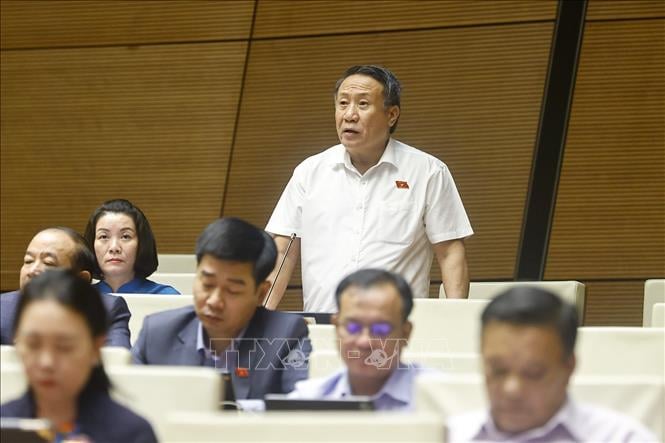
During the discussion, delegates offered many insightful opinions, focusing on overcoming bottlenecks in implementation, particularly the delayed tax refund mechanism and tax policies on agricultural products, waste, and by-products, in order to facilitate the removal of practical difficulties for the business community. The opinions emphasized the need to establish technical tools and a robust, transparent legal framework to both support production and business while protecting the state budget.
Establish an automatic tax refund mechanism with clear penalties.
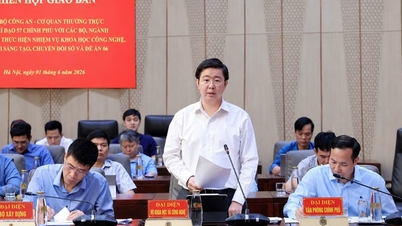
While supporting the amendment of the law, delegate Ha Sy Dong (Quang Tri) noted that many current obstacles do not stem from the law's regulations but mainly from the implementation process. Typical examples include the prolonged tax refund process, the lack of transparent lookup tools, and the inconsistency in policy application. The delegate argued that amending the law too early, while the guiding documents are still being finalized, could lead to policy misalignment and disrupt production and business activities.
To thoroughly address the tax refund bottleneck, Representative Ha Sy Dong proposed implementing an automatic tax refund mechanism based on risk levels, rather than merely using the general slogan "shorten the tax refund time" as stated in the government report. Specifically, a fixed timeframe should be stipulated for tax refunds for businesses with good compliance – for example, 30 days – while businesses classified as high-risk should undergo pre-refund verification. Furthermore, specific penalties should be established if tax authorities prolong processing times, causing capital stagnation for businesses.
The application of technology, big data, and artificial intelligence (AI) also needs to be regulated in detail through written documents, not just slogans. These documents must clarify what types of data can be connected, the technical standards, data security measures, and the specific responsibilities of each party involved. All of this aims to supplement the technical tools for risk control and ensure that the amendments to the law truly address the bottleneck of slow tax refunds.
Analyzing the impact of tax refund policies on business capital flows, Representative Tran Huu Hau ( Tay Ninh ) emphasized that adding content to Clause 1, Article 5 of the Law would help Vietnamese export businesses reduce tens of thousands of billions of dong in capital that would otherwise be spent on upfront tax payments and interest payments, before the State reimburses them. The representative affirmed that although the final tax amount is refunded, businesses have lost a significant amount in terms of value, not only in interest payments on loans used for tax payments – which are often not even approved by banks – but also in profits that would have been generated if that money had been invested in business.
In the context of Vietnamese agricultural products facing fierce competition in the international market, even a small percentage of profit is of great significance, helping businesses become more stable and develop. Furthermore, maintaining the old regulations would cause tens of thousands of businesses and thousands of tax officials to waste a great deal of time and effort on administrative procedures, creating a "request-and-grant" mechanism that easily leads to corruption.
Tighten management of agricultural products and waste using technical tools.
Regarding tax policies on agricultural products, special goods, waste products, and by-products, Representative Ha Sy Dong commented that the explanatory report was lengthy and did not clarify specific operating criteria. He suggested that the National Assembly should require clear regulations in the law or assign the Ministry of Finance to issue a detailed list of goods by HS code, along with export ratio criteria, to apply the "no declaration required but deductible" mechanism, avoiding arbitrary expansion through guiding documents. At the same time, a minimum set of mandatory documents is needed, including contracts, collection slips, transportation documents, and confirmations from cooperatives; along with standardized forms to prevent circular trading and fraud.
Regarding waste and by-products, Representative Ha Sy Dong proposed that the Ministry of Finance develop a system of codes/names and classification criteria based on HS codes, and require businesses to prepare production standard lists. This measure aims to combat the practice of understating value to shift revenue to lower tax rate groups, a point where the report's explanation is weak and needs to be tightened using technical tools.
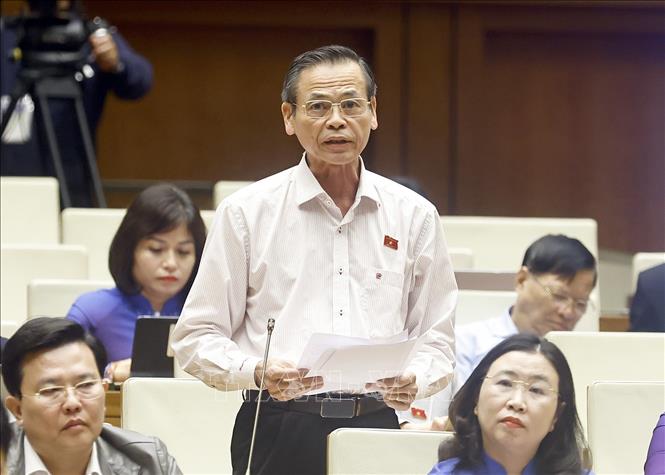
Representative Tran Huu Hau particularly emphasized the significance of removing the first clause of Article 9, Clause 5, affirming that this will create conditions for tens of thousands of agricultural and aquatic product processing facilities to have more opportunities to consume waste products such as bran, distiller's grains, beer residue, cassava pulp, pineapple pulp, molasses, shrimp shells, etc. This will not only help animal feed processing facilities reduce input costs and lower the selling price of animal feed, making it equal to imported raw materials as the Government has explained, but also increase processing efficiency, contributing to solving environmental problems, implementing the green production policy, and developing a circular economy. The cassava industry alone generates over 4 million tons of cassava pulp annually – a major source of pollution for businesses and localities. If cassava pulp is not subject to value-added tax, it will have more opportunities to become animal feed, bringing significant economic value and efficiency in many aspects.
The delegates unanimously agreed with the proposal to remove point c, clause 9, Article 15 regarding the conditions for tax refund (requiring "the seller has declared and paid value-added tax in accordance with regulations for invoices issued to the business requesting the tax refund").
Representative Tran Huu Hau stated that the current regulations are unreasonable and pose significant risks because they "free" businesses from a responsibility that is often "impossible": checking the tax compliance status of sellers. Buyers and sellers are two independent entities, and buyers have neither the right nor the tools to check or interfere with the seller's tax obligations. Businesses cannot be held responsible for the compliance of others and cannot only receive tax refunds when the seller has declared and paid taxes, because the responsibility for tax collection rests with the tax authorities.
Representative Tran Huu Hau affirmed that, although the current regulations primarily aim to combat invoice fraud and ensure budget revenue, it is unacceptable to make the majority of legitimate businesses face difficulties and disadvantages simply to prevent fraudulent activities by a few enterprises.
Agreeing with the removal of this condition, Representative Ha Sy Dong requested that a mechanism to protect both the budget and businesses be established simultaneously. If the National Assembly considers removing the condition "the seller has declared and paid taxes," a public portal for checking the tax compliance status of sellers should be immediately established, with an API for banks and businesses to use. Furthermore, the criterion of the seller's tax compliance history should be included in the automatic refund mechanism to classify risks…
Source: https://baotintuc.vn/thoi-su/ap-dung-hoan-thue-tu-dong-theo-muc-do-rui-ro-20251209184707854.htm
















































































![[Photo] Hanoi residents on the first day after the official cessation of E5 RON 95 gasoline sales.](https://vphoto.vietnam.vn/thumb/402x226/vietnam/resource/IMAGE/2026/06/02/1780370815909_666523_thumb_1780357660_06474202.jpeg)


![[Infographic] Market starts June 2026 with negative sentiment, VN-Index drops nearly 19 points.](https://vphoto.vietnam.vn/thumb/402x226/vietnam/resource/IMAGE/2026/06/02/1780370839687_666534_thumb_1780357795_06495602.jpeg)











Comment (0)