

The demand for accommodation, relaxation and experiences from the recovery of the tourism industry with the increase in international visitors thanks to the maintenance and expansion of visa exemption policies has been contributing to promoting the recovery process in key tourism and resort real estate markets.
 |
In order to implement the tourism stimulus program, the Government has just issued Resolution No. 229/NQ-CP dated August 8, 2025, on visa exemption for citizens of 12 countries, from August 15 to August 14, 2028.
In August, the Government also issued Decree No. 221/2025/ND-CP dated August 8, 2025, stipulating the temporary visa exemption for foreigners belonging to special categories requiring preferential treatment to serve socio-economic development.
Previously, in March, the Government issued Resolution No. 44/NQ-CP dated March 7, 2025, on visa exemption for citizens of 12 countries. Thus, Vietnam is currently implementing a unilateral visa exemption policy for citizens of 24 countries, mainly from Europe. Notably, from August 2023, the length of stay for tourists under the unilateral visa exemption policy has also been increased from 15 days to 45 days.
This is a significant step forward in immigration procedures, helping Vietnam enhance its competitiveness with other destinations in the region and attract international tourists – a group that tends to stay longer and spend more.
According to a report from the General Statistics Office (Ministry of Finance), the number of international visitors to Vietnam in 2024 reached 17.6 million, an increase of nearly 40% compared to 2023 and 98% compared to 2019 - the golden year of tourism, with visitors from visa-exempt markets accounting for a large proportion.
Notably, four of the ten fastest-growing countries—Russia, Italy, Sweden, and France—are among the countries recently granted unilateral visa exemptions.
The visa exemption policy continues to bring positive signals for Vietnam's tourism industry in 2025. Specifically, in the first six months of 2025, the number of international visitors to Vietnam is expected to reach 10.7 million, an increase of nearly 21% compared to the same period in 2024 and nearly 26% compared to 2019.
Notably, according to statistics from the Vietnam National Tourism Administration, in the first half of 2025, the number of tourists from Poland to Vietnam increased by 44%, while that from Switzerland increased by 10% compared to the same period in 2024.
The recovery of the tourism industry, with strong growth in international visitors leading to a surge in demand for accommodation, resorts, and experiences, has contributed to the recovery process in key tourism and resort real estate markets. Consequently, occupancy rates have improved significantly.
Specifically, survey data from the Vietnam Institute for Real Estate Market Assessment Research (VARS IRE) and statistics from the Departments of Culture, Sports and Tourism of provinces and cities show that currently, occupancy rates at 4-5 star hotels in key tourism markets are reaching 70 to 90%, even fully booked during holidays and festivals, with room revenue increasing by 20-30% compared to the same period.
Notably, these destinations are all locations that attract the most international tourists, such as Da Nang, Nha Trang, and Phu Quoc, with integrated infrastructure, strong tourism brands, and clear strategies for attracting international visitors.
As a result, the value of tourism and resort real estate in the aforementioned localities is gradually improving. Although no sudden price increases have been recorded, the phenomenon of continued losses has almost ended as investors have more expectations for the market's prospects. In fact, some projects have even seen secondary market transaction prices increase by 5-10% over the past year.
Alongside this, a series of high-end resort projects have been launched and restarted, and some developers have boldly launched projects with positive transaction results.
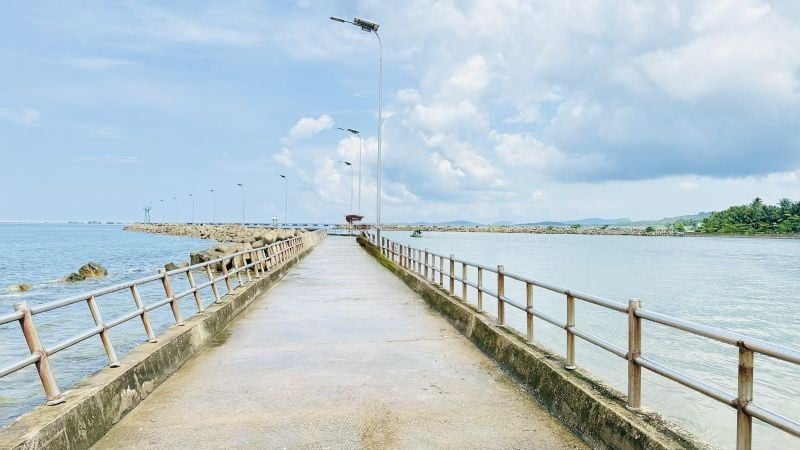 |
| A pier on Phu Quoc Island, An Giang province. (Photo: HNV) |
The Vietnam Institute for Real Estate Market Research and Evaluation (VARS IRE) believes that the visa exemption policy will continue to boost the recovery of hotel occupancy rates, leading to increased demand for new investments in real estate projects. Many developers will continue to take advantage of this signal to launch new properties or restart stalled projects in key tourist areas.
Furthermore, maintaining and expanding the visa exemption policy also helps shape the long-term development strategy for resort real estate. The strong increase in the number of international tourists with long stays and high spending power will encourage investors to accelerate the development of high-end products such as beachfront villas, international standard resorts, or luxury condotels.
Simultaneously, to anticipate the rapidly increasing influx of international tourists, many localities will prioritize investment in key infrastructure such as airports, seaports, and connecting transportation systems. This will not only enhance tourism service capacity but also increase the value of real estate throughout the region.
In the long term, maintaining and expanding the visa exemption policy will also contribute to enhancing Vietnam's attractiveness as a long-term holiday and investment destination.
This policy not only extends the length of stay but also helps attract and retain high-value customer groups, ranging from long-stay leisure tourists and international professionals to investors seeking business opportunities and an attractive living environment.
A segment of international visitors, especially those who have visited Vietnam multiple times, tend to seek to purchase real estate for long-term residence, retirement, and investment. As a result, the resort real estate market not only benefits from short-term demand but also strengthens its foundation for sustainable long-term growth.
It is clear that the visa exemption policy is a crucial "lever" helping Vietnam's tourism industry recover quickly and sustainably after the pandemic. However, to turn this advantage into a breakthrough for tourism and resort real estate, investors need to continue creating differentiated products and experiences to enhance competitiveness with other countries in the region, such as developing diverse product projects, developing tourism products combined with health care, or linking with the development of the night economy to retain tourists for longer periods.
At the same time, the State needs to promptly remove legal obstacles and create a transparent and stable investment environment, thereby strengthening the confidence of domestic and foreign investors.
According to HAN NGUYEN/ nhandan.vn
Source: https://baovinhlong.com.vn/kinh-te/202508/bat-dong-san-du-lich-nghi-duong-huong-loi-tu-chinh-sach-mien-thi-thuc-1431ad6/














































































Comment (0)