

The Russian government is seeking to finalize its long-awaited Energy Strategy 2050 against a backdrop of a dynamic and rapidly changing global environment following successive US and EU sanctions on Moscow's energy business.
The extensive Western sanctions imposed following the conflict in Ukraine have forced Russia to overhaul its entire energy sector and have caused significant delays in the development of its Energy Strategy 2050.
Therefore, the energy strategy that Russian President Vladimir Putin called for two years ago has yet to be submitted to the Russian parliament for consideration.
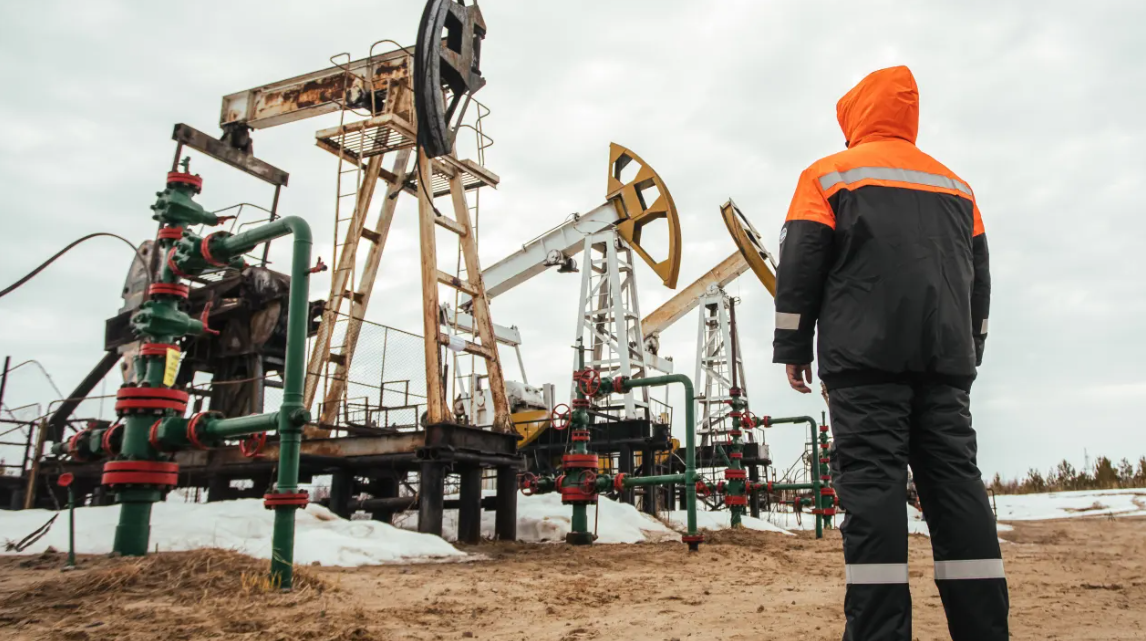
A worker at the Surgutneftegas oil and gas production corporation stands near oil pumps in the Surgut region, in the West Siberian oil basin, Russia. Photo: TASS.
Russian Deputy Prime Minister Alexander Novak, in charge of energy affairs, told the Interfax news agency in July that the Russian government was in the final stages of developing this strategy.
"According to the Russian President's directive, the Energy Strategy 2050 is in its final stages, with the goal of minimizing the negative impact of the fuel and energy sectors on the environment and adapting to climate change," Novak said.
According to Yuri Stankevich, Deputy Chairman of the Energy Committee of the Russian State Duma (Lower House of Parliament), the final draft strategy could be widely discussed this autumn.
In the first year of the war, an energy crisis in Europe caused prices to skyrocket and gave the Kremlin its highest current account surplus ever at $235 billion.
However, when sanctions on Russian oil and oil products took effect at the end of 2022, the surplus narrowed to $51 billion in 2023. More recently, last December, the US began imposing additional sanctions that forced approximately 10% of the "shadow fleet," used to transport Russian oil to Asian customers, to cease operations.
The Energy Strategy 2050 needs to address all of these issues, as well as the need to build new infrastructure to reroute energy supplies and redirect Russia's pipeline network from West to East, and a number of other challenges.
Sanctions against Moscow are continuing to escalate, particularly as the U.S. increasingly targets Russia's plans to expand liquefied natural gas (LNG) capacity and its future oil production projects.
Recent sanctions targeting Novatek's Arctic LNG 2 project in the Arctic and contractors involved in Vostok Oil's large-scale program underscore the growing pressure weighing on Russia's energy ambitions.
As the global outlook for oil and gas demand changes, with many advocating for a gradual energy transition, the Russian government is also facing declining revenue from its oil and gas sector due to rising costs.
In an interview with the Russian newspaper Rossiyskaya Gazeta, published last week, Mr. Stankevich suggested focusing more on improving production quality rather than quantity.
However, Russia faces a major challenge in this area after the West imposed sanctions in the technology sector aimed at cutting off crucial inputs that Russia previously received from Western suppliers.
The Arctic LNG 2 project is particularly severely affected because it relies on complex components manufactured by a handful of companies worldwide, primarily Western companies.
The power generation sector has also been severely affected because most of the gas turbines used in power plants are manufactured by the German company Siemens. This company has also withdrawn from Russia, leaving Russian power companies without a supply of spare parts.
Minh Duc (According to bne IntelliNews, Interfax)
Source: https://www.nguoiduatin.vn/chien-luoc-nang-luong-cua-nga-trong-boi-canh-lenh-trung-phat-day-dac-cua-phuong-tay-204240831155056406.htm
















![[Photo] Prime Minister Pham Minh Chinh holds a phone call with the CEO of Russia's Rosatom Corporation.](/_next/image?url=https%3A%2F%2Fvphoto.vietnam.vn%2Fthumb%2F1200x675%2Fvietnam%2Fresource%2FIMAGE%2F2025%2F12%2F11%2F1765464552365_dsc-5295-jpg.webp&w=3840&q=75)















































Comment (0)