

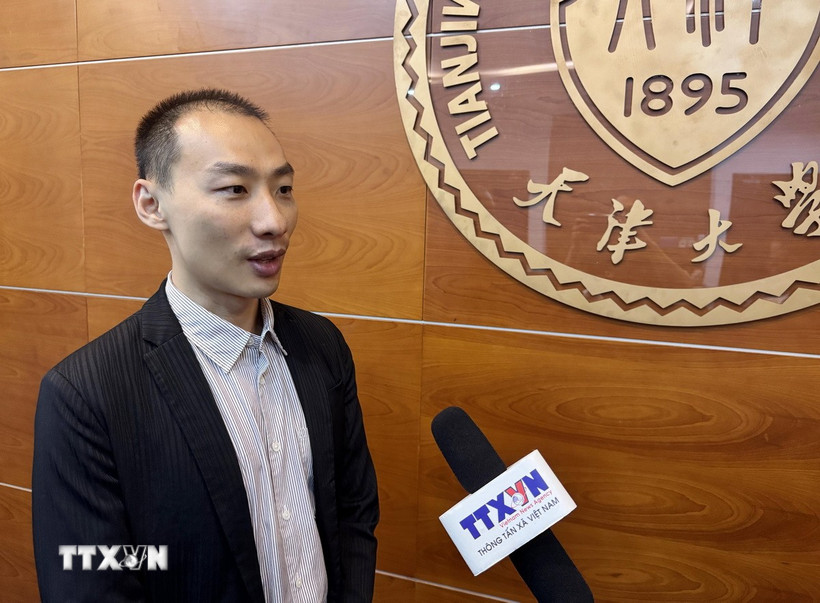
Associate Professor Li Junkai, Deputy Head of the Department of Multilingual Teaching, Southern Hemisphere Research Institute, Tianjin University (China), answers questions from a VNA reporter in Beijing. (Photo: Cong Tuyen/VNA)
On July 1st, Vietnam merged 63 provinces and centrally-administered cities into 34, simultaneously implementing a two-tiered local administrative system.
Evaluating this model, Chinese scholars believe that Vietnam's vigorous reforms will bring benefits in the medium and long term.
In an interview with a Vietnam News Agency (VNA) reporter in Beijing, Associate Professor Li Junkai, Deputy Head of the Multilingual Teaching Department at the Southern Hemisphere Research Institute of Tianjin University (China), stated that Vietnam's merger of provinces and cities and the abolition of district levels nationwide, driven by constitutional amendments, is a structural reform that takes into account both governance modernization and cost control.
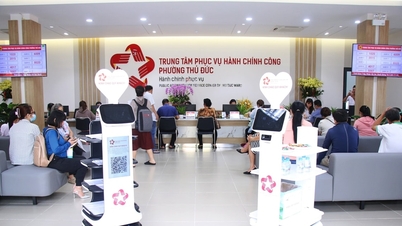
This helps to concentrate previously dispersed financial resources, human resources, and capital approval authority in a more capable provincial government; and, through digital government platforms, directly brings public services from the district level down to the commune and ward levels with the goal of striving to achieve integration of both online and in-person services without disconnection.
Associate Professor Ly Tuan Khai cited Vietnam's example of administrative "cutting down" as similar to the idea of regional mergers and strengthening regional power in France in recent years; it also reflects China's practice of "abolishing counties to create districts, merging communes and towns." However, Vietnam has abolished the entire county-level government system and established "regional representative offices." This not only avoids the emergence of administrative gaps but also demonstrates the strong consensus and determination of the highest level towards political reform.
Assessing the impact of these drastic reforms on Vietnam's future development, Associate Professor Ly Tuan Khai affirmed that in the future, the merged provinces and cities will have greater strength, more comprehensive functions, and more centralized financial and investment decisions. This will help Vietnam invest more resources in infrastructure, social welfare, and the digital economy , instead of being "eroded" by the activities of government agencies.
In terms of industrial layout, the merger of provinces and cities in northern and central Vietnam will help unify the planning of seaports, railways, and industrial zones, and strengthen connections with southwestern China and neighboring countries in the Indochina peninsula.
At the public service level, if the "one province, one cloud" government platform operates smoothly, data such as citizen identification cards, health insurance cards, land ownership certificates, etc., can be shared between provinces, shortening the administrative procedures for citizens.
Chinese scholars assert that, generally speaking, as long as supportive policies are maintained, given the economic scale brought about by the annexation of French territories and the urban economic vitality resulting from the transformation of Chinese counties into districts, Vietnam's vigorous reforms are also expected to yield similar benefits in the medium and long term.
Regarding Vietnam's future development prospects, Associate Professor Ly Tuan Khai stated that in recent years, Vietnam has demonstrated strong growth momentum in export manufacturing, digital industry, and green energy.
If this administrative simplification effort is successfully implemented, it will help reduce institutional transaction costs, create a clearer window for attracting provincial-level investment for both domestic and foreign capital, and create a more favorable institutional environment for Southern Hemisphere partners to cooperate with Vietnam in the fields of new energy, smart agriculture, and digital ports.
According to Mr. Ly Tuan Khai, in the process of implementing reforms, Vietnam needs to fully listen to the voices and aspirations of the people, balance development opportunities between large cities and communes, integrate local identity into regional strategies like France, and narrow the urban-rural gap through "digital governance" like China...
In this way, Vietnam can not only consolidate its rapid growth momentum, but is also expected to provide a governance model that combines “reducing structural burdens and ensuring digitalization” for low- and middle-income countries, while playing a more significant role in the overall development of developing countries.
(VNA/Vietnam+)
Source: https://www.vietnamplus.vn/chinh-quyen-dia-phuong-2-cap-nhung-loi-ich-trung-va-dai-han-doi-voi-viet-nam-post1048317.vnp







































































Comment (0)