

Preventing market manipulation
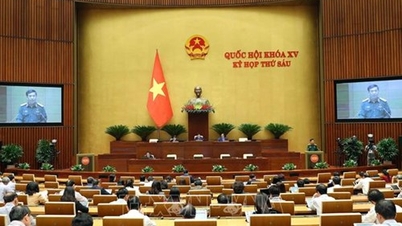
During the group discussion on the draft Law amending and supplementing a number of articles of the Law on Auctioning Assets, delegate Ta Thi Yen ( Dien Bien ) proposed analyzing and clarifying the existing shortcomings, obstacles, and inconsistencies between the provisions of the law on land, investment, auction, and tax management, finance, and corporate credit, especially the conditions for registering to participate in the auction, the financial capacity of auction participants, and the deadline for paying the winning bid.
"Simply amending and supplementing the regulations of the Auction Law is not enough to prevent market manipulation and speculation, especially in the real estate sector. Therefore, a more comprehensive solution is needed, encompassing policies on credit, land, businesses, and asset auctions to address current shortcomings," suggested Representative Ta Thi Yen.
According to the delegates, in recent times, in asset auctions, there has been a phenomenon of manipulating starting prices, bidding very high prices and then abandoning deposits to create an artificial price level for profit, creating a speculative land bubble... The draft Law has amended and supplemented regulations on canceling auction results by clearly defining the subjects and grounds for canceling auction results to ensure feasibility and compliance with civil law regulations, and the legal consequences of canceling auction results to protect the rights of the State, the legitimate rights and interests of individuals and organizations, and clearly define the responsibility of those who violate the law leading to the cancellation of auction results.
"However, in practice, when the behavior of the participants in auctions is unusual, the draft law should stipulate that the auction can be postponed or stopped," suggested Representative Ta Thi Yen.

National Assembly representative Nguyen Thi Yen from Ba Ria - Vung Tau province delivers a speech. Photo: Doan Tan/TTXVN
Sharing the same view, delegate Nguyen Thi Yen (Ba Ria - Vung Tau) suggested considering and adding regulations to handle violations by organizations and individuals who win auctions but forfeit their deposits.
Representative Nguyen Thi Yen stated that recently there have been many cases of bidders winning auctions but abandoning their deposits, failing to pay to receive the auctioned assets, especially with assets of very high value after auction such as vehicle license plates or real estate. "Meanwhile, the Law on Auctioning Assets does not have sanctions for bidders abandoning their deposits; it only stipulates that those who win the auction but fail to pay will lose their deposit," Representative Nguyen Thi Yen emphasized.
To address this issue, Representative Nguyen Thi Yen suggested that the drafting agency consider adding a regulation stating that assets managed by the State cannot be abandoned after being auctioned. "We need to supplement and adjust the penalties for abandoning deposits; there should be measures to fine the amount many times greater than the deposit to prevent successful auctions followed by abandonment of deposits," Representative Nguyen Thi Yen said.
Speaking at the group meeting, delegate Nguyen Van Canh (Binh Dinh) argued that in the draft Law amending and supplementing some articles of the Law on Auctioning Assets, the starting price is quite low; for example, the starting price for auctioning a phone number is only 262,000 VND.
Pointing out that some properties have low starting prices but the winning bids are several thousand times higher, Representative Nguyen Van Canh proposed adjusting the pricing to be more flexible, adding a percentage-based pricing option in addition to the maximum, minimum, and fixed prices as in the draft law.
“For example, when auctioning a phone number, the starting price is 262,000 VND, but when the auction reaches 1 million VND, the next bid should be 5% of that 1 million. When it reaches 100 million VND, the next bid should be 5% of 100 million VND. This way, the bidding levels will be appropriate. Similarly, many car license plates are auctioned for billions of VND, but the next person might only need to add 5 million VND to win, which is very unreasonable. When it reaches 1 billion VND, the next bid should be about 50 million VND higher,” Representative Nguyen Van Canh cited as an example.
Commenting on the regulation regarding the cancellation of auction results, delegate Nguyen Van Canh suggested that if the bidder can prove force majeure leading to the cancellation, such as loss of property, flooding, or an accident, it could be accepted without penalty. However, if they cannot prove such a reason, they should be prohibited from participating in property auctions for a certain period.
In the event that the winning bidder does not claim the property, Representative Nguyen Van Canh suggested that the second-highest bidder could be granted the right to receive the property, thus avoiding the need for a re-auction, which would save time and effort.
Expand the practice of industrial mobilization even in peacetime.
Contributing her comments to the group discussion on the draft Law on National Defense, Security and Industrial Mobilization, delegate Nguyen Thi Yen (Ba Ria - Vung Tau) agreed that the National Assembly should consider and provide feedback on this draft Law to create favorable legal conditions and improve the efficiency of the national defense industry to meet the requirements and tasks of protecting the Fatherland in the new situation.
Regarding the compatibility of the law with the current legal system, Representative Nguyen Thi Yen suggested a comprehensive review of the contents of the draft law that relate to other laws such as the Enterprise Law (regulations related to the production and business activities of enterprises; regulations and financial mechanisms of organizations participating in industrial mobilization); the Intellectual Property Law (in cases where the State can requisition or purchase intellectual property products, transfer inventions, technical innovation solutions for the defense and security industry and industrial mobilization)...
Agreeing with the necessity of enacting the Law on National Defense, Security and Industrial Mobilization based on political, legal, and practical grounds as presented in the Government's submission, Representative Duong Khac Mai (Dak Nong) stated that while the draft Law introduces the concept of "weapon complexes," the Law on the Management and Use of Weapons, Explosives, and Supporting Tools does not contain this concept, only the concept of "complexes of manufactured and produced means." Therefore, Representative Duong Khac Mai requested the Drafting Committee to review and adjust the law to ensure overall consistency within the legal system.
To develop the defense and security industry in a dual-use, modern direction, delegate Duong Khac Mai suggested considering expanding the practice of industrial mobilization even during peacetime to maximize the mobilization of forces inside and outside the military to build, gradually improve the production, repair, upgrade, modernization, and extend the service life of weapons and technical equipment.
According to VNA/News Agency
Source



















![[Photo] Prime Minister Pham Minh Chinh holds a phone call with the CEO of Russia's Rosatom Corporation.](/_next/image?url=https%3A%2F%2Fvphoto.vietnam.vn%2Fthumb%2F1200x675%2Fvietnam%2Fresource%2FIMAGE%2F2025%2F12%2F11%2F1765464552365_dsc-5295-jpg.webp&w=3840&q=75)













































Comment (0)