

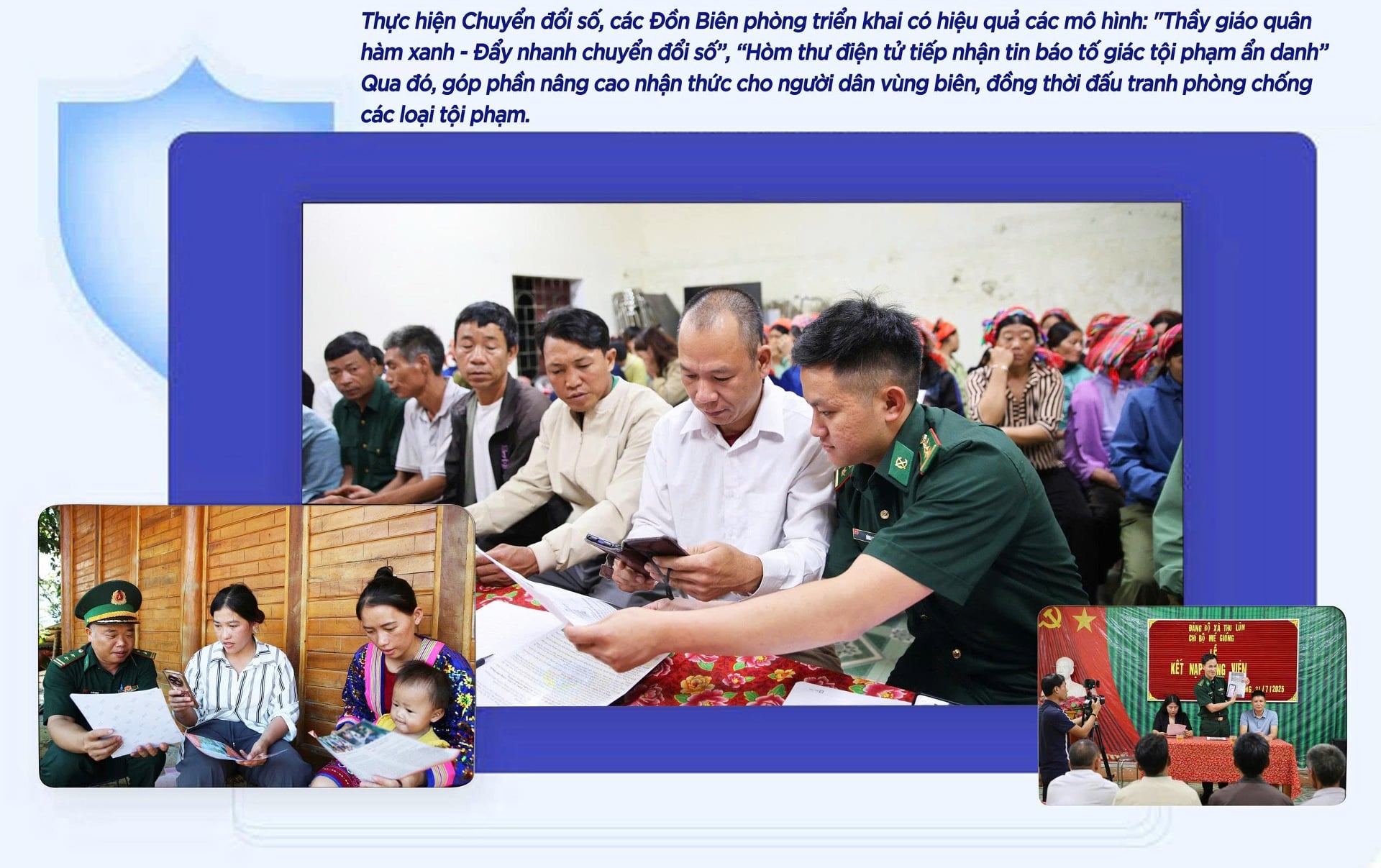
These days, officers and soldiers of the Ka Lăng Border Guard Post (Thu Lũm commune) are working tirelessly day and night, rain or shine, going to each village and household to educate and guide people on using smartphones to access online public service portals to handle administrative procedures, search for useful information for social life and entertainment, and scan QR codes to report crimes. Even though the people's literacy is limited and they may not understand after one or two explanations, the soldiers in green uniforms diligently explain each step slowly and carefully so that everyone can follow along.
After the reorganization of commune-level administrative units, the province now has 11 border communes with 25,043 households and over 119,230 inhabitants, mainly ethnic minorities such as the Thai, Mong, Dao, Giay, Ha Nhi, and Mang. Recognizing the profound humanitarian significance of bringing digital technology to the people in border areas, contributing to raising their intellectual level, providing access to information, laws, and new knowledge, and gradually changing their mindset and practices towards a more civilized and modern life, the Party Committee and the Border Guard Command of the province have decisively directed digital transformation as a central and continuous task to build a strong border region.
Based on that, the Party Committee and the Command of the Provincial Border Guard have organized the thorough understanding and effective implementation of directives and resolutions from all levels on digital transformation, focusing on: Resolution No. 57-NQ/TW dated December 22, 2024, of the Politburo on breakthroughs in the development of science, technology, innovation, and national digital transformation; Resolution No. 09-NQ/TU dated February 25, 2022, of the Provincial Party Committee on the Lai Chau Provincial Digital Transformation Program for the period 2021-2025, with orientation to 2030. They have proactively developed a plan to implement the "Digital Literacy Movement" and created conditions for officers to participate in training and professional development on digital transformation. In particular, the Provincial Border Guard Command directed border guard posts throughout the province to effectively implement models such as: "Military-trained teachers - Accelerating digital transformation," establishing "Digital skills consulting teams," and "Digital support teams" with the motto "going to every village, every hut, guiding every person"; "Anonymous email mailbox for receiving crime reports," and "Email mailbox for implementing grassroots democracy"...
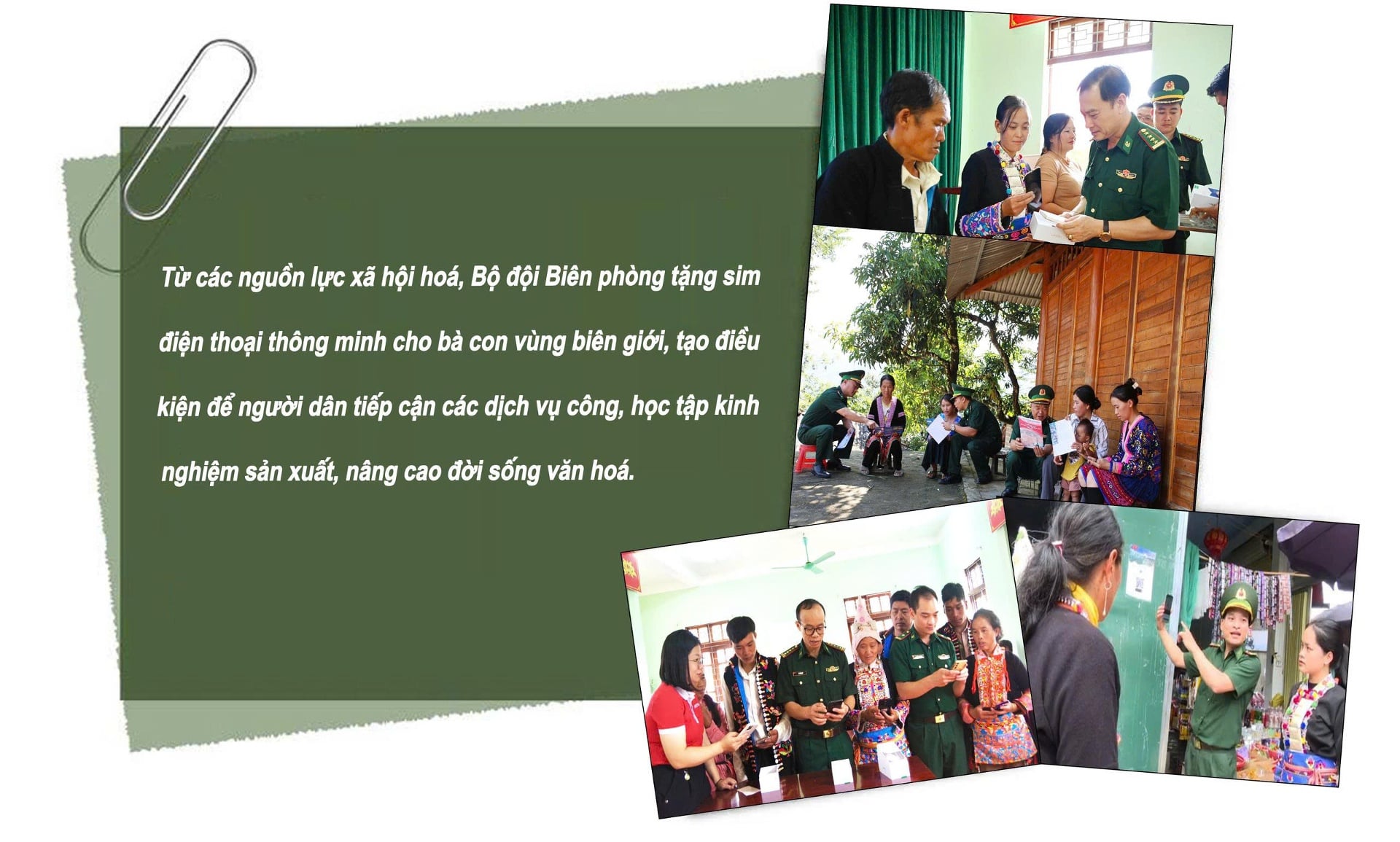
Simultaneously, the Party Committee and the Command of the Provincial Border Guard Force, in coordination with telecommunications units, surveyed and compiled statistics on areas with poor telephone and internet coverage; developed a plan to upgrade infrastructure to provide widespread telephone and internet coverage in border areas to serve national defense and security, digital transformation, and the needs of the people. They surveyed and assessed the current state of people's access to digital transformation, their level of awareness, and their ability to purchase smartphones. They actively promoted and mobilized resources from agencies, units, organizations, and individuals; and simultaneously collected donations from officers and soldiers at border guard posts to provide smartphones to people in border areas, thereby promoting the pioneering role of the Ho Chi Minh Army under the slogan "Where there is a need, where there is difficulty, the Border Guard Force is there."
With many solutions implemented synchronously in digital transformation and the "Digital Literacy Movement," to date, more than 20,000 people have received guidance and instruction from military instructors on using digital applications for information retrieval, learning, administrative transactions, and livestreaming product promotion on social media platforms. The Border Guard Command of the province mobilized agencies, units, organizations, and individuals to contribute resources to donate 135 smartphones (worth over 270 million VND) to people in border villages. They also received support for digital transformation in border areas from Lieutenant General Nguyen Van Long, Deputy Minister of Public Security , who mobilized resources to purchase 1,000 smartphones and 200 Nubia V70 Design 8GB 256GB phones with a total value of nearly 2.6 billion VND for people in border areas.
Through the "Anonymous Email for Reporting Crimes" model, border guard posts received 75 reports, 31 of which were valuable. Based on these reports, the Border Guard Force, in coordination with other functional forces, successfully investigated and prosecuted 2 major cases and 4 other cases, arresting 7 individuals involved in drug trafficking and illegal cross-border goods smuggling; seized evidence included 2 blocks of heroin, nearly 3 kg of dried betel nuts, 2 motorcycles, and 1 mobile phone.
The most important aspect of the provincial Border Guard's digital transformation and the "Digital Literacy Movement" is the continuous improvement of awareness among people in border areas. As a result, the people are united and wholeheartedly cooperate with the Border Guard in the fierce fight against all types of crime, firmly protecting national sovereignty and border security.
Source: https://baolaichau.vn/xa-hoi/nang-cao-nang-luc-ung-dung-cong-nghe-thong-tin-cho-nguoi-dan-758337
![[Photo] Closing Ceremony of the 10th Session of the 15th National Assembly](/_next/image?url=https%3A%2F%2Fvphoto.vietnam.vn%2Fthumb%2F1200x675%2Fvietnam%2Fresource%2FIMAGE%2F2025%2F12%2F11%2F1765448959967_image-1437-jpg.webp&w=3840&q=75)



![[Photo] Prime Minister Pham Minh Chinh holds a phone call with the CEO of Russia's Rosatom Corporation.](/_next/image?url=https%3A%2F%2Fvphoto.vietnam.vn%2Fthumb%2F1200x675%2Fvietnam%2Fresource%2FIMAGE%2F2025%2F12%2F11%2F1765464552365_dsc-5295-jpg.webp&w=3840&q=75)
































![[OFFICIAL] MISA GROUP ANNOUNCES ITS PIONEERING BRAND POSITIONING IN BUILDING AGENTIC AI FOR BUSINESSES, HOUSEHOLDS, AND THE GOVERNMENT](https://vphoto.vietnam.vn/thumb/402x226/vietnam/resource/IMAGE/2025/12/11/1765444754256_agentic-ai_postfb-scaled.png)










































Comment (0)