

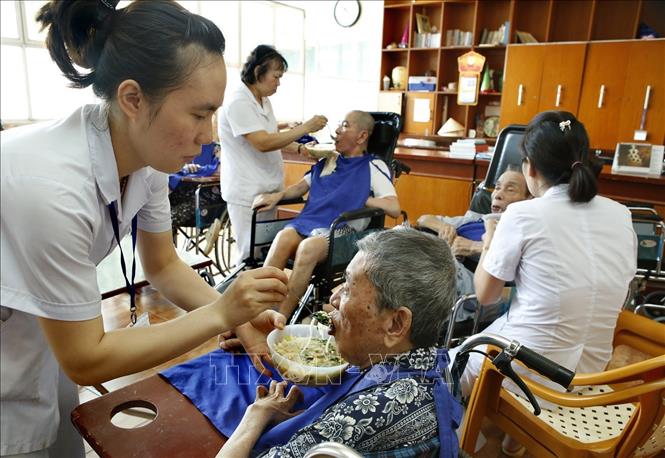
In particular, following General Secretary To Lam's speech at the National Conference on the Implementation of the Politburo 's Four New Resolutions held on September 16th, it can be expected that the model of nursing homes, especially semi-residential nursing homes, will develop more significantly in the coming time.
Unlike the "full-time nursing home" model, where the elderly live permanently at the facility, the "part-time nursing home" model allows senior citizens to come for daily activities, medical care, and community engagement, while returning home to their children and grandchildren in the evening.
The Vietnam Institute for Real Estate Market Research and Evaluation (VARS IRE) believes that this is a solution that strikes a balance between the traditional "living with family" and the need for professional care for the elderly.
However, this concept is still very new, and most existing facilities operate full-time and are often overcrowded. In the context of a rapidly aging population, developing a system of day-care nursing homes would be a suitable solution given Vietnam's cultural, social, and economic conditions.
VARS IRE experts analyze that the semi-residential nursing home model not only contributes to providing attentive care for the growing elderly population but also demonstrates the gratitude of descendants towards the older generation. From a supply-demand perspective, this model will also drive new development in the nursing home real estate segment.
VARS IRE cites information from the Ministry of Health, stating that, in general, most elderly people suffer from chronic diseases such as diabetes, cardiovascular disease, and musculoskeletal disorders; on average, each person has three or more diseases. Therefore, the need for regular health check-ups and specialized medical care is very great.
Ms. Kim Anh (Hanoi) shared that despite receiving excellent care at home and having a personal caregiver, her mother, over 80 years old, began showing signs of dementia and falling into "senile depression," even failing to recognize her own daughter. After learning from friends' experiences, she sought help from the Kaigo Nursing Home, hoping to improve her mother's care.
The results were surprising because, thanks to professional and dedicated care and a suitable environment, her mother became much more alert and healthier. The life of the over 80-year-old woman has improved significantly at the nursing home – which Kim Anh affectionately calls her mother's "boarding school".
Furthermore, many elderly people desire professional medical care while maintaining emotional connections with their families. In Vietnam, several specialized healthcare apartment projects have emerged near family residences; however, the costs often exceed the affordability of most people.
Therefore, the semi-residential nursing home model is also expected to contribute to solving this problem, helping the elderly to maintain their health while avoiding feelings of loneliness. Not only does this model benefit the elderly, but it also allows the younger generation to work with peace of mind.
Due to the pressures of life, many young workers find it difficult to stay home regularly to care for their parents. Sending their parents to a daytime nursing home allows them to focus on their careers while still maintaining family ties.
From a modern perspective, this is not a sign of "distance" but rather a way for children to express their responsibility and love. This also aligns with the tradition of "remembering one's roots."
In fact, the concept of "day-care nursing homes" is still quite new. Most existing facilities still operate on a full-time model. Only a few nursing homes allow residents to be admitted in the morning and returned in the evening. However, a common characteristic of these centers is that they are all overcrowded.
VARS IRE believes that, in the context of a rapidly aging population, developing a system of day-care facilities would be a suitable solution given Vietnam's cultural, social, and economic conditions.
Each age group requires a suitable supportive environment. Just as children need daycare centers for their early years, the elderly also need "daytime nursing homes" to receive healthcare, socialize, and live happy and meaningful lives. However, the cost of an average nursing home stay is currently relatively high, exceeding pensions or support from children and grandchildren.
Specifically, according to statistics up to the end of 2024, the average pension of beneficiaries is 6.2 million VND/month, while the average cost of old-age care is 10 million VND per month.
Therefore, for this model to truly become a reality, in addition to social welfare policies and health insurance to reduce costs for the elderly, the State needs to research and enact preferential policies on land allocation and credit for elderly care projects to encourage businesses to participate in developing this potential segment.
Troy Griffiths, Deputy Managing Director of Savills Vietnam, commented that in Vietnam, the market has many levers to support the development of retirement properties specifically for the elderly. Particularly noteworthy are the increasingly popular insurance packages that complement investment values. In the future, the traditional family model will gradually change, creating more opportunities for the retirement housing segment.
Vietnam entered the stage of population aging in 2011 and is experiencing the fastest aging rate in the world. According to the National Population Data, the country currently has approximately 16.1 million elderly people, accounting for over 16% of the population. It is projected that by 2038, Vietnam will enter a period of an aging population. One in five Vietnamese people will be over 60 years old, leading to a growing need for healthcare, mental well-being, and living standards for the elderly.
Recognizing this trend, many businesses have proactively invested in products to meet market demand. For example, since mid-2022, Intracom Group has invested in building the Asahi Oriental Nursing Home, located within the nearly 10-hectare Oriental Medical Complex, designed in a modern art-décor style and equipped with numerous amenities.
Asahi Oriental Nursing Home is a pioneering initiative in Vietnam, integrating nursing homes with a unique healthcare system, amenities, and green spaces in the heart of Hanoi. Asahi Oriental Nursing Home offers a variety of services, including: inpatient care for elderly individuals requiring long-term accommodation or those with underlying or serious illnesses; and day care for busy families or elderly individuals seeking a world-class resort-style experience.
Here, the elderly receive initial health check-ups, advice on suitable retirement and care packages from experienced medical, nutritional, and nursing professionals; combined with a system of modern equipment that effectively supports the care and treatment of geriatric diseases...
Similarly, in 2024, Well Group and Vingroup Corporation, including Vinmec Healthcare System and VinMedtech Company, jointly implemented a healthcare model for the elderly based on the strict and high-end standards of Japan in Vinhomes urban areas under Vingroup Corporation. Accordingly, Vinhomes Ocean Park 2 will be the first in the entire Vinhomes urban chain to implement this model, pioneering the opening of an international standard elderly care model right in the heart of urban areas in Vietnam.
In this project, Well Group will invest in equipment and human resources by bringing experts and caregiving teams from Japan to Vietnam to directly operate and manage healthcare facilities for the elderly, ensuring high-quality services according to Japanese standards.
On Vingroup's part, VinMedtech Company is investing in infrastructure to meet the specialized technical standards for elderly healthcare. The Vinmec Healthcare System will contribute its expertise in disease management, care, and treatment for the elderly.
The international-standard elderly healthcare model is implemented by three parties in two forms: day care for the elderly and long-term care for the elderly (nursing homes).
However, not every family has the financial means to send their elderly relatives to high-quality nursing homes. But to expand, diversify the model, and make it truly effective, VARS IRE believes that, in addition to social welfare policies, it needs to be combined with health insurance.
At the same time, the State has issued preferential policies on land allocation and credit to encourage businesses to participate. This will lead to the creation of products at reasonable costs, suitable for the needs of more people.
Source: https://baotintuc.vn/xa-hoi/nha-duong-lao-ban-tru-can-chinh-sach-mo-duong-20250921123420094.htm


































































Comment (0)