

Video: Hanoi has the 3rd most polluted air in the world , the sky is hazy from morning to noon.
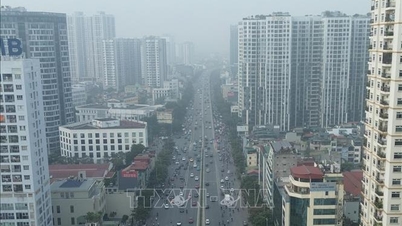
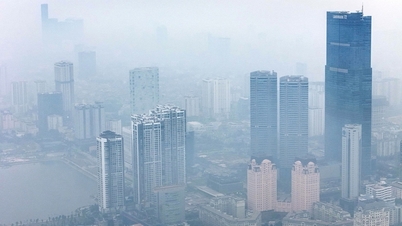
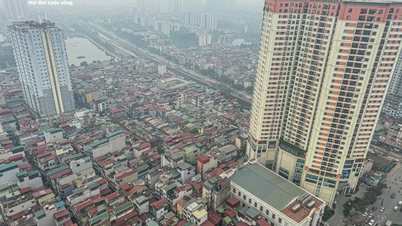
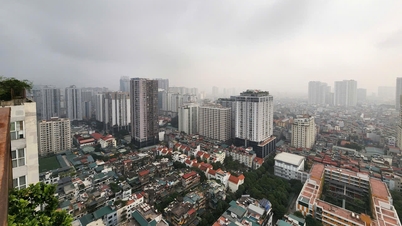
Since November 2023, air pollution in Hanoi and the northern provinces has been at a bad level for many days, greatly affecting people's health. A layer of white fog and fine dust continuously covers the capital.
On the morning of December 3, the IQ Air application continuously ranked Hanoi in the top 10 most polluted cities in the world. At one point, the application ranked Hanoi as the third most polluted city in the world.

At 8:30 a.m. on December 3, the IQAir application recorded the air quality index (AQI) in Hanoi as the third highest in the world at 182, not good for sensitive people.
At 11:00 a.m. the same day, measuring point 556 Nguyen Van Cu (Long Bien district) under the Department of Environmental Pollution Control ( Ministry of Natural Resources and Environment ) displayed an AQI of 160, a bad air level. From 7:00 a.m. to 12:00 p.m., this index continuously fluctuated at a bad level, specifically at 7:00 a.m. it was 151, at 8:00 a.m. it was 162, at 9:00 a.m. it was 167, and at 10:00 a.m. it was 165.
The Environmental Pollution Control Department warns that while normal people are starting to experience health effects, sensitive groups may experience serious health problems.
According to the PAM Air application, at 12:30, the AQI at the Vietnam Forestry University (Chuong My district, Hanoi) was measured at 186, and at the Co Am Commune Library (Vinh Bao district, Hai Phong) was 198, harmful to health. These are places with high AQI index.
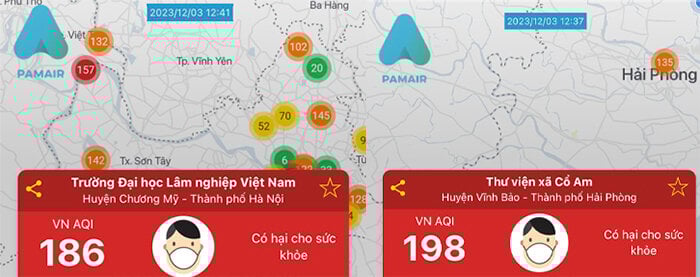
Places with high air pollution index at noon today, December 3, according to PAM Air application.
Why is Hanoi air pollution so severe?
Responding to VTC News reporter, Dr. Hoang Duong Tung, Chairman of Vietnam Clean Air Network, said that the main cause of environmental pollution is from human activities and the impact of weather and climate.
According to analysis by Dr. Hoang Duong Tung, inside and outside Hanoi, many recycling facilities such as aluminum and lead recycling... do not have exhaust gas treatment systems according to environmental protection regulations. They produce but do not comply with regulations, leading to pollution.
In addition, personal vehicles such as cars and motorbikes using gasoline and oil are also the cause of air pollution. According to statistics, Hanoi currently has nearly 7 million motorbikes in circulation, many of which are old and not regularly maintained, emitting black smoke into the environment... which is a source of PM2.5 fine dust emissions. This is also one of the main causes of air pollution.
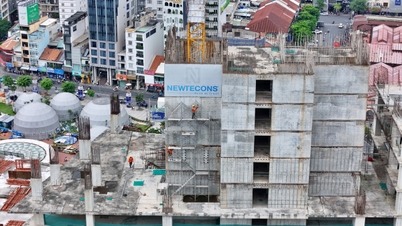
"For a long time, a series of constructions in Hanoi such as roads, bridges, sewers and housing constructions were built and repaired, but the problem of covering up dust and dirt was neglected.
Garbage burning also happens a lot, especially in suburban districts where we do not manage it well, so garbage is burned. In addition, twice a year during the rice harvest, people burn straw," said the Chairman of the Vietnam Clean Air Network.
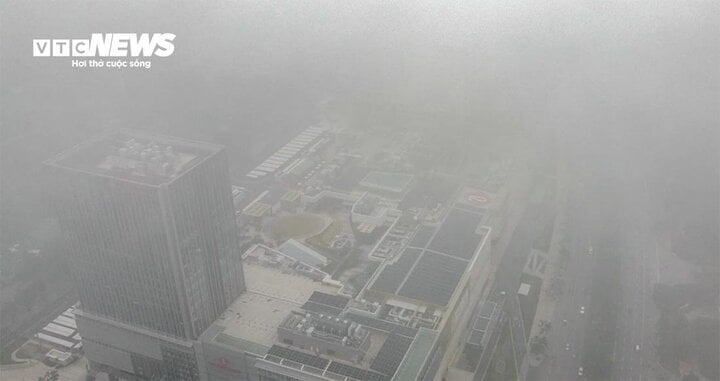
At 7am on December 3, Tay Ho district (Hanoi) was covered in a thick layer of fog, the air was dense. (Photo: Ngo Nhung)
According to Dr. Hoang Duong Tung, another reason is the climate and weather. With the same emission source, the air is very clean during the summer months. Although PM2.5 fine dust is released into the air a lot, it is washed away by rains, storms or dispersed to other areas by strong winds.
In winter, the weather is humid and the wind is very still, so fine dust lingers in the low layers. This is a characteristic of the northern provinces, including Hanoi, so in winter, the air is heavily polluted on many days.
In fact, as pointed out by Dr. Hoang Duong Tung, many countries in the world have restricted personal transportation and built public transportation systems such as buses, elevated trains, etc. Because they are considered sources of pollution, many cities in the world have restricted motorbikes, gasoline and diesel cars and encouraged the use of electric vehicles.
There have been cities in the world where the AQI index was often high in the past, but thanks to the efforts of the government, people, and businesses, the index has improved a lot, which is remarkable. However, in Hanoi, the air pollution level has been monitored at a high level for many days, which is very worrying.
Mr. Tung added that before such polluted days, many people feel very uncomfortable, especially through surveys at hospitals, the rate of patients coming for examination related to respiratory diseases is very high.
"People must first protect themselves, must regularly monitor websites or apps with AQI index to know the area they live in and the level of air pollution.
Air pollution affects health, people need to limit going outside. When going out, you must wear a mask that can protect against PM 2.5 fine dust, close the doors at home, and when coming back from outside, you must wash your eyes and nose according to the recommendations of the Ministry of Health," Dr. Hoang Duong Tung advised.
Control of activities generating emissions and dust
The Department of Environmental Pollution Control recently issued a document requesting the Department of Natural Resources and Environment of provinces and centrally-run cities to urgently direct and concentrate resources to implement drastic solutions to control activities that generate emissions and dust in the provinces and cities.
This is to strengthen air pollution control. Air pollution in some localities in the Northern Delta provinces, especially Hanoi and neighboring provinces, is getting worse, threatening public health and socio-economic development activities.
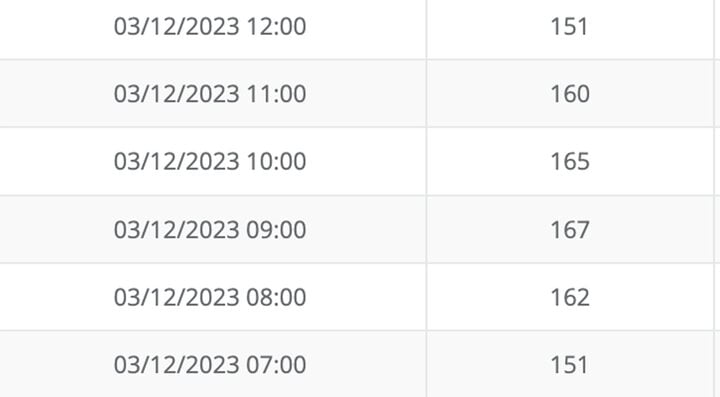
Measuring point 556 Nguyen Van Cu (Long Bien district) under the Department of Environmental Pollution Control (Ministry of Natural Resources and Environment) shows the air quality index AQI from 7am to 12pm continuously fluctuating at a bad level.
Specifically, the Department of Environmental Pollution Control stated that the impact of seasonal weather conditions with many adverse fluctuations, large day-night differences in temperature, humidity, wind direction and speed, heat radiation... in the air also contributes to affecting the ability to diffuse pollutants in the air, especially PM10 dust and PM2.5 fine dust.
In addition, the situation of people burning waste, burning straw, agricultural by-products in the fields (open burning and scattered burning) is still very common and frequent for many years without effective measures to prevent it, increasing air pollution and smog in urban areas and concentrated residential areas.
The Department of Environmental Pollution Control requests the Department of Natural Resources and Environment of provinces and centrally-run cities to organize inspection and monitoring of emission sources (especially sources from open burning points, waste burning, burning of straw, agricultural by-products, construction areas; point sources from industrial production facilities).
Localities need to require industrial production facilities in the area to strictly implement control measures and ensure that exhaust gas treatment meets environmental technical standards, especially facilities that generate large sources of dust and exhaust gas.
In addition, localities also need to urge and monitor production facilities that are required to install automatic emission monitoring and transmit data to the Department of Natural Resources and Environment according to regulations.
The Department also requested units to advise people to immediately apply health protection solutions, especially for groups of people who have outdoor activities between 5am and 7am and 2pm and 7pm.
The Department of Environmental Pollution Control requested the Department of Natural Resources and Environment to report to the Provincial and Municipal People's Committees to direct the District and Commune People's Committees and functional units to strengthen propaganda and mobilize people not to burn solid waste, straw, and agricultural by-products after harvest to reduce emissions and dust causing environmental pollution. Regularly inspect the actual situation, identify and promptly prevent open burning activities in the area.
At the same time, localities need to have radical solutions, fully recover and reuse agricultural by-products for other purposes, limit burning in fields causing environmental pollution; strictly handle violations of environmental protection laws for burning domestic solid waste in violation of regulations.
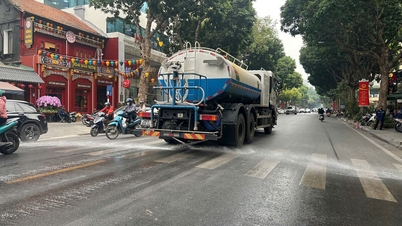
Localities direct relevant functional units to organize inspections and urge project owners, management units, and construction, traffic, and urban infrastructure renovation projects to strictly implement measures to prevent and minimize the spread of dust and emissions into the surrounding environment (covering construction sites, vehicles transporting construction materials and waste, spraying water, washing roads, washing vehicles entering and exiting demolition sites, construction sites, etc.).
Nguyen Hue
Source
























![[Photo] Worshiping the Tuyet Son statue - a nearly 400-year-old treasure at Keo Pagoda](/_next/image?url=https%3A%2F%2Fvphoto.vietnam.vn%2Fthumb%2F1200x675%2Fvietnam%2Fresource%2FIMAGE%2F2025%2F12%2F02%2F1764679323086_ndo_br_tempimageomw0hi-4884-jpg.webp&w=3840&q=75)
![[Photo] Parade to celebrate the 50th anniversary of Laos' National Day](/_next/image?url=https%3A%2F%2Fvphoto.vietnam.vn%2Fthumb%2F1200x675%2Fvietnam%2Fresource%2FIMAGE%2F2025%2F12%2F02%2F1764691918289_ndo_br_0-jpg.webp&w=3840&q=75)
































































Comment (0)