


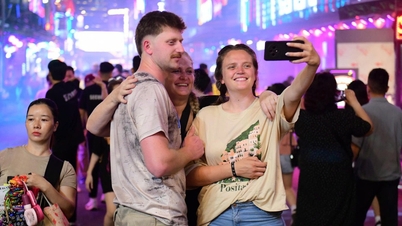
Looking at the global tourism picture in 2025, it can be seen that Gen Z (those born between 1997 and 2012) are using travel as a way to answer questions about identity, purpose and connection.
Concert tickets sold out like Taylor Swift's show, or young people diligently checking in at every location in Seoul after the K-pop animation Demon Hunters, have caused the phrase "doom spending" to appear frequently.
But if we observe carefully, we will see that this behavior is not just impulsive, but also reflects the complex psychology of young people in the context of important life goals such as stabilizing their jobs, buying a house, starting a family, etc. becoming increasingly burdensome.
Morgan Housel, author of The Psychology of Money, shared on Fortune that when young people have not found their purpose in life or sustainable values such as a stable career, family or contributing to the community, they easily turn to recognition through material things and experiences.
Gen Z today is under great pressure: inflation, rising living costs, the risk of losing their jobs, and the opportunity to buy a house or start a family is not easy. When long-term goals are difficult to achieve, they seek short-term joy but bring an immediate sense of achievement, it can be a trip, a shared meal or the opportunity to meet their idol...
From these motivations, a more diverse travel trend has emerged. Gen Z not only “spends” but also “invests” in experiences in a creative way. A prominent example is volunteer tourism - where labor is converted into accommodation and meals.
Platforms like Workaway, Worldpackers, WWOOF… attract millions of young people to work a few hours a day in exchange for the opportunity to live on a New Zealand farm, teach English in a Thai village school, or help promote a homestay in Costa Rica.
Worldpackers alone has attracted more than 7 million members from 140 countries. CEO Ricardo Lima said that the younger generation is not looking for luxury. They want to experience real life, to give and learn, to be part of a community, not just a passing guest.
Meanwhile, Gen Z is transforming the luxury travel market. Cruises, once a “playground” for the middle-aged, are now appealing to young people again. The British Travel Association (Abta) said that nearly 20% of 25-34 year olds have gone on a cruise in the past 12 months, double the number in 2019.
Quickly catching on to this trend, Royal Caribbean Group has designed 3-4 night itineraries, adding many entertainment amenities and “virtual living” spaces to suit young people’s tastes. This direction has helped Royal Caribbean reach a value of about 70 billion USD, far surpassing Carnival (35 billion USD) and Norwegian Cruise Line (9 billion USD).
Bank of America data also shows that US household spending on cruise vacations increased 9% in September 2025 compared to the same period last year, while spending on hotels and airlines decreased. This has forced cruise lines to rethink their products: Icon of the Seas focuses on amenities for content creation; Wonder of the Seas and Mardi Gras are optimized for short trips with "dense" experiences for young people...

Promote tourist exchange
In Vietnam, Gen Z has similar characteristics but still has its own nuances. According to Vietnam Report (December 1), the average Vietnamese person travels 2-3 times per year; the group of customers spending 10-15 million VND accounts for nearly 37%, while the group above spending 15 million VND is increasing rapidly in urban areas.
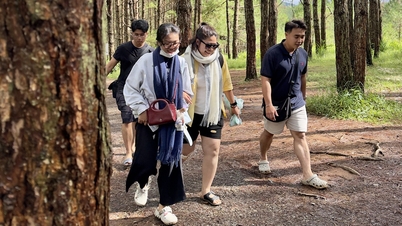
For Gen Z, nearly 54% plan to travel more in 2026, although the cost per trip is still modest (3 - 5 million VND). Most are not married yet, so they are ready to take on challenges with backpacking, trekking, camping... to both assert themselves and create a personal mark.
Their journeys are marked by a strong sense of autonomy, with 31% opting for personal vehicles for flexibility and freedom. Social media, friends and online communities become a determining factor in where they go, their style and how they tell their story.
Technology, especially AI, plays a key role. Booking.com reports that 99% of Gen Z use AI before a trip, with 42% wanting personalized recommendations, 40% choosing AI to find the best time…
Branavan Aruljothi, Director of Booking.com Vietnam, said that AI not only simplifies choices but also increases inspiration, helping Gen Z confidently build an itinerary that suits their budget and interests. AI becomes a bridge between the desire to be “different” and the problem of limited finances.
Despite their love of experiences, Gen Z still spends money wisely: 62% choose low season, 63% hunt for discount codes and loyalty offers. When planning for 2026, up to 69% prioritize unique experiences such as skydiving or hot air ballooning - activities that are personal and easy to go viral...
Source: https://baovanhoa.vn/du-lich/the-he-gen-z-dang-lam-thay-doi-thi-truong-du-lich-toan-cau-186001.html


![[Photo] National Assembly Chairman Tran Thanh Man attends the VinFuture 2025 Award Ceremony](/_next/image?url=https%3A%2F%2Fvphoto.vietnam.vn%2Fthumb%2F1200x675%2Fvietnam%2Fresource%2FIMAGE%2F2025%2F12%2F05%2F1764951162416_2628509768338816493-6995-jpg.webp&w=3840&q=75)
![[Photo] 60th Anniversary of the Founding of the Vietnam Association of Photographic Artists](/_next/image?url=https%3A%2F%2Fvphoto.vietnam.vn%2Fthumb%2F1200x675%2Fvietnam%2Fresource%2FIMAGE%2F2025%2F12%2F05%2F1764935864512_a1-bnd-0841-9740-jpg.webp&w=3840&q=75)
















































































Comment (0)