

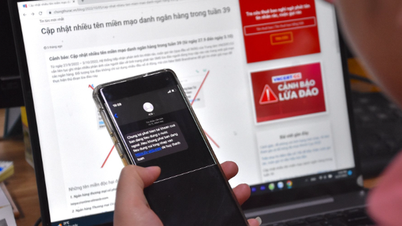
Online scams are on the rise, with most involving fake websites impersonating financial institutions and banks.
Increased cyberattacks on banks.
Data from the Ministry of Information and Communications shows that in the first half of 2023, the agency received more than 4,000 reports from internet users about fraudulent activities. Of these, more than 95% were scams targeting the banking and financial sectors.
Recently, there have been numerous cyberattacks targeting banks.
In 2021, according to the "Security Endpoint Threat Report," Vietnam ranked second in Asia in the number of ransomware infections, a 200% increase compared to 2020.
A 2021 study by Viettel Network Company also showed that 90% of cyberattacks in 2021 were related to the financial and banking system, an increase of 42.4% compared to 2020.
In 2022, Group-IB, a cybersecurity company headquartered in Singapore, detected an unprecedented phishing attack in Vietnam.
Accordingly, 240 fraudulent linked domains were used to impersonate 27 familiar Vietnamese financial institutions and banks in an attempt to collect customers' personal information, even stealing their bank accounts and using techniques to bypass OTP verification.
At the seminar on sharing experiences in implementing data security solutions for the banking sector, held on the morning of October 6th, representatives from CDNetworks shared the latest updates on the current cybersecurity situation.
According to CDNetworks experts, banks often face Layer 3/4 attacks, Layer 7 DDoS attacks, and attacks on web applications using a variety of attack methods.
Cyberattacks have also become more sophisticated, with statistics showing that over 87% of attacks involve a combination of two or more attack methods.
In addition, the banking system also faces the risk of slow connectivity with global applications, significantly impacting customer experience.
The bank issued continuous warnings.
In response to this situation, banks are constantly issuing warnings about new scams aimed at stealing customer accounts.
According to Agribank , recently, taking advantage of the borrowing needs of some people, many individuals have impersonated bank employees to create Facebook Fanpages/Groups/accounts disguised as "customer care," "customer support," "quick loans," "unsecured loan support," "online loans," etc., in order to commit fraud and embezzle assets.
The scammers will ask customers to provide information (phone number, personal information), then call them directly to offer advice, invite them to take out loans, and request them to transfer various fees.
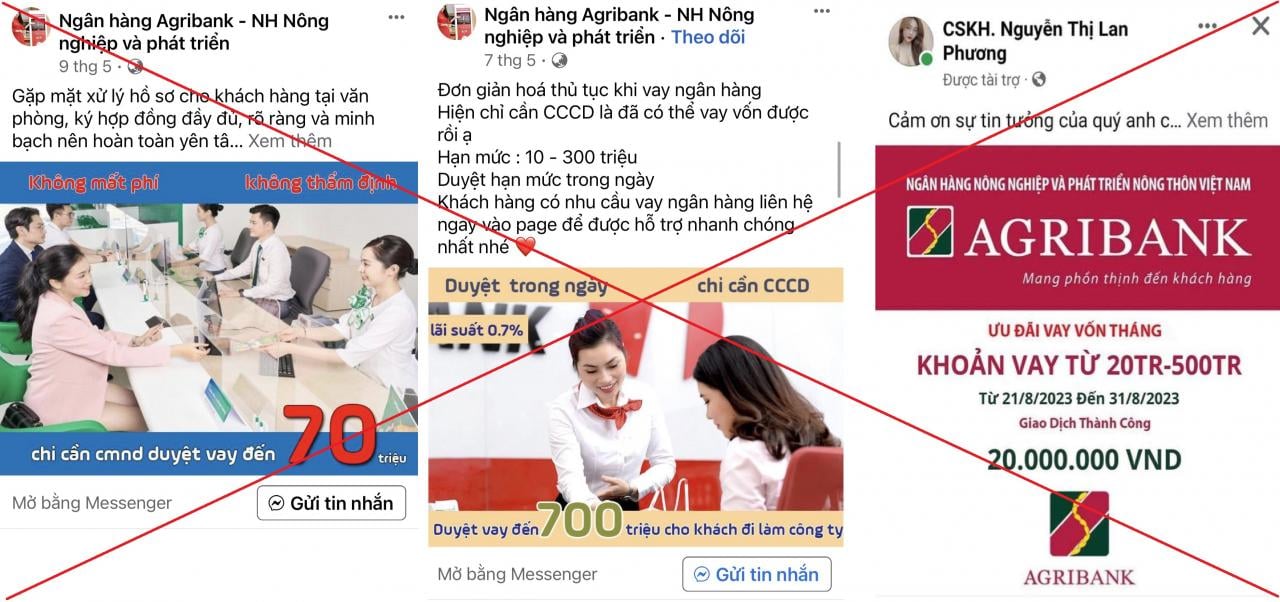
Agribank warns about fake bank websites.
Scammers create hundreds of websites/Facebook accounts with fake information, join groups and forums, and post advertisements for unsecured loans with low interest rates, simple procedures, no need for face-to-face meetings; loans even for those with bad credit; no collateral, no credit check, just an ID card/Citizen's Identity Card and a bank account/ATM card are needed to borrow money...
When a borrower approaches, the perpetrators will lure them into providing personal information such as: full name, phone number, photos of ID cards/citizen identification cards, portrait photos, etc., for loan application processing. Then, the perpetrators will request the borrower to transfer a small amount of money upfront (approximately 500,000 to 5 million VND) to cover verification and loan approval costs.
After tricking borrowers into transferring money for verification and loan approval, the perpetrators then cite a series of reasons why the loan is not disbursed, stemming from errors in the borrower's application (such as incorrectly stating the beneficiary's name, changing the spelling of the beneficiary's name from lowercase to uppercase, not meeting the loan eligibility requirements, having extra or incorrect digits on the citizen identification number, etc.).
From there, they require borrowers to deposit additional funds to secure the loan or fix system errors; promising to return the money sent to customers after the loan is disbursed. However, when borrowers transfer money to the accounts provided by the perpetrators, the perpetrators immediately embezzle the funds and cut off communication.
If customers fail to transfer the money as requested, they will threaten the customers by claiming their loan has been classified as a bad debt in order to force them to transfer the money.
With this sophisticated scam, victims not only lose money but also lose all their personal information and identity, potentially leading to further exploitation for other illegal activities, such as registering SIM cards under false names, opening bank accounts and e-wallets for fraudulent activities, money laundering, and online gambling.
Banks advise customers not to access any fake website/fanpage/Facebook links impersonating bank officials offering quick loan assistance and expedited procedures. Do not provide any personal information (ID card/Citizen ID, address, facial recognition photos, etc.) without verifying the website, application, and identity of the consultant.
Do not provide bank account information or OTP codes sent to your email or mobile phone to these individuals. Do not transfer money to personal accounts provided or used by strangers as a means of deception.
Vietnamnet.vn





























![[Photo] Prime Minister Pham Minh Chinh holds a phone call with the CEO of Russia's Rosatom Corporation.](/_next/image?url=https%3A%2F%2Fvphoto.vietnam.vn%2Fthumb%2F1200x675%2Fvietnam%2Fresource%2FIMAGE%2F2025%2F12%2F11%2F1765464552365_dsc-5295-jpg.webp&w=3840&q=75)















































Comment (0)