

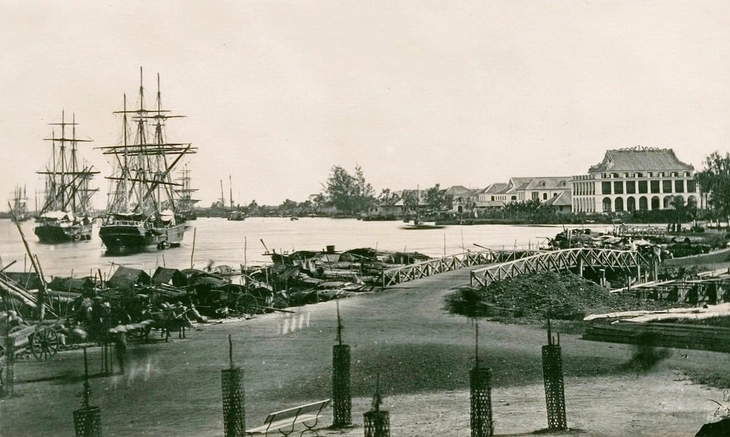
Saigon commercial port in 1866 – Photo: Emile Gsell
For 165 years, Saigon port has been a special historical witness of the colonial invasion period and the heroic defense of the Vietnamese people, and later the period of peace , development, and happiness for the people.
Saigon Port has a special location as the center of the region with the Saigon River 12-20m deep for large tonnage ships to enter and exit conveniently. Therefore, France and the US both chose this place as the port to receive human resources and weapons to conduct war and develop trade later.
From the pier of the invasion fleet
Just one year after the French occupied Gia Dinh citadel – on February 10, 1860, the commander of the French expeditionary force in Saigon announced the opening of Saigon port. In it, 16 provisions were stipulated on travel and taxation of ships exporting and importing goods. This document was widely published to French diplomatic agencies abroad to be sent to the press and business circles of many countries.
The French Government supported the Compagnie des Messageries shipping company to build the port. The purpose was to establish a berth for warships and to receive manpower and weapons shipped from France. From here, France began to exploit the colonies of Vietnam and Indochina for nearly 100 years.
On November 23, 1862, the first steamship of the Compagnie des Messageries opened the sea route from France to the commercial port of Saigon. In 1863, the port officially opened for international trade with the name Port de Commerce de Saigon. In early 1864, the construction of the company's headquarters and project, Nha Rong Wharf, was completed. In 1872, the Chargens Réunis shipping company participated in the construction of a new port, contributing to the completion of the construction of the commercial port of Saigon.
By 1911, Saigon commercial port was divided into two parts: the military port and the commercial port. The military port land was 600m long from Ba Son Factory to Rigault de Gerouilly construction site (now Me Linh construction site). This was the area where the warship and cargo ship repair plant was built. The commercial port land was also 600m long from Me Linh construction site to Khanh Hoi bridgehead, where warships and cargo ships were moored.
Due to the need for large ships to dock, in 1912, France expanded Saigon commercial port from Khanh Hoi bridge to the Te canal intersection - near Tan Thuan bridge (next to Nguyen Tat Thanh street, old district 4) to promote colonial exploitation and serve World War I.
According to Dr. Nguyen Thi Hoa Xinh - former director of the Ho Chi Minh Museum branch in Ho Chi Minh City, the early period of the port's formation was military in nature. Only at the end of the 19th century, when the invasion and pacification were temporarily stable, did France expand the port's operations for commercial purposes as a traffic hub for import and export of goods to serve the French policy of domination and colonial exploitation.
The historic victory of Dien Bien Phu in 1954 forced France to withdraw from Indochina. On January 1, 1955, the French Government signed a contract to hand over Saigon commercial port to the Saigon government for management. From then on, Saigon commercial port had a new name: Saigon Commercial Port Authority.
Later, the US replaced France in the South and also used this port to send ships carrying weapons to launch campaigns to attack the revolution in the South. This shows the very important role of Saigon port in the wars of aggression.
Therefore, immediately after the establishment of the Communist Party of Vietnam in 1930, the Saigon Port Party branch initiated port workers to protest and strike to prevent the unloading of weapons from French and American ships. The protests and strikes took place from 1930 to 1975 to protest the war of aggression.
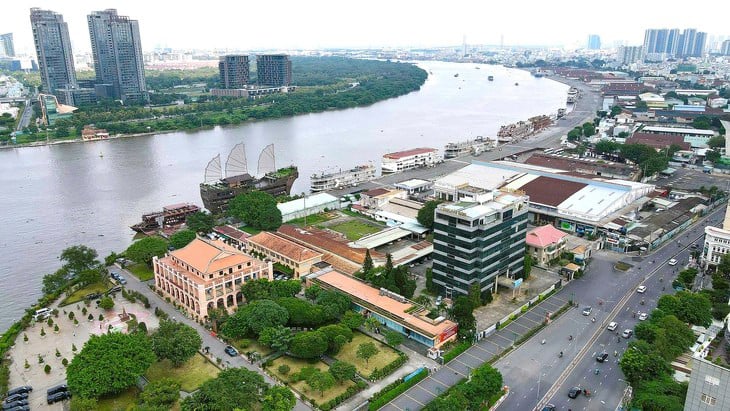
Nha Rong – Khanh Hoi port area is expected to become Ho Chi Minh cultural space, park and expansion of Nguyen Tat Thanh street – Photo: PHUONG NHI
To the economic pier
The United States poured billions of dollars into the Republic of Vietnam's economy and intensified the war to prevent Vietnam from unifying the country. From here, the United States provided economic aid to the South, such as investing in the construction of a series of transport infrastructure projects. Most notably, the construction of the Saigon Bridge, the Dong Nai Bridge, and the Bien Hoa Highway (later called the Hanoi Highway, now Vo Nguyen Giap Street).
In 1963, the Saigon government built Bien Hoa Industrial Park (later called Bien Hoa Industrial Park 1 and the first industrial park in Vietnam) with 94 factories operating to serve the economy of the South.
Accordingly, raw materials and imported and exported goods from Saigon port will be transported via Saigon bridge - Bien Hoa highway - Dong Nai bridge - Bien Hoa industrial park very quickly. With the advantage of the port being located next to the center of Saigon and the Saigon river with a natural depth of 12-20m, it is very convenient for cargo ships with a capacity of up to 30,000 tons to dock. Therefore, the important role of the port in economic activities is further affirmed.
After the country was unified and despite many difficulties, in 1976 Saigon port handled nearly 1.1 million tons of goods. Since 1986, the State has transformed from a subsidized economy to a market economy, the port has also transformed itself to improve its operational capacity. Investment in port facilities and modern loading and unloading equipment meets the requirements of a rapidly growing economy in terms of import and export.
In particular, in 1997, the project with an investment capital of 40 million USD upgraded the infrastructure and loading and unloading equipment at Nha Rong and Khanh Hoi ports. At the same time, Saigon port used more than 300 billion VND from self-funded capital and budget capital to complete the construction of the production control center building. The following year, the port invested in building a 400m container wharf, Tan Thuan 2 bulk cargo loading and unloading port and a general port in Can Tho.
By 2003, the port had invested in increasing the wharf length to 3,035m and the port area to 635,439m2. Previously, in 1975, the port only had a wharf of 1,832m and a port area of 475,000m2. With such an expanded scale, Saigon port can handle cargo at the same time for more than 30 ships.
Most effectively, Saigon Port has invested in upgrading and increasing its cargo handling capacity to 16 million tons/year, 16 times higher than in 1976. It can be said that the Saigon Port brand has effectively accompanied the city's economic development...
Currently, Saigon Port still plays the role of a general commercial port (including bulk cargo and containers) with the leading scale in the Vietnamese seaport system. The port has a fairly complete warehouse system and equipment according to advanced technological processes in the port exploitation industry. At the same time, it was granted ISO 9001:2000 certificate by BVQI (Bureau Veritas Quality International - now Bureau Veritas Certification) for container exploitation and service provision.
Implementing the national marine economic development strategy, Saigon Port has utilized its internal resources and effectively linked with the world's strong maritime corporations, PSA - Singapore, SSA Marine - USA, Maersk A/S - Denmark, to build three modern ports in Cai Mep - Thi Vai area in Ba Ria - Vung Tau province with 2,000m wharf length that can receive ships up to 80,000 DWT, loading and unloading capacity of more than 3.5 million TEU/year, total investment of 800 million USD.
Mr. Le Cong Minh, former chairman of the board of members and general director of Saigon Port, said that for the projects to build a port cluster in Ba Ria - Vung Tau to play a leading role for the entire southern economic region, receiving large ships from 80,000 to 100,000 tons, the port has promoted joint ventures with maritime corporations from the US, Singapore, and Denmark to attract investment capital and high technology in the field of port construction and exploitation.
Saigon Port became a historical witness during the years of national reunification. Many tears and smiles were seen on the ships that came and went here.
>> Part 2: Historic trains
Tuoi Tre Newspaper
Source: https://vimc.co/165-nam-thuong-cang-sai-gon-ky-1-ben-tau-cua-chien-tranh-va-phat-trien/
![[Photo] General Secretary To Lam receives the Director of the Academy of Public Administration and National Economy under the President of the Russian Federation](/_next/image?url=https%3A%2F%2Fvphoto.vietnam.vn%2Fthumb%2F1200x675%2Fvietnam%2Fresource%2FIMAGE%2F2025%2F12%2F08%2F1765200203892_a1-bnd-0933-4198-jpg.webp&w=3840&q=75)








































































Comment (0)