

.jpeg)
Towards standardization and integration
Many universities in Da Nang have achieved outstanding results in quality accreditation, contributing to affirming their prestige and enhancing their position in the Vietnamese higher education system. Among them, the University of Technology (Da Nang University) stands out, currently offering over 30 training programs, including 4 internationally accredited master's programs. The university achieved accreditation according to the European HCERES standard in 2018 and the second cycle in 2024.
According to Associate Professor Dr. Nguyen Huu Hieu, Rector of the University of Technology, over the years, the university has continuously improved and innovated its curriculum content, teaching methods, and invested in facilities to support training. Quality assurance has always been a priority for the university. Currently, the university has 26 undergraduate programs and 4 master's programs that have been certified by international accreditation organizations such as AUN-QA, CTI, and ASIIN. Many programs have undergone re-accreditation for the second, third, and fourth cycles.
Also concerned with the quality of training, the University of Technical Education (Da Nang University) currently has 15 training programs that have been accredited. These programs are accredited according to the standards of Circular No. 04/2016/TT-BGDĐT dated March 14, 2016, of the Ministry of Education and Training .
Associate Professor Dr. Nguyen Le Hung, the school's principal, stated that the school considers quality accreditation a strategic step to affirm its reputation and commitment to students, while also creating a foundation for the sustainable development of its training programs. Therefore, in the initial phase, the school prioritizes selecting leading disciplines with strong training capabilities and high impact for accreditation, such as mechatronics engineering technology and control and automation engineering technology.
According to Associate Professor Dr. Nguyen Le Hung, these two majors belong to the university's large faculties, have a long tradition of training, a team of experienced lecturers, and graduates who achieve good results and are highly valued by businesses. These are favorable conditions that help the program easily access and meet the requirements of the Ministry's educational quality accreditation standards in the first cycle.
These are also sectors with high recruitment demand, closely linked to industrial development trends and digital transformation, so early accreditation helps the school affirm its commitment to training that meets societal needs and enhances the trust of students, employers, and stakeholders.
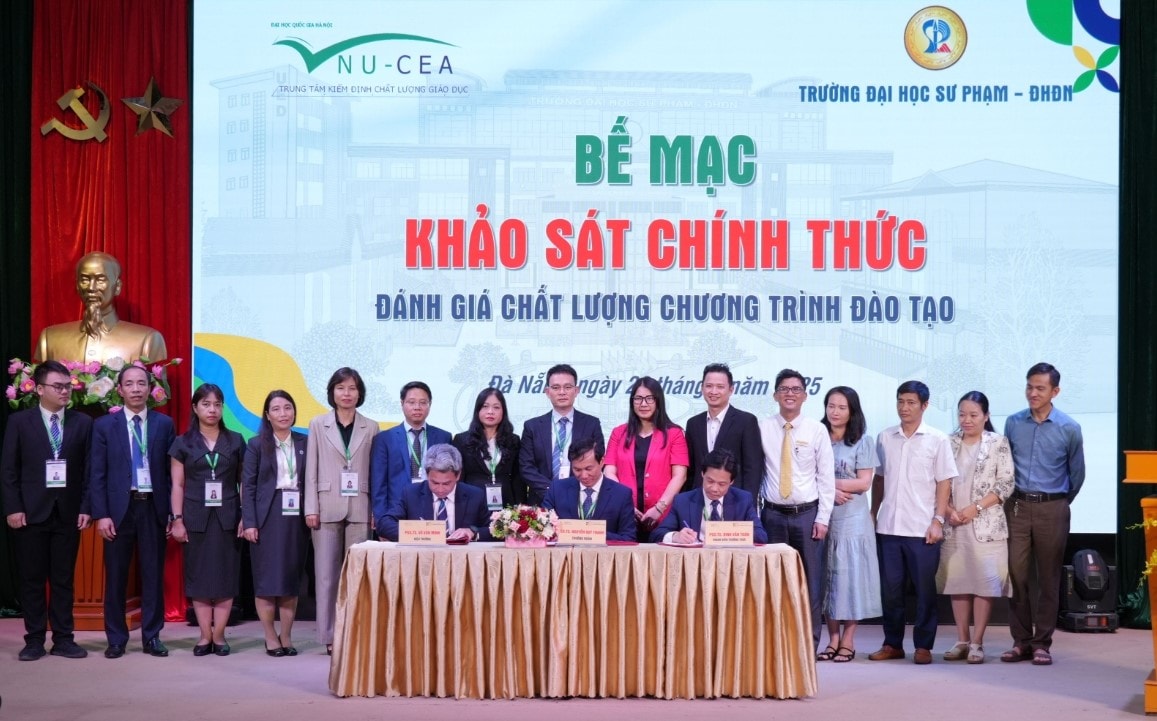
Standardizing training to meet market demands.
According to representatives from many universities in Da Nang, quality accreditation of training programs is not only a mandatory requirement in ensuring educational quality, but also a commitment of the universities to society, allowing them to review the implementation process, improve programs, and enhance training effectiveness.
Dr. Phan Duc Tuan, Vice Rector of the University of Education (Da Nang University), shared that among the 30 accredited training programs of the university, 4 programs are accredited according to the international AUN-QA standards. Improving the quality of teaching and training is an ongoing and continuous process involving many activities.
Program quality assurance helps schools identify their strengths and weaknesses, enabling them to plan for continuous improvement. Accredited programs demonstrate accountability and provide reliable information to students, employers, and society. As a result, students learn through standardized, up-to-date programs that are relevant to real-world needs, thereby enhancing their professional skills and increasing their employment opportunities after graduation.
Associate Professor Dr. Nguyen Le Hung further explained that a program's accreditation process typically takes 3-5 years, from the program's design and implementation to self-assessment and completion of supporting documentation. Throughout this process, the university focuses on building and operating an internal quality assurance system according to the PDCA cycle (Plan - Do - Check - Act), ensuring that all activities such as program development, teaching, scientific research, facilities, and student support are continuously monitored, evaluated, and improved.
"The most important condition for a program to achieve accreditation is to demonstrate systematic, effective, and transparent quality management, while ensuring that graduates meet the required learning outcomes and fulfill the practical needs of society," Assoc. Prof. Dr. Nguyen Le Hung emphasized.
According to representatives from the University of Da Nang, in recent years, member training institutions have accredited many training programs to meet domestic and international standards. Specifically, in the period 2020-2025, an additional 95 training programs have been accredited, including 38 programs that meet international standards (CTI, ASIIN, AUN-QA).
Going forward, Da Nang University will continue to improve and ensure compliance with the standards for higher education institutions as stipulated in Circular No. 01/2024/TT-BGDĐT of the Ministry of Education and Training on standards for higher education institutions, issued on February 5, 2024. Simultaneously, it will continue to enhance the quality of training, develop English-language training programs, promote international student exchange, and prioritize the selection of strategic fields for appropriate investment…
Source: https://baodanang.vn/chuan-hoa-chat-luong-dai-hoc-3308091.html


































































































Comment (0)