

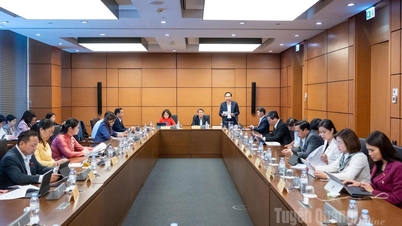
The need to review the targets to ensure feasibility as well as avoid overlapping with other programs is the suggestion of National Assembly deputies when discussing in groups about the Investment Policy of the National Target Program on new rural areas, sustainable poverty reduction, and socio -economic development in ethnic minority and mountainous areas by 2035.
The program is a combination of three national target programs for the 2021-2025 period: new rural areas, sustainable poverty reduction, and socio-economic development in ethnic minority and mountainous areas.
The program is divided into two components: component 1 is new rural areas and poverty reduction, component 2 is socio-economic development in mountainous ethnic minority areas.
Counterpart funds make it difficult for disadvantaged areas
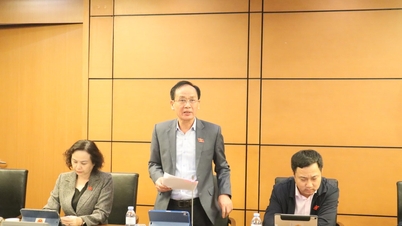
Delegate Nguyen Quoc Luan ( Lao Cai delegation) commented that in the recent period, national target programs have provided valuable resources to stabilize life, develop production, increase income, contribute to poverty reduction and enrich ethnic minorities and mountainous areas, changing the face of rural, mountainous, highland, remote and particularly difficult areas.
However, there are still shortcomings and difficulties in the implementation process. Integrating three national target programs into one program will avoid overlap in both resources and implementation mechanisms, creating more favorable conditions for localities in implementation.
Expressing concerns about the capital source, the delegate said that the Government 's proposal estimated the capital source for the first phase of the program (2026-2023) at 1.23 trillion VND, but the draft Resolution stated nearly 500 trillion VND, of which the central capital is 100 trillion VND and the local capital is nearly 400 trillion VND. Delegate Nguyen Quoc Luan said that this would be very difficult for localities, especially the mountainous provinces with difficult economies, which depend on the central budget.
Accordingly, the delegates proposed to recalculate the contribution mechanism of local budgets and should regulate contributions by component. Component 1 of the central budget should only be the seed capital, local budgets contribute more, but component 2 of the central budget must be the main one.
This is also the concern of delegate Dang Thi My Huong (Khanh Hoa delegation). According to the delegate, many localities in ethnic minority and mountainous areas can only match a maximum of 10%, so the local capital mobilization rate of up to 33% as drafted is too high. Delegate Hoang Quoc Khanh (Gia Lai delegation) commented that the requirement for large match capital will slow down the project implementation progress.
Besides the issue of local capital, delegate Nguyen Quoc Luan agreed with the Government's proposal that the National Assembly allow the extension of the disbursement period of state budget capital for national target programs in 2026 until December 31, 2026, including capital from previous years transferred to 2025, and at the same time allow localities to adjust their budget estimates.
Delegates proposed that the National Assembly consider allowing localities to implement special policy mechanisms such as: deciding to adjust the allocation plan for public investment capital and regular expenses between national target programs; adjusting the structure of state budget capital between investment expenditure and regular expenditure of projects.
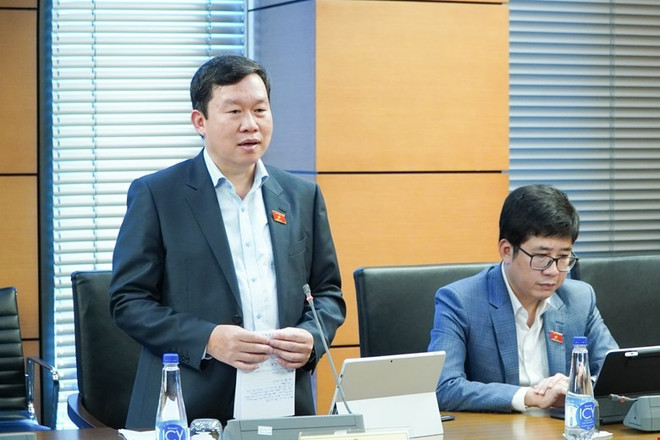
Delegates also proposed to allocate and adjust implementation content according to actual needs from component projects that no longer have subjects or expenditure content, to focus resources on projects that are in need and have the ability to absorb capital; continue to use the remaining or unallocated program capital to implement a number of urgent projects to overcome the consequences of natural disasters, storms, and landslides in the recent past in particularly difficult communes and villages.
In addition to the capital issue, delegate Nguyen Quoc Luan also said that the practical implementation of national target programs shows that there are many issues that are very difficult to implement due to current regulations. Therefore, the delegate proposed to add special mechanisms other than the law, under the authority of the National Assembly, to facilitate localities and maximize the effectiveness of State investment.
Still overlapping goals
Although the implementation mechanism of national target programs is not allowed to overlap, delegates said that many contents and objectives of the program still overlap with other national target programs such as national target programs on education, health, culture, etc.
According to delegate Hoang Quoc Khanh, the program is to ensure that 100% of ethnic minorities and the poor have health insurance and access to health services, but these goals have been set in the national health target program. The program also aims to ensure essential infrastructure and facilities that meet standards for the education system, but this content is already included in the national education target program.
“I request that the drafting agency review the goals more carefully to avoid duplication and not repeat goals that already exist in other programs because funding has been allocated,” said delegate Hoang Quoc Khanh.
Sharing the same view, delegate Dang Thi My Huong cited the audit report, pointing out that 6/58 contents of Component 1 belong to other programs (culture and health). Therefore, if the capital is continued to be allocated, it will cause duplication and dispersion. Accordingly, the delegate suggested that the drafting agency review and regulate the contents of the components to ensure consistency, limit loss and improve efficiency.
Delegate Chamaléa Thi Thuy (Khanh Hoa delegation) expressed concerns about the allocation of resources for the program. According to delegate Thuy, the capital allocation rate for component 2 on socio-economic development of ethnic minorities in mountainous areas is still low while this is an area with many difficulties and shortages, many communes do not have connecting roads, lack medical facilities and schools. "70% of total resources should be focused on this area," delegate Thuy suggested.
Delegate Chamaléa Thi Thuy also expressed concerns about the authenticity and feasibility of the target of 90% of communes meeting standards by 2030, of which 50% are in remote, isolated, and extremely disadvantaged areas. The delegate said that this is a commendable target but also very high when in reality, most of the communes that have not met standards are located in these areas, where infrastructure is weak and investment resources are limited.
Accordingly, delegates suggested that it is necessary to develop more flexible criteria, suitable to the socio-economic conditions of each region./.
Source: https://www.vietnamplus.vn/chuong-trinh-muc-tieu-phat-trien-vung-dan-toc-thieu-so-ra-soat-de-dam-bao-kha-thi-post1080853.vnp







![[Video] Focus on thematic audits and hot areas of interest to voters](https://vphoto.vietnam.vn/thumb/402x226/vietnam/resource/IMAGE/2025/12/03/1764777738344_2-691-png.webp)

![[Video] More than 96% of cases related to land planning, management and use have been resolved.](https://vphoto.vietnam.vn/thumb/402x226/vietnam/resource/IMAGE/2025/12/03/1764775937805_1-5566-png.webp)
![[Video] Many bright spots in implementing 16 Resolutions of the National Assembly on thematic supervision and questioning](https://vphoto.vietnam.vn/thumb/402x226/vietnam/resource/IMAGE/2025/12/03/1764774130071_3-896-png.webp)









![[Photo] Parade to celebrate the 50th anniversary of Laos' National Day](/_next/image?url=https%3A%2F%2Fvphoto.vietnam.vn%2Fthumb%2F1200x675%2Fvietnam%2Fresource%2FIMAGE%2F2025%2F12%2F02%2F1764691918289_ndo_br_0-jpg.webp&w=3840&q=75)
![[Photo] Worshiping the Tuyet Son statue - a nearly 400-year-old treasure at Keo Pagoda](/_next/image?url=https%3A%2F%2Fvphoto.vietnam.vn%2Fthumb%2F1200x675%2Fvietnam%2Fresource%2FIMAGE%2F2025%2F12%2F02%2F1764679323086_ndo_br_tempimageomw0hi-4884-jpg.webp&w=3840&q=75)






















































Comment (0)