

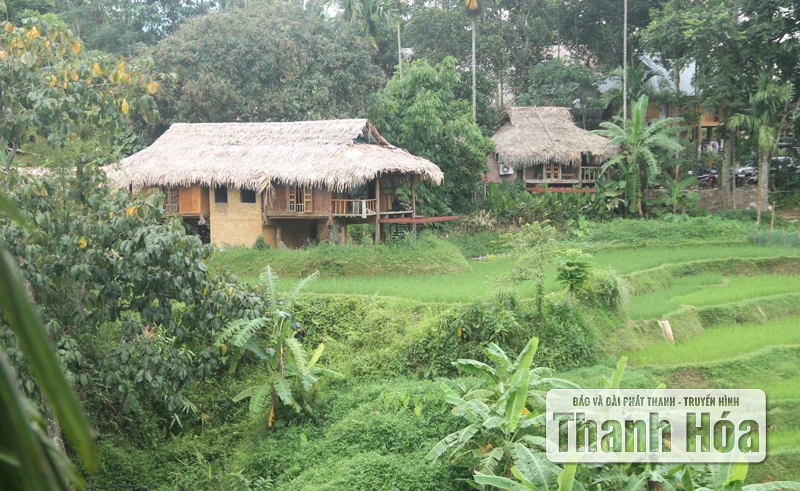
Simple stilt houses with thatched roofs are becoming a tourist resource in Bản Đôn village, Pù Luông commune.
Behind the lingering morning mist, Bản Đôn in Pù Luông commune presents a picturesque landscape of majestic mountains and forests. The village has developed 21 community-based tourism establishments offering accommodation, including 8 homestays in stilt houses run by local Thái ethnic minority families. Hà Văn Luyện's Pù Luông AROMA homestay is located on a small, winding road at the end of the village. This young owner, born in 1989, has taken a unique approach, primarily targeting Western tourists from European countries such as the Netherlands, England, and France. Therefore, instead of promoting on Facebook, Zalo, or through media outlets like other establishments, he introduces his homestays on foreign community tourism websites, allowing guests to book directly and find their way there.
“I use the image of simple stilt houses, characteristic of the local people, and the beautiful, familiar natural scenery as the main elements to attract tourists. Understanding their preference for tranquility, exploring local culture, and closeness to nature, I invested in building small stilt houses for guests to stay in. If it were modern, luxurious hotel-style apartments, they might not necessarily like it. What attracts foreign tourists is staying in the homes of the locals, immersing themselves in the natural mountain and forest environment, and experiencing the daily life of our Thai people,” shared Mr. Ha Van Luyen.
This accommodation currently features one large family-owned stilt house for group tours and five smaller bungalow-style stilt houses nestled on a picturesque hillside for individual guests. From the beds and clothes hangers to the doors and chairs, everything is designed simply, reminiscent of the hardships faced by the local people, using only branches and pieces of wood from their own gardens. Even the pathways leading to the bungalows and within the garden are paved with natural stones, avoiding concrete or asphalt. Perhaps this sound investment strategy has resulted in occupancy rates consistently above 90%, with over 95% of guests being European.
Having only invested in community-based tourism development for less than two years, the establishment now welcomes an average of 300 foreign visitors per month. Being a family-run business, they only provide food and accommodation for 10 to 12 guests per day. According to Mr. Luyen, the family avoids loud speakers and karaoke, opting instead for a quiet and peaceful atmosphere. Visitors are introduced to local culture, assisted with village tours, and can participate in evening cultural and artistic activities, immersing themselves in the daily life of the local Thai people.
“Every month, my family earns an average of about 90 million VND in revenue, with a profit of about half. More importantly, the whole family has stable jobs; some specialize in growing vegetables, harvesting chayote, raising Co Lung ducks, developing chicken flocks, or cooking for tourists year-round. From borrowing and investing step by step, the family has now achieved economic stability, gradually accumulating wealth and becoming rich,” added Mr. Ha Van Luyen. Expanding to the entire Don village with 21 homestay establishments developing community tourism, hundreds of workers have jobs thanks to related services. The former Ba Thuoc district also coordinates with relevant departments and units to organize training courses on tourism, cooking, and how to welcome guests... to support the people in developing their livelihoods right in their homeland. Women and mothers who have long been confined to the old forests and rice paddies now have additional income from cleaning rooms. Farmers are more motivated now that their home-grown vegetables and chayote vines are purchased by accommodation establishments, providing them with year-round income. Their free-range chickens and Co Lung ducks raised in the streams no longer face the worry of unstable prices. Middle-aged workers also have additional work transporting tourists to visit the village and nearby attractions such as Hieu Waterfall, Pho Don Market, and Kho Muong Cave by motorbike.
Having studied at a foreign language university and then left home, young woman Ha Thi Gam decided to return to her hometown to develop community tourism. According to her, the people of Buon Don can absolutely prosper with this type of eco-friendly tourism. Her English skills have helped and will continue to help the local people connect with the increasing number of foreign tourists visiting the area. “Not only do we develop the economy, but our Buon Don tourism community also contributes to introducing our local culture to the world. Many Western tourists, after returning home, leave feedback on our pages, praising the friendly people, the stunning natural scenery, and the fascinating culture of the local people… It is these feedbacks on the pages of tourists, and their spreading of information after their visits to friends and relatives, that have led to more and more people traveling halfway around the world to find us,” Ms. Gam shared.
Without being overly elaborate, developing community tourism through simplicity and readily available resources has proven to be a unique path to success. Bundles of wild ferns and bamboo shoots, once a staple food for the local people, are now attracting visitors to community tourism destinations in Bản Mạ village, Thường Xuân commune. Stream fish and bamboo-cooked rice have become signature dishes at homestays in the Cẩm Lương fish stream area, Cẩm Tú commune... In the coastal region, even the poorest families, despite lacking many things, never lacked jars of fish sauce, a key element of year-round food security. Now, with widespread development and marketability, the Khúc Phụ fish sauce village in Hoằng Thanh commune has begun attracting tourists thanks to its proximity to the Hải Tiến coastal ecological tourism area. A prime example is the Lê Gia fish sauce facility in Hồng Kỳ village, gradually replacing traditional Southern-style wooden fermentation vats and developing experiential tourism services.
Although the tourism and experiential activities have only been developed for less than two years, the Le Gia facility already attracts around 20,000 visitors annually to experience the traditional fish sauce making process in Khuc Phu. In the area between the fermentation vats, the facility has built octagonal houses with thatched roofs, where visitors can sit on bamboo benches, drink herbal tea, and eat rice cakes dipped in fish sauce. The image of the impoverished countryside of the past is recreated through the scenery and the experience of eating starfruit and figs dipped in shrimp paste, just like the impoverished life in the coastal region in the past. Many urban visitors express their delight at hearing stories of the simple fishing village, learning about the fish sauce making process and life in the past... The "poverty" is being revealed and recalled, not to dwell on hardship, but to become a tourism resource, a way to generate wealth.
Text and photos: Linh Truong
Source: https://baothanhhoa.vn/dem-cai-ngheo-de-lam-giau-260743.htm

![[Image] Hanoi Police officially crowned champions of V-League 2025/2026](https://vphoto.vietnam.vn/thumb/1200x675/vietnam/resource/IMAGE/2026/05/31/1780244769054_ndo_br_039d561b692be875b13a-jpg.webp)
![[Photo] The General Secretary, President and his wife begin their state visit to the Philippines.](https://vphoto.vietnam.vn/thumb/1200x675/vietnam/resource/IMAGE/2026/05/31/1780230559452_anh-man-hinh-2026-05-31-luc-19-28-11.png)
![[Photo] Admire the coral "masterpiece" amidst the million-year-old heritage of Dak Lak province.](https://vphoto.vietnam.vn/thumb/1200x675/vietnam/resource/IMAGE/2026/05/31/1780221235105_anh-man-hinh-2026-05-31-luc-16-53-27.png)
![[Photo] Solemn bathing ceremony and Buddha procession in Hue](https://vphoto.vietnam.vn/thumb/1200x675/vietnam/resource/IMAGE/2026/05/31/1780228263543_1-jpg.webp)















![[Video] Sunset at Lap An Lagoon – Where the sun sets over the fishing nets](https://vphoto.vietnam.vn/thumb/340x192/vietnam/resource/IMAGE/2026/05/31/1780192137701_beach-landscape-sea-water-nature-grass-745871-pxhere-com.jpeg)





























































Comment (0)