

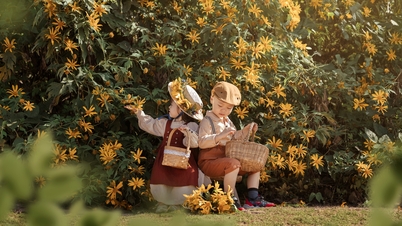
Every spring, when Ban and Plum flowers bloom white and Ma flowers bloom yellow all over the mountains and forests, the White Thai people in Ban Ang, the old Dong Sang commune, now Moc Son ward, Son La province, enthusiastically celebrate the Het Cha Festival.
Unique spiritual beliefs
Het Cha Festival is a unique spiritual custom, with profound humanistic meaning, demonstrating the traditional cultural beauty of the White Thai people in the Northwest highlands; plays an important role in the spiritual and cultural life of the Thai people, is a place for community religious activities to consolidate and enhance solidarity, and help each other overcome difficulties in life.
According to legend, long ago in Muong Moc - today's Moc Son ward, there was a shaman named Phi Mun who specialized in using traditional medicine to cure people. The Thai people were very poor in the past, they did not have money to buy medicine so they often came to the shaman to cure their illnesses. Day by day, the number of people treated by Phi Mun increased. After being cured, the sick people asked Phi Mun to adopt them as their children to thank him for his care and treatment. From then on, in the spring, when the trees sprouted and flowers bloomed, Phi Mun's adopted children from all over the country returned to visit him. Each person brought different gifts to thank their adoptive father. Phi Mun's family held a ceremony for their children and grandchildren to come back and have fun together. The Het Cha Festival was born from that time.
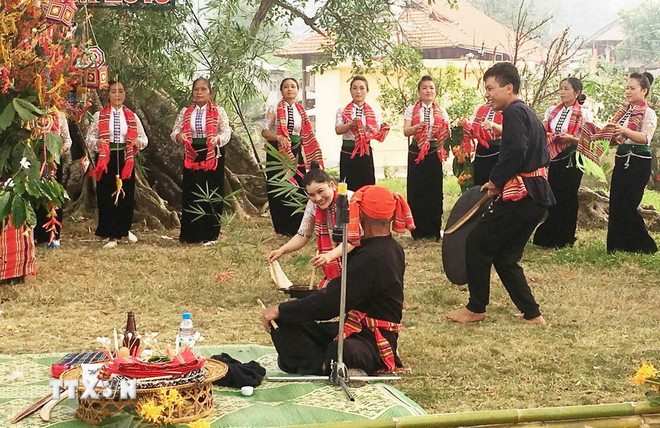
Every year, the shaman organizes the Het Cha festival as a thanksgiving ceremony for those who have been cured by the shaman. This is also an occasion for people to thank the earth and sky, thank their parents, their teachers, and pray for harmony, growth, a peaceful life, favorable weather, good harvests, and happiness for everyone. The Het Cha festival is the time when young men and women get to know each other, fall in love, and become husband and wife.
The Het Cha Festival consists of two parts: the ceremony and the festival. To prepare for the ceremony, villagers need 20 spans of brocade fabric, 20 spans of local cotton fabric, and food...
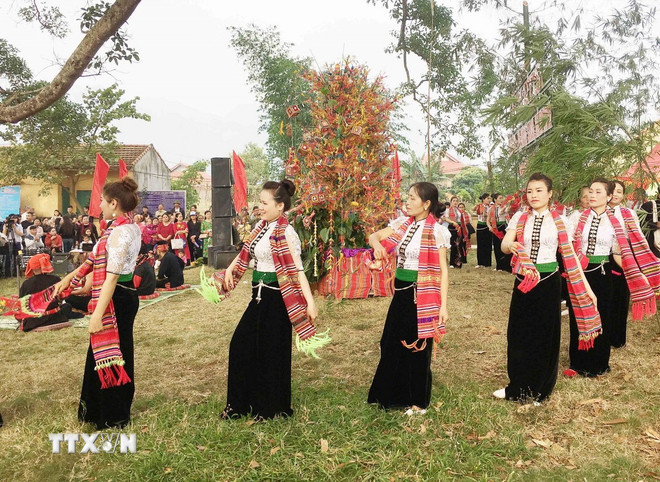
The Het Cha Festival is a day of solidarity, community bonding, deeply humanistic, showing the simple and peaceful life of all people with nature. All of these things are shown on the pole or also known as the tree of all things (sang cha) with many symbolic animals and plants such as birds, fish, boats... The trunk of the sang cha tree is made of bamboo, the branches are made of wooden bars and many bamboo sticks are used to hang animal models and labor tools are made very elaborately from materials such as: plastic, wood, rattan, bamboo, paper, colored thread... Making the sang cha tree not only requires sophistication, meticulousness, dexterity but also requires many requirements such as: the tree trunk must be big, straight and a good day must be chosen to bring the tree home.
Festival performance
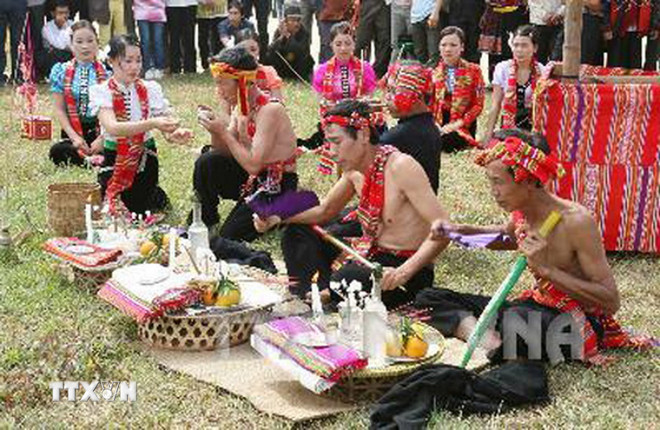
At the beginning of the ceremony, the shaman sings Cha to introduce to the ancestors and deceased masters about his family's Cha work during the year, hoping for blessings for the work to go smoothly and sings the song "Xên Chá" to invite master "Phi mun" from heaven to come down to earth to witness. After that, the shaman lights a candle and sticks it into the tip of the sword, holds a fan in his hand, carries the sword, stands up, walks to the salty offering tray, holds the sword with the candle and shines a circle around the Sang Cha tree to check, then returns to the vegetarian offering tray and sits down to chant the spell.
When performing the ritual, the shaman enters into his mind, "leaves his body and ascends to heaven" and invites the master to come down and enter the two assistant shamans "lam". The team of assistants plays tang bu music in the rhythm of 2/4, 4/4. The two lam men dance to the rhythm of the sword fight, the clown holds a tray and beats it to the rhythm of tang bu to cheer. After the sword fight, the lam man holds a towel and jumps over the sang cha, throws it to the couples, and each dances to the rhythm of tang bu around the sang cha 3 times. The shaman leads the master to review the sang cha, carries the sword and follows the rhythm of tang bu, stops at the base of the sang cha tree to drink rice wine, and looks at the tree.
Adopted children from all over the village come one after another to give “living gifts” such as: rice, chicken, grilled fish, sticky rice, eggs, white wine, etc. The shaman is in a trance, takes off his shirt, puts a black scarf on his head, tests the heart of the adopted child by poking the gift package with the tip of a sword and bringing it to his ear to listen. Any adopted child who truly loves his adoptive father, when he pokes the tip of the sword into the gift package, brings it to his lips to taste, will nod and smile. After that, he teaches the adopted child. The offering is expressed by singing folk songs, called “all over cha”, with the melody sometimes cheerful, sometimes melodious, deep, and exciting, accompanied by the sound of the “pi mun” flute.
Attractive festival games
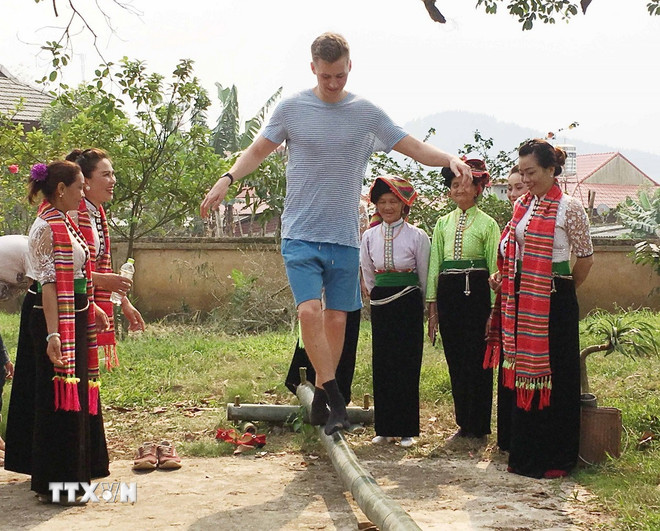
After the ceremony, the festival will take place with exciting activities to simulate the simple daily life of the Thai ethnic people in the process of building villages, building new lives with many images recreated in a very humorous and vivid way. Funny folk games such as throwing con, to ma le, going to bridge bridge...; funny and humorous folk performances with many humanistic meanings are recreated on stage such as: The story of buffalo training to plow the fields, a trip to pick wild vegetables, going to the fields, the game of catching fish, a hunting trip or a time going to the forest to get bamboo shoots...
In addition, folk songs, folk dances and scenes of daily life are conveyed by the artists through short, lively skits hidden in the Het Cha Festival's xoe circle. These activities also truly reflect the strong vitality of the Thai people in their working life and the struggle for survival between humans and nature.
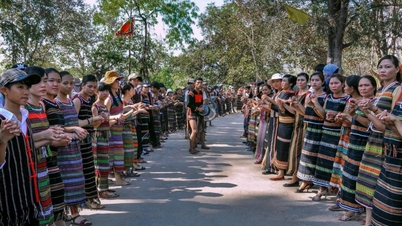
The festival atmosphere is even more vibrant and attractive with the graceful and rhythmic dances around the pole of graceful Thai girls in traditional costumes, along with the sound of drums, gongs and the high and low tones of the music band, as if inviting people and tourists to attend the festival.
Preserve and maintain cultural beauty
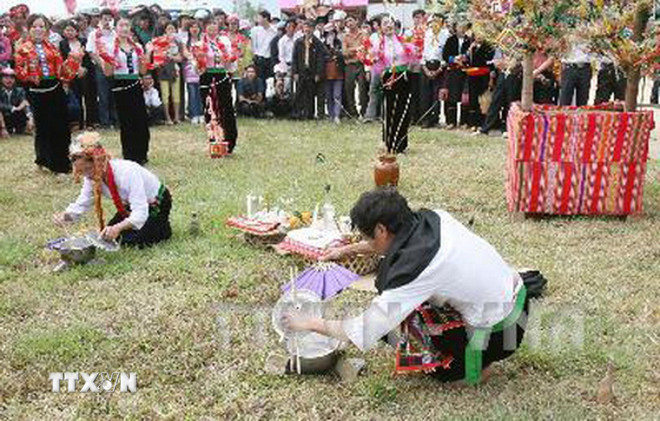
Through the ups and downs of time, Het Cha Festival has become a typical cultural beauty preserved by the White Thai people for many generations. At the same time, it is also an important cultural product in the development orientation of community cultural tourism space of Moc Chau National Tourist Area.
Het Cha Festival is one of the national intangible cultural heritages, bearing the spiritual imprint and long-standing traditions of the White Thai people. In order to preserve and promote the values and cultural identity of the ethnic group, with the support of the People's Committee of Moc Chau ward and the cooperation of the local government, the people of Ang village have collected and restored the Het Cha Festival to preserve it for future generations. From 2008 to now, when the Ban flowers are white and the Ma flowers are golden, the Het Cha Festival has been held again and has become one of the annual activities of Son La province. Every year, Son La province always maintains the organization of the festival to preserve, maintain and promote the cultural values of the Thai ethnic group.
In order to innovate and diversify cultural activities and attract more tourists to Moc Chau, Son La, in addition to maintaining and organizing the Het Cha Festival periodically every spring to preserve traditional rituals and original cultural space, Son La province needs to organize widespread propaganda about the origin, historical significance and cultural values of the Het Cha Festival in community activities and on mass media. There should be teaching programs on Thai ethnic culture and traditions in schools so that students can understand and appreciate the festival, thereby creating successors who are aware of protecting and promoting the festival, and at the same time posting festival content on digital platforms and social networks to spread information about the festival more widely.
At the same time, promote scientific research on rituals, beliefs and folk culture related to festivals; develop documents, publications and videos to scientifically and fully record the values of festivals, serving the work of preservation and education .
In addition, the province also needs to promote development and teaching, creating conditions for folk artisans to be able to pass on skills, dances, songs and knowledge about festivals to the younger generation as well as support community groups, creating opportunities for them to be able to promote their role in preserving and promoting traditional festivals.
With its beautiful landscapes and diverse culture, Son La province can consider the Het Cha Festival as an opportunity to develop community tourism. Cultural tours, combining sightseeing and experiencing the festival, will help visitors better understand the culture and traditions of the Thai people. Developing community tourism brings direct economic benefits to the people, creating jobs, increasing income and encouraging the maintenance and protection of their cultural identity. However, for sustainable development, the province needs to focus on protecting the environment, preserving the intact festival space, and training people in tourism and tour guide skills, ensuring the quality of tourism services and respect for local culture./.
Source: https://www.vietnamplus.vn/doc-dao-le-hoi-het-cha-cua-dong-bao-dan-toc-thai-o-son-la-post1080509.vnp


![[Photo] General Secretary To Lam receives the Director of the Academy of Public Administration and National Economy under the President of the Russian Federation](/_next/image?url=https%3A%2F%2Fvphoto.vietnam.vn%2Fthumb%2F1200x675%2Fvietnam%2Fresource%2FIMAGE%2F2025%2F12%2F08%2F1765200203892_a1-bnd-0933-4198-jpg.webp&w=3840&q=75)



























































Comment (0)