

With the goal of becoming a centrally-governed city by 2035, Ninh Binh has consistently and overarchedly adopted the perspective of developing tourism as a key economic sector, guiding and leading other industries and fields towards green and sustainable development. This is also the development orientation for the province's multi-value ecological agricultural economy.
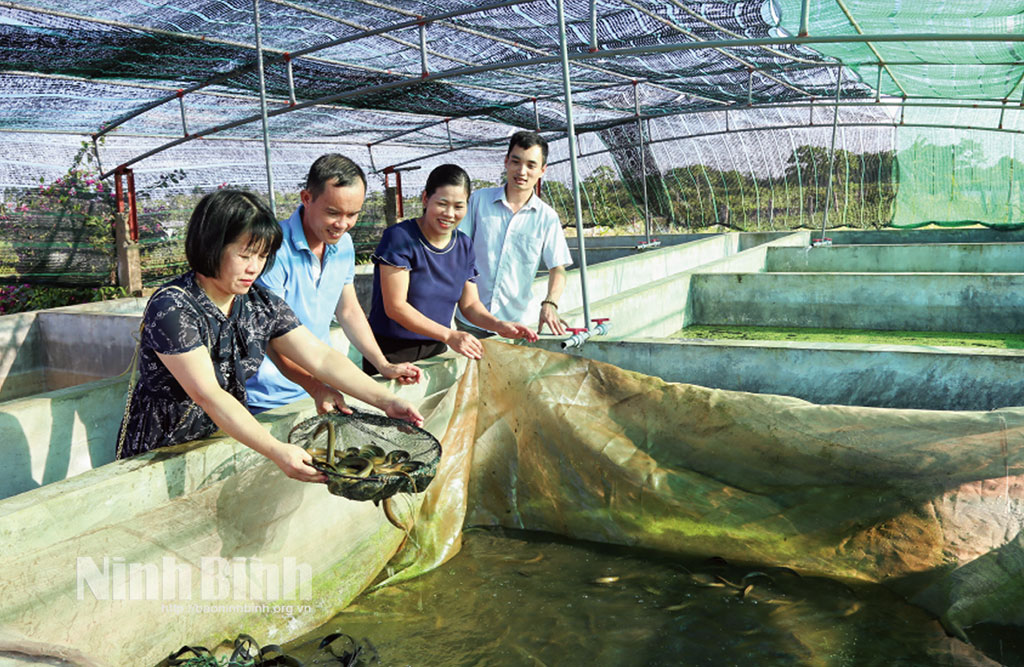
Model for breeding and raising commercial freshwater eels at Thanh Long Trading & Aquaculture Co., Ltd. (Khanh Tien commune, Yen Khanh district). Photo: Minh Duong
An inevitable trend
The concept of "multi-value agriculture" in Ninh Binh's agriculture is not a recent development. Over time, the province has clearly defined its three economic pillars: agriculture, industry, and tourism services. Tourism plays a leading role in guiding other economic sectors towards a green and sustainable direction. Simultaneously, overcoming the disadvantage of limited arable land, the agricultural sector has shifted towards "on-site export" to serve tourism with multi-value products, creating high value per unit area.
A prime example is the Tam Coc rice field, covering 22 hectares. Every year, the Department of Agriculture and Rural Development of Hoa Lu district directs and supports local people in producing rice using organic methods and local, specialty varieties. The rice field is not only a food product but also a tourism product and service developed to serve tourists visiting for sightseeing and worship. From the farmers' rice field, set against the backdrop of the existing landscape, the tourism industry has elevated it into a large-scale "agricultural festival," a key product in the "Tam Coc-Trang An Golden Tourism Week," attracting tens of thousands of domestic and international tourists each year. Revenue from the field reaches billions of VND annually, becoming a typical multi-value ecological agricultural model in Ninh Binh.
Besides the Tam Coc rice paddies, the province also has many other rice paddies that have been exploited by farmers in a multi-valued way, such as the Hang Mua lotus pond; and lotus ponds associated with tourism experiences in Hoa Lu. In addition, since 2018, Ninh Binh has applied organic farming practices, and to date, more than 4,000 hectares of rice are produced organically; approximately 5,000 hectares of agricultural land are cultivated using methods that reduce chemical pesticides and fertilizers, decrease seed usage, and increase productivity, laying the groundwork for low-emission rice farming.
According to statistics from the Department of Agriculture and Rural Development, in recent years, the agricultural sector has accounted for nearly 10% of the province's economic structure; the average growth rate during the 2021-2023 period was nearly 3%; and the value of one hectare of cultivated land reached over 155 million VND. The province has formed five sub-regions of agricultural ecological economic zones, each with its own specific products and specialties: the hilly and semi-mountainous region; the lowland rice paddy region; the urban and suburban region; the plain region; and the coastal region. Each region has its own key products and a diverse range of specialties. To date, the province has 181 OCOP products that are characteristic and unique to these sub-regions.
Significant results have been achieved in the new rural development program in the province. Eight out of eight districts and cities have met/completed the new rural development program, with one district achieving the advanced new rural development standard; 119 out of 119 communes have met the new rural development standard; 50 out of 119 communes have met the advanced new rural development standard (42%); 18 out of 119 communes have met the model new rural development standard (15.12%); and over 542 villages (hamlets) have been recognized as model new rural development standards (accounting for 40% of the total number of villages in the province). The province has basically met the criteria to complete the new rural development program...
Comrade Nguyen Thanh Binh, Deputy Director of the Department of Agriculture and Rural Development, stated: When achievements in agriculture reach a certain point, a new direction is needed to restructure and create higher value. Therefore, innovation to develop the agricultural economy towards multi-value production is an inevitable trend. This has been fully guided by the Central Government and has been defined with specific goals and directions in the Resolution of the 22nd Provincial Party Congress.
Accordingly, Resolution No. 19-NQ/TW of the 13th Central Committee of the Communist Party of Vietnam on agriculture, farmers, and rural areas until 2030, with a vision to 2045, has set the goal: "Agriculture is a national advantage and a pillar of the economy. Developing agriculture efficiently, sustainably, and with multi-value integration towards increasing added value and competitiveness, linked with promoting the development of post-harvest processing and preservation industries and developing agricultural product markets both domestically and internationally; ensuring food safety, national food security, and protecting the ecological environment; encouraging the development of green, organic, and circular agriculture."
In the Resolution of the 22nd Congress of the Ninh Binh Provincial Party Committee, term 2020-2025; Action Program No. 01-CTr/TU; Conclusion No. 83-KL/TU dated August 23, 2021 of the Standing Committee of the Ninh Binh Provincial Party Committee on continuing to implement Resolution No. 05-NQ/TU on developing agricultural economy towards commodity production, applying high technology, advanced and sustainable production methods in the period 2016-2020, with orientation to 2030...
Based on the above, the development orientation for Ninh Binh's agriculture until 2030, with a vision to 2050, will be to become an ecological, organic, safe, multi-value agriculture, applying high technology, developing digital agriculture, eco-tourism agriculture, and landscape agriculture. It will promote innovative entrepreneurship based on the model of ecological agriculture development linked to multi-value.
Plenty of room for growth
Based on the potential from favorable natural conditions and agricultural infrastructure, Mr. Nguyen Thanh Binh, Deputy Director of the Department of Agriculture and Rural Development, also outlined the advantages for Ninh Binh to develop multi-value agriculture, namely: Forest resources with 28,000 hectares, including the Cuc Phuong National Park with 11,200 hectares in Ninh Binh province, the Hoa Lu historical-cultural forest, the Van Long wetland nature reserve, and coastal protection forests, which have potential for ecological recreation and carbon credit exchange; rice cultivation land with 44,000 hectares, 7,000 hectares of fruit trees, and 15,000 hectares of various vegetables, ensuring food security; aquaculture area of 14,000 hectares, including 10,000 hectares of freshwater and 4,000 hectares of brackish water. Ninh Binh also has a system of irrigation infrastructure, especially on-farm irrigation, which has been invested in to meet multiple needs, including disaster prevention and control, serving production and people's lives... and has the potential to be improved to meet the requirements of rice cultivation with reduced emissions.
Furthermore, Ninh Binh also has great potential in terms of diverse, abundant, and unique agricultural products such as: mountain goat, crispy rice, fermented pork sausage, shrimp paste, Tong Truong perch, royal carp, Cuc Phuong golden flower tea…
To form a startup and innovation ecosystem in the province, developing multi-value agriculture is an extremely important component. Therefore, in the coming time, the province will continue to focus on developing specialty, endemic, and characteristic agricultural products serving tourism, as well as crops and livestock with the province's advantages; forming concentrated commodity production areas on a scale suitable for key agricultural products, specialty products, and OCOP products with high economic value and competitiveness; promoting the development of processing and preservation industries to meet the requirements of the domestic and export markets, sustainably connecting to the global agricultural value chain; and developing agricultural economy in conjunction with the Red River Delta and the Hanoi Capital Region.
Thus, innovative entrepreneurship through the development of multi-value agricultural models in Ninh Binh province is a direction consistent with the development trend. Implementing this orientation will help Ninh Binh's agriculture maintain its role as a pillar of the economy, as a multi-value ecological agriculture, and make a significant contribution to Ninh Binh becoming a centrally-governed city with the characteristics of a Millennium Heritage City.
Nguyen Thom
Source: https://baoninhbinh.org.vn/doi-moi-sang-tao-thong-qua-phat-trien-cac-mo-hinh-nong/d20241001210911860.htm




























































Comment (0)