

Vehicles carrying knowledge
The Ho Chi Minh City General Science Library has given special attention to serving the visually impaired for over two decades.
Since 1999, the library has established a Reading Room for the Blind with a wide range of Braille books, audio tapes, CD-ROMs, CCTV magnifiers and other modern equipment.
Diverse forms of service, not only in libraries but also in shelters, facilities for disabled children, Associations for the Blind, and even in provinces and cities such as Tay Ninh, Dong Nai , Lam Dong...
Organizing mobile library vans has helped bring audiobooks and materials to remote areas where the visually impaired do not have access to appropriate materials.
Having worked at the Ho Chi Minh City General Science Library for a long time, Mr. Nguyen Cao Hoang (39 years old), an employee in charge of producing documents for the visually impaired, has become accustomed to a quiet but meaningful work pace.
Every year, his department makes about 16 mobile service trips, bringing push-up books, hearing aids, and specialized equipment to shelters and facilities for disabled children in Ho Chi Minh City, Dong Nai, Tay Ninh , etc.
"This year's 16th trip took place in Long Thanh commune, Dong Nai province, and it was also the last trip before the year-end summary," Hoang shared.
These trips usually involve only two staff members and a driver, but the value they bring is many times greater.
These are science books, reference stories, life documents... converted into specialized formats, helping visually impaired children access knowledge in the most appropriate way.

Not only serving reading needs, the trips are also an opportunity for Mr. Hoang and his colleagues to survey the actual needs of each place, from which to choose production materials for the right audience.
There were no extensive surveys or rigid questionnaires; all the information came from natural conversations.
"We've become familiar and close friends with many of them. Every time we visit these shelters or centers, we're greeted with very warm smiles."
We gently ask the students what they need, or we talk to the person in charge there to understand their needs so that we can produce the right materials.
"Sometimes the children talk about science lessons they're curious about, and sometimes they ask for more question-and-answer books because they want to learn more about the weather and nature," Mr. Hoang shared.
These are also important resources that help young children build a foundation of knowledge, creating a basis for learning in later stages.
Those small details, which sound simple, are the basis for Mr. Hoang and his colleagues to return to the library and create books that truly meet the needs of each place.
Thanks to this, every pop-up book or audiobook sent "goes to the right address", serves the right readers and supports the right learning stage of the children.
That is also how libraries, though unspoken, are contributing to bridging the gaps in access to knowledge for disadvantaged children.

In Mr. Hoang’s eyes, the greatest happiness is seeing the excitement of the children every time the library cart appears. It is the joy of children who have little access to suitable materials, now having more opportunities to read - listen - learn in a more accessible way.
Over 17 years working in the Braille book department, Mr. Hoang and his colleagues have participated in producing hundreds of books, many of which have three or four Braille volumes occupying a large area. At the same time, the library has also created thousands of audio documents for reading and learning for the visually impaired.
Each embossed book, each completed audiobook file is another door to knowledge opened. Not only does the library provide on-site and mobile services, it is also developing online services.
An audiobook listening application, programmed by Mr. Hoang himself, is preparing to be put on the app store after the censorship period.
This app allows blind people to listen to books with the touch of a button, while still strictly adhering to copyright regulations for specialized materials.
"The app is completely free for the visually impaired," Mr. Hoang said.
These actions, though silent, open up a wider path for many disadvantaged people to access knowledge, gradually reducing the gap in learning and integration abilities.
Technology opens the way to new learning opportunities.
In parallel with mobile activities, the Ho Chi Minh City General Science Library is promoting the application of technology in the production of specialized documents, helping the visually impaired and children with special needs access knowledge without depending on traditional print.
The latest training course that Mr. Hoang participated in introduced him to many completely new technologies, even for those who have been working in the field for many years.
Mr. Hoang said: "There I learned 3D printing, design software for embossing, and websites that provide ready-made 3D models. The library had never had this area before, so it was very new."
This knowledge aims to create visual models for visually impaired children such as raised maps, shapes, scientific objects, etc. to help them understand the world through touch, not just through sound.
This is an important developmental step, especially for children who cannot yet read print or Braille fluently.
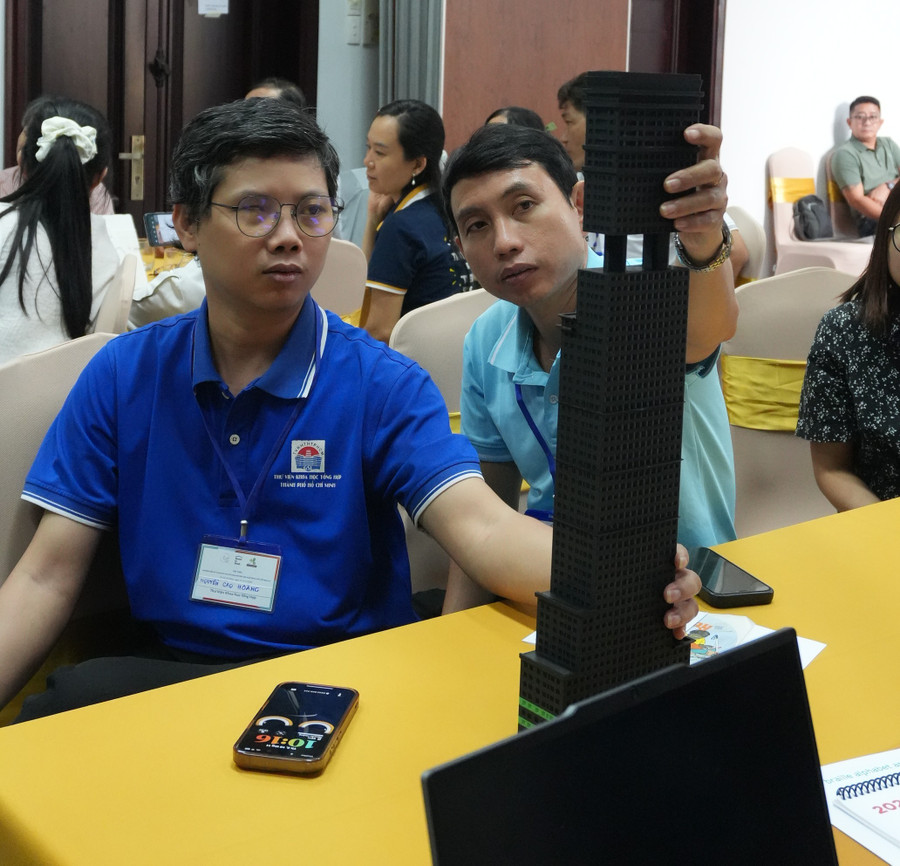
In addition, the training program also introduced a series of software to support visually impaired people in accessing information, from platforms for creating illustrated books to websites that synthesize 3D models.
For the library's pop-up book production department, this is a resource that helps them shorten design time, focusing on editing and perfecting to suit each target group.
In addition to acquiring knowledge, Mr. Hoang also shared his years of experience in making pop-up books, a job that requires meticulousness and patience.
These efforts are in line with the general direction of expanding access to information for all groups of people, narrowing the gap in knowledge acquisition and gradually improving self-learning ability for disadvantaged children.
In the current context, technology becomes an important bridge, allowing many people who face barriers in reading and writing to get closer to the world of knowledge.
Source: https://giaoducthoidai.vn/go-cua-tri-thuc-bang-hanh-trinh-luu-dong-sach-post759866.html

![[Photo] Prime Minister Pham Minh Chinh holds a phone call with the CEO of Russia's Rosatom Corporation.](/_next/image?url=https%3A%2F%2Fvphoto.vietnam.vn%2Fthumb%2F1200x675%2Fvietnam%2Fresource%2FIMAGE%2F2025%2F12%2F11%2F1765464552365_dsc-5295-jpg.webp&w=3840&q=75)


![[Photo] Closing Ceremony of the 10th Session of the 15th National Assembly](/_next/image?url=https%3A%2F%2Fvphoto.vietnam.vn%2Fthumb%2F1200x675%2Fvietnam%2Fresource%2FIMAGE%2F2025%2F12%2F11%2F1765448959967_image-1437-jpg.webp&w=3840&q=75)
































![[OFFICIAL] MISA GROUP ANNOUNCES ITS PIONEERING BRAND POSITIONING IN BUILDING AGENTIC AI FOR BUSINESSES, HOUSEHOLDS, AND THE GOVERNMENT](https://vphoto.vietnam.vn/thumb/402x226/vietnam/resource/IMAGE/2025/12/11/1765444754256_agentic-ai_postfb-scaled.png)






































Comment (0)