

That was the notable information at the "Career Guidance - Study Abroad and International Employment 2025" Festival on December 7 at the Center for Training and Fostering Diplomacy and Foreign Language Knowledge, Ministry of Foreign Affairs (in Ho Chi Minh City).
There was a time when more than 225,000 graduates were unemployed.
At the festival, Ms. Hoang Van Anh, General Director of An Duong Group, cited figures and pointed out that at one point, more than 225,500 people with university or postgraduate degrees were unemployed, accounting for 20% of the total unemployed.
According to the General Statistics Office, in the third quarter of 2025, more than 1.6 million young people aged 15-24 were not studying, working or training, equivalent to 11.5% of the country's youth. This number increased by more than 222,000 people compared to the previous quarter and nearly 183,000 people compared to the same period last year. In addition, the youth unemployment rate has now exceeded 9%, 3 times higher than the national average.
It is worth mentioning that while the number of graduates increases every year, many businesses still believe that the practical skills, foreign languages, working style and adaptability of young people do not meet practical requirements.

Ms. Hoang Van Anh believes that currently, having a degree does not necessarily mean having a job, the problem of solving employment for students after graduation is very difficult.
PHOTO: YEN THI
"Many students, no matter how good, good or excellent they are when they graduate, still have to start training from scratch when they enter a business. A degree is no longer a guarantee, the market requires real skills and the ability to work in practice," Ms. Hoang Van Anh frankly said.
Ms. Van Anh added that in reality, many students choose their major based on their parents' wishes, not their own dreams, so many of them lack motivation to study, and after graduating, they work in a field that is not their major.
Representatives of the units at the festival said that the habit of studying heavy theory and lacking practical experience makes it difficult for students to integrate into the working environment right after graduation. Meanwhile, the labor market increasingly requires higher standards, from foreign languages, vocational skills, to industrial style.
According to Ms. Hoang Van Anh, Vietnamese human resources are facing many big challenges in the context of globalization, competition with human resources in the region and internationally is increasing strongly. Meanwhile, Vietnam lacks human resources with standard skills, foreign languages and industrial style.
The trend of "study - work - get paid"
Experts say that in the context of an increasingly competitive domestic labor market, many young people are starting to look for occupations that are "thirsty" for human resources and have the ability to ensure better employment. Many people choose more practical paths, focusing on vocational skills, practical application, opportunities to work abroad and high income.
At the festival, Mr. Mai Anh Thai, Director of the Center for Training and Fostering Diplomatic and Foreign Language Knowledge ( Ministry of Foreign Affairs ), said that many countries are forming a training model in the direction of "study - work - get paid", creating conditions for learners to access knowledge, practice practical skills and earn income to cover their living expenses. This is a very potential opportunity for Vietnamese students, if they know how to choose the right path and have good preparation. In fact, in the past, hundreds of thousands of Vietnamese youth have been studying and working in developed countries.
Mr. Ho Nhu Duyen, Deputy Director of the Southern Center for Education and Training Development, Office of the Ministry of Education and Training, informed that recently, the demand for learning about studying abroad, vocational training and working abroad has increased.
From 2025-2030, developed countries will continue to expand human resource needs in the following fields: nursing - health care; information technology, automation and high technology; mechanics - electricity - electronics; restaurant - hotel management and industrial engineering.
Many countries have shifted strongly to the "dual training" model, combining study and work with early income. This model helps learners access international standard knowledge, practice practical skills, earn income and cover their own expenses, and quickly accumulate professional experience.
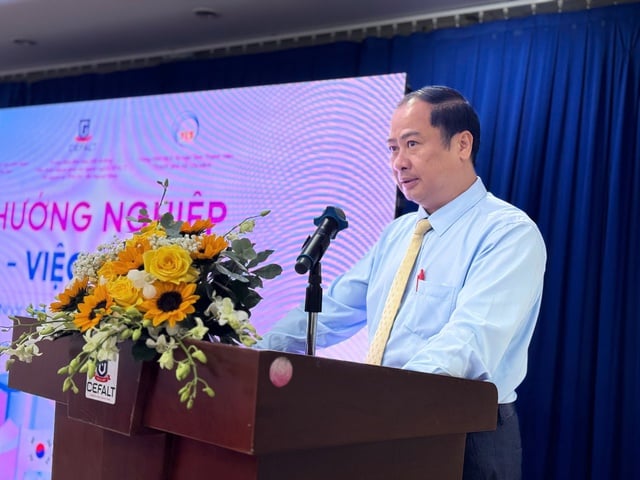
According to Mr. Ho Nhu Duyen, from 2025-2030, developed countries will continue to expand human resource needs in many fields.
PHOTO: YEN THI
According to Ms. Hoang Van Anh, Germany, Japan, South Korea and Taiwan are countries and territories with the highest aging populations in the world. The low birth rate that has lasted for decades has made the local labor force insufficient to meet the demand. In addition, the young local labor force does not want to work in stressful, hard or middle-income industries.
Therefore, these countries and territories are forced to expand their policies to attract young international human resources, especially in industries with serious shortages. Vietnam, with its young population and good adaptability, is quickly becoming a potential source of labor supply.
Ms. Hoang Van Anh informed that each country and territory will have different criteria, income and opportunities after graduation:
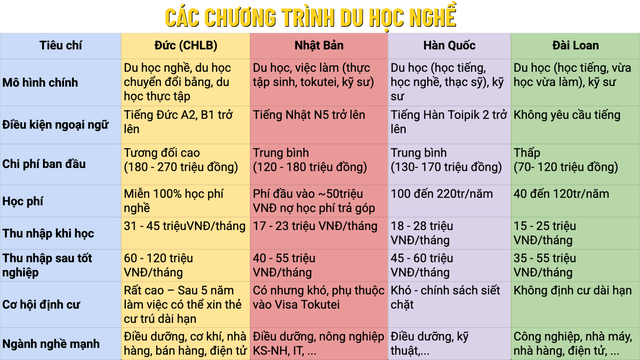
PHOTO: YEN THI
"During my business trips to Germany, Japan, Korea or Taiwan, I often met young Vietnamese people who were studying, interning or working in technical, mechanical, healthcare, hotel and restaurant enterprises. Many of them shared that they had difficulties at first, from differences in communication, culture, living, schedule to work discipline. But after a short time, they adapted very quickly," Mr. Mai Anh Thai added.
Source: https://thanhnien.vn/hon-16-trieu-thanh-nien-khong-hoc-khong-lam-khong-dao-tao-bai-toan-sau-tot-nghiep-185251207221816045.htm


![[Photo] General Secretary To Lam receives the Director of the Academy of Public Administration and National Economy under the President of the Russian Federation](/_next/image?url=https%3A%2F%2Fvphoto.vietnam.vn%2Fthumb%2F1200x675%2Fvietnam%2Fresource%2FIMAGE%2F2025%2F12%2F08%2F1765200203892_a1-bnd-0933-4198-jpg.webp&w=3840&q=75)






















































































Comment (0)