

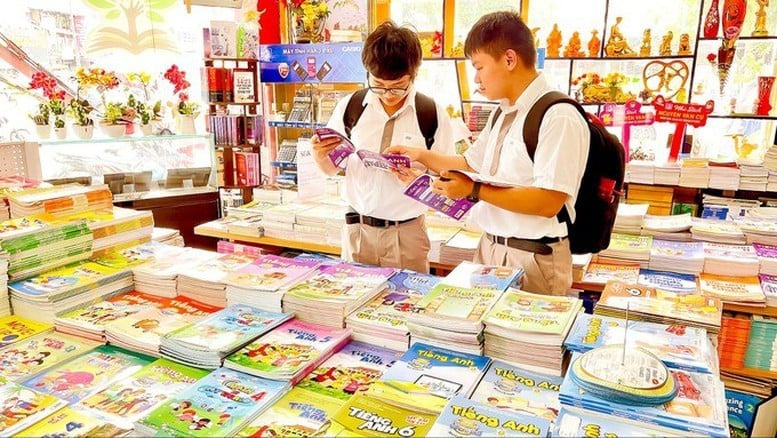
Textbooks are not only learning materials in the hands of students, but also the foundation for teachers to organize teaching, for schools to operate, and for families to accompany their children throughout the learning process.
Therefore, choosing the right set of textbooks that fully meet professional, pedagogical and practical criteria plays a very important role in the stability and development of the education system.
Minister of Education and Training (MOET) Nguyen Kim Son, on behalf of the Prime Minister, signed a report on receiving and explaining the opinions of National Assembly deputies related to the draft Law on amending and supplementing a number of articles of the Law on Education. One of the contents that received much attention was the policy of issuing a unified set of textbooks for use nationwide from the 2026-2027 school year.
According to the Government, to carry out the tasks stated in Resolution No. 71-NQ/TW, the draft law stipulates: "The Ministry of Education and Training decides on a set of general education textbooks for unified use nationwide."
The Government has assigned the Ministry of Education and Training to develop a report on the implementation plan for a unified set of textbooks nationwide from the 2026-2027 school year according to the following principles: Publicity, transparency, objectivity, thrift and anti-waste; at the same time, inheriting the advantages of existing textbooks, ensuring no disruption to teaching and learning activities, minimizing the impact on teachers and students.
After the competent authority decides on the policy, the Government will direct the review and adjustment of regulations related to textbooks; perfect the reuse mechanism, shared library; and specify the free textbook policy in the decrees. These contents aim to create a complete legal basis, suitable for practice and meet the requirements of transparency in implementation.
A suitable set of textbooks must be complete, synchronous and have a diverse ecosystem of learning materials.
The first and most important criteria when choosing textbooks is completeness and consistency. A suitable set of books must cover all subjects and educational activities according to the requirements of the program, including special subjects or subjects that are rarely chosen by students. At the same time, local educational materials need to be compiled in accordance with the socio-economic and cultural conditions of each region, ensuring a close connection between national content and local characteristics.
In addition to paper textbooks, the digital learning materials ecosystem plays an increasingly important role in the context of digital transformation of education. A set of textbooks that meets current requirements needs to be developed with rich digital learning materials such as video lectures, audio illustrations, interactive exercises, practical materials, educational animations and a library of learning materials to support self-study.
Teacher materials such as teacher textbooks, workbooks, training and education materials must be comprehensive, continuously updated and easily accessible.
To ensure the quality of textbook implementation, the compilation and publishing unit needs to have human resources, finance, and technology capacity, and be ready to develop new artificial intelligence and educational technology application platforms, contributing to promoting the smart education model according to the general orientation of the industry.
Reasonable price - a practical factor to help reduce the burden on society
In addition to the quality of content, the price of textbooks is also a criterion that needs to be seriously considered. A suitable set of textbooks must be produced according to an economical - effective - transparent process, helping to reduce costs to the most reasonable level for parents and students.
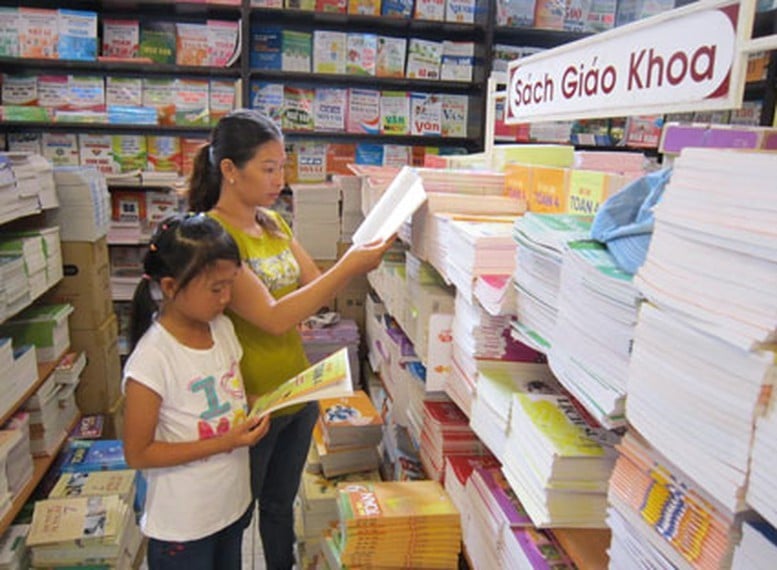
Optimizing the compilation, design, printing and distribution stages not only helps reduce retail prices, but also contributes to limiting waste when constantly changing textbooks.
When book prices are reasonable and stable over the years, parents can reuse books for future generations, reducing financial pressure, especially in disadvantaged areas. This also creates conditions for the State to effectively implement programs to distribute free textbooks or support poor students.
A suitable set of textbooks is a set of books that is trusted and chosen by many teachers, parents and students, contributing to creating the necessary stability in teaching and learning, avoiding annual disruption when changing books.
When a set of textbooks is widely selected, teachers do not have to constantly retrain, do not have to get used to new structures, new approaches. This helps them have more time to invest in teaching methods, innovate learning organization and student assessment. Schools are also more convenient in professional management, building teaching plans, organizing exams and synchronous assessment.
The unification in the use of textbooks also helps to facilitate the organization of inter-school, inter-provincial or national activities, from professional activities to academic activities and student experiences.
Ensuring security and safety in the supply and operation of textbooks
A suitable set of textbooks must not only be good in content, but also ensure adequate, timely and stable supply.
The ability to meet policies such as providing free textbooks and ordering with state budget is also an important criterion to ensure fairness in access to education.
A good set of textbooks must be consistent in educational philosophy, implementation methods, lesson structure and knowledge system. The interconnectivity from grade 1 to grade 12 helps students gradually develop their abilities and qualities according to the program's orientation, avoiding duplication, disjointness or deviation between levels of education.
Textbooks should facilitate teachers in developing lesson plans, teaching by topic, organizing practice - experience and designing competency-based assessments. The structure of the book should help teachers reduce their workload in the context of many localities streamlining the management apparatus and increasing autonomy in education.
Towards a unified set of textbooks - Inheritance for sustainable development
In the context of many opinions suggesting the need for a unified set of textbooks used nationwide to ensure fairness, reduce social burdens and create long-term stability, determining the above criteria becomes even more urgent. A unified set of textbooks, if built, selected and deployed in the right direction, will help save resources, limit disruption and increase teaching and learning efficiency.
It is important that the selection process is based on the principle of inheriting textbooks that have been proven to be suitable in practice, avoiding completely rewriting them, which puts more pressure on teachers, schools and parents. The implementation roadmap needs to be transparent, scientific, with the participation of experts, teachers and community representatives.
Choosing the right set of textbooks is an important foundation to ensure the quality of teaching and learning and the sustainable development of general education. When textbooks are selected based on criteria of completeness, uniformity, reasonable price, practical stability, guaranteed supply, and pedagogical suitability, the education system will have a solid foundation to implement program innovations.
A comprehensive, scientific and objective review of these criteria is a necessary step to build a stable, fair, modern and future-oriented educational environment.
Source: https://baolangson.vn/khi-su-on-dinh-cua-giao-duc-bat-dau-tu-viec-chon-dung-bo-sach-giao-khoa-5067268.html

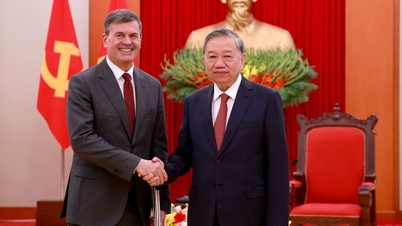
![[Photo] General Secretary To Lam receives the Director of the Academy of Public Administration and National Economy under the President of the Russian Federation](/_next/image?url=https%3A%2F%2Fvphoto.vietnam.vn%2Fthumb%2F1200x675%2Fvietnam%2Fresource%2FIMAGE%2F2025%2F12%2F08%2F1765200203892_a1-bnd-0933-4198-jpg.webp&w=3840&q=75)






































































Comment (0)