


Nishijinori, the exquisite kimono weaving technique that dates back more than a thousand years in Japan's ancient capital of Kyoto, is getting a high-tech helper: Artificial Intelligence (AI).
The colorful weaving style associated with the 11th-century Heian period's "Tale of Genji" has seen its ups and downs. But the preservation of the ancient art is facing challenges as demand for kimonos has plummeted among Japanese people.
Hironori Fukuoka, the fourth-generation successor of the Nishijinori business, is determined to preserve the art from his ancestors, even if it means using AI.
"I wanted to preserve the legacy my father left behind. I pondered how the Nishijinori weaving technique could remain relevant to today's needs," Mr. Fukuoka said in his shop in Kyoto's Nishijin district.
Alongside the AI project, Mr. Fukuoka is also researching using weaving techniques to create super-strong materials.
The giant Fukuoka Weaving looms are still used in his shop. The process of deciding which dyed yarn to use to create patterns is like turning a digital signal on or off in a computer.
It was that similarity that led Mr. Fukuoka to harness AI tools for Nishijinori weaving, with the help of Sony Computer Science Laboratories, an independent research arm of Sony Corporation.
The AI only makes suggestions for designs but doesn’t do any actual manufacturing work, but that doesn’t bother Mr. Fukuoka or the researchers.
“Our research is based on the idea of human life, both preserving and approaching new ways of weaving art,” said Jun Rekimoto, chief scientist at Sony CSL, which is also researching how to use AI to record and transmit movements in the traditional Japanese tea ceremony.
“We don’t think AI can do everything. Nishijinori is a meticulous industry, so we started looking for support from AI,” said Rekimoto, who is also a professor at the University of Tokyo.
The result of this research is a surprising twist, consistent in thinking, in line with the Japanese Imperial kimono decoration art.
The AI provided several pre-made Nishijinori patterns and was guided to come up with its own suggestions. One of them was a bold black and orange pattern that evoked tropical imagery.
Exploiting AI in Textile Art
According to Mr. Fukuoka, some of the ideas of AI are quite interesting but not suitable. The acumen of AI is that it can make many suggestions in just a few seconds.
Mr. Fukuoka was immediately drawn to the AI using leaf patterns to shape the angular lines of a traditional pattern, something he said humans would not have thought of.
The AI-co-produced kimono is a soft, alluring green, though it has yet to be priced or produced. The weaving is done using an old-fashioned machine under the guidance of an artisan in the traditional way.
Nishijinori's kimonos sell for up to one million yen ($6,700). Many Japanese people today no longer bother buying kimonos and often rent them for special occasions.
Wearing a kimono is a difficult, complicated task that often requires professional assistance, making kimono even more difficult to access.
Dr. Lana Sinapayen, research associate at Sony CSL, believes that AI will be given creative and interesting jobs in the art of kimono weaving.
“That is my goal,” she said in an interview at Fukuoka Weaving, about her intention to use AI as an assistant.
Digital technology cannot automatically replicate all the nuances of Nishijinori weaving. But AI can assist, or correct, patterns at some stage.
Once all that is done, the AI can tackle difficult tasks in just seconds, and do it pretty well, according to the researchers.
Besides, AI is also being widely used in factories, offices, schools and homes, because it can perform tasks faster with larger volumes, but quite accurately and objectively, compared to human efforts.
According to NDTV
Link to original articleSource: https://baovanhoa.vn/van-hoa/nhat-ban-su-dung-ai-bien-hoa-sang-tao-trong-nghe-thuat-det-kimono-co-xua-159822.html


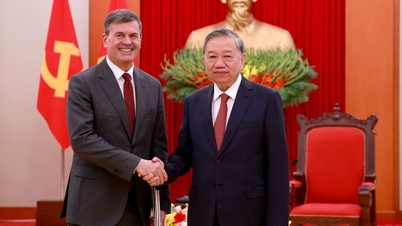
![[Photo] General Secretary To Lam receives the Director of the Academy of Public Administration and National Economy under the President of the Russian Federation](/_next/image?url=https%3A%2F%2Fvphoto.vietnam.vn%2Fthumb%2F1200x675%2Fvietnam%2Fresource%2FIMAGE%2F2025%2F12%2F08%2F1765200203892_a1-bnd-0933-4198-jpg.webp&w=3840&q=75)








































































Comment (0)